

Female Pattern Hair Loss (Androgenetic Alopecia):
Written by: Dr. Muhammad Ihsan Ullah, PhD
Medically reviewed by: Dr. Muhammad Mudassar Hassan Bhatti, MD (Dermatology)
Last updated on February 13, 2026

Female Pattern Hair Loss (often referred to as female androgenetic alopecia, FPHL/AGA) is a clinically significant, progressive nonscarring alopecia that affects millions of women worldwide. It is characterised by a distinctive pattern of hair thinning and hair follicle miniaturisation, with far‑reaching psychological and quality‑of‑life consequences if left unaddressed. Recent scientific research continues to refine our understanding of its pathogenesis, diagnostic markers, and therapeutic strategies (Norman, R. J., et al., 2023).
Female Pattern Hair Loss (Androgenetic Alopecia): Definitions & Terminology

Female Pattern Hair Loss (FPHL) is the preferred clinical term for what was historically called female androgenetic alopecia (AGA) — a chronic hair thinning disorder primarily involving the central and parietal scalp with relative sparing of the frontal hairline (Ramos, P. M., 2023).
Unlike male pattern baldness, women rarely develop complete baldness but instead experience diffuse reduction in hair density that is cosmetically noticeable and often emotionally distressing (Ho, C. Y., 2023).
Pathogenesis of Female Pattern Hair Loss (FPHL / AGA)
At its core, female pattern hair loss arises from a progressive miniaturisation of hair follicles, a phenomenon in which large, thick terminal hairs progressively transform into fine, thin vellus‑like hairs over time (Ramos, P. M., 2023).
Although the term “androgenetic” implies hormonal influence, emerging research suggests a complex interplay of genetic predisposition, follicular receptor sensitivity, and local scalp environment factors rather than simply elevated systemic androgen levels (Ho, C. Y., 2023).
A landmark clinical review noted that adult women with FPHL may have normal circulating testosterone, yet still experience enhanced local follicular sensitivity to androgens (Chan, L., 2024).
Epidemiology & Clinical Pattern

FPHL is the most common type of hair loss in women post‑puberty, with prevalence increasing with age — studies suggest up to 30–68% of women show some degree of pattern hair thinning by age 60–75 (Ramos, P. M., 2023).
Notable Clinical Features
- Diffuse thinning over crown and vertex
- Preservation of frontal hairline
- Potential “Christmas tree” thinning pattern in some women
Varying psychological impact depending on severity (Chan, L., 2024)
Evidence Based Therapeutic Concepts for Androgenetic Alopecia
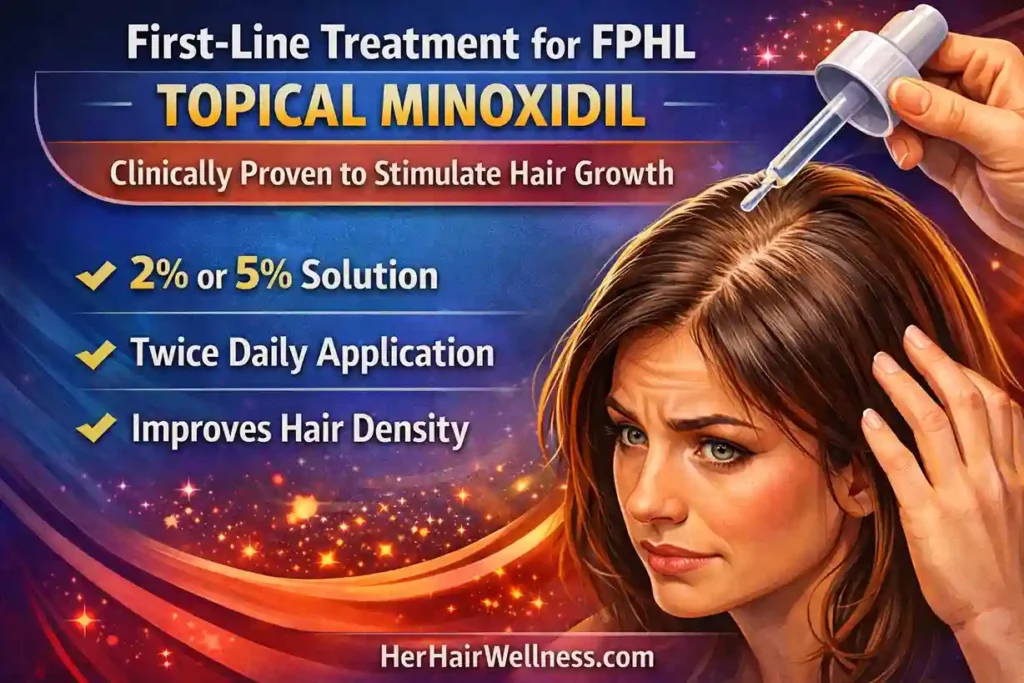
Unlike many other causes of alopecia, FPHL has specific evidence‑based treatments that arrest progression and, in some cases, promote partial regrowth.
1. First‑Line Medical Therapy: Topical Minoxidil
Current consensus from randomised controlled trials positions topical minoxidil as the cornerstone of therapy for female pattern hair loss, with demonstrated efficacy in delaying progression and increasing hair density (Norman, R. J., et al., 2023).
Key Facts
- Approved over‑the‑counter therapy with high levels of clinical evidence (Ramos, P. M., 2023).
- Often initiated at 2% solution twice daily for women (Ho, C. Y., 2023).
- May improve quality of life even in earlier stages (Carmina, E., 2023).
2. Anti‑Androgen & Hormonal Therapies
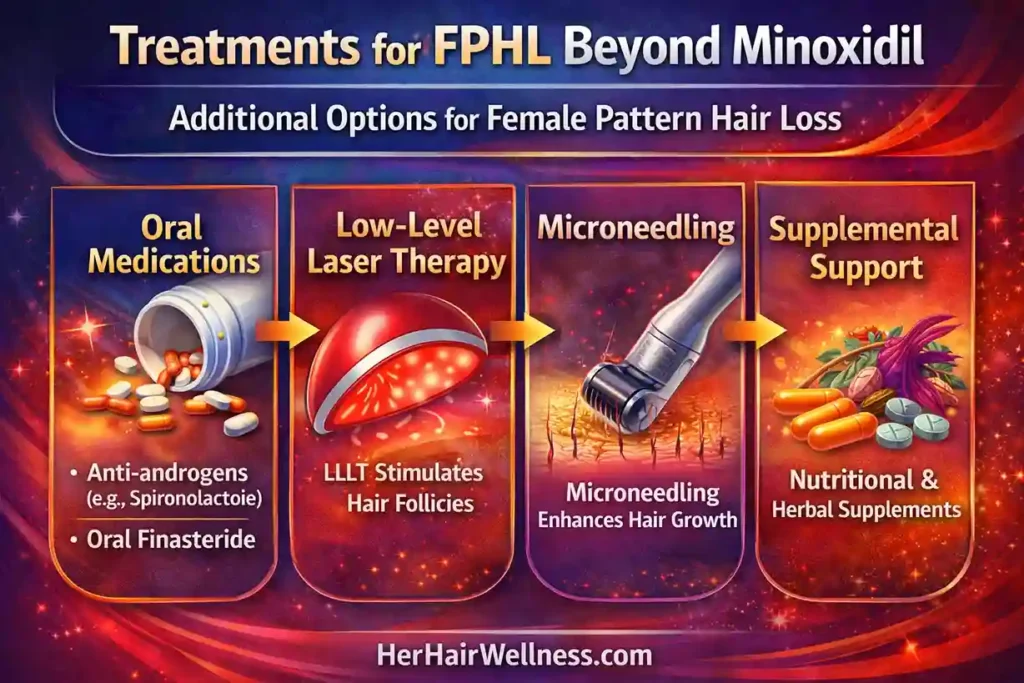
When hyperandrogenism is suspected or when hair loss is severe, adjunctive therapies such as low‑dose 5‑α‑reductase inhibitors (e.g., finasteride/dutasteride) or systemic anti‑androgens (e.g., spironolactone) may be considered, though evidence varies and treatment must be individualised (Chan, L., 2024).
Clinical Note: Assessment of androgen excess, thyroid profile, and micronutrient status is often recommended in comprehensive management protocols (Norman, R. J., et al., 2023).
3. Emerging & Adjunctive Therapies
Research into platelet‑rich plasma (PRP), low‑level laser therapy (LLLT), mesotherapy, and novel compounds (e.g., AR‑targeted therapies) shows promising results in enhancing hair thickness and follicular health, though long‑term clinical trials are ongoing (Carmina, E., 2023).
Histologic Features & Classification in AGA

Although not always required clinically, diagnostic staging systems such as the Ludwig scale provide useful frameworks for quantifying severity and monitoring treatment response (Ho, C. Y., 2023).
Histological Hallmarks
- Progressive follicular miniaturisation
- Higher proportion of vellus hairs
- Decreased terminal hair count
These features distinguish FPHL from other alopecias and affirm its classification as a non‑scarring patterned alopecia (Norman, R. J., et al., 2023).
Quality of Life & Clinical Importance
Female pattern hair loss is not merely cosmetic. It can profoundly affect self‑esteem, emotional wellbeing, and social confidence. Many patients report significant distress, making early and evidence‑based intervention essential (Ramos, P. M., 2023).
Medical Disclaimer
The content provided in this article is for informational purposes only and should not be construed as medical advice. Always consult with a qualified healthcare provider for diagnosis and treatment options tailored to your individual needs. This article is not intended to substitute professional medical care or advice.
Frequently Asked Questions (FAQs)
1. What is Female Pattern Hair Loss (Androgenetic Alopecia)?
Female Pattern Hair Loss (FPHL) is a common form of hair thinning in women, characterized by gradual miniaturization of hair follicles, especially on the crown and vertex of the scalp.
2. What causes Female Pattern Hair Loss?
FPHL is caused by a combination of genetic predisposition, hormonal changes, and androgen sensitivity. These factors lead to the thinning of hair follicles over time.
3. What are the most effective treatments for Female Pattern Hair Loss?
Topical minoxidil is the most common and evidence-backed treatment. Other options include anti‑androgens like spironolactone and platelet‑rich plasma (PRP) therapy.
4. Can Female Pattern Hair Loss be reversed?
While FPHL cannot be fully reversed, treatments like minoxidil and PRP can help slow progression and promote partial regrowth of hair.
5. How does Female Pattern Hair Loss impact quality of life?
FPHL can affect self-esteem and emotional wellbeing, leading to distress. Early treatment and psychological support are important for managing the emotional impact.
References
- Norman, R. J., et al. (2023). Female pattern hair loss: A clinical, pathophysiologic, and therapeutic review. PMC.
- Ramos, P. M. (2023). Female‑pattern hair loss: Therapeutic update. PMC.
- Ho, C. Y. (2023). Female Pattern Hair Loss: An Overview with Focus on Emerging Treatments. PMC.
- Chan, L. (2024). Female Pattern Hair Loss and Androgen Excess: Report on Therapeutic Strategies. J Clin Endocrinol Metab.
- Carmina, E. (2023). Female Pattern Hair Loss and Androgenetic Alopecia: Current Concepts and Treatments. J Clin Endocrinol Metab.