

Diffuse Hair Thinning in Women
Written by: Dr. Muhammad Ihsan Ullah, PhD
Medically reviewed by: Dr. Asma Fareed Khan, PhD
Last updated on February 13, 2026

If you’ve noticed overall hair thinning rather than a single bald patch, a widening central part, increased scalp visibility under bright light, or a reduced ponytail volume, you are describing a very common presentation known as diffuse alopecia—a form of non-scarring alopecia in which the hair follicle remains intact, but scalp hair density and/or hair shaft diameter gradually decline (DermNet, 2023; Olsen, 2025).
What Is Diffuse Hair Thinning?
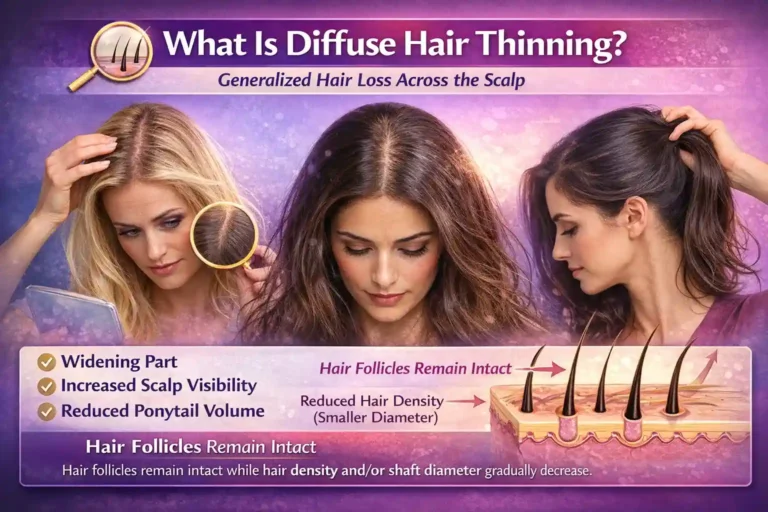
Diffuse hair thinning in women refers to a generalised reduction in hair volume across the scalp, without sharply defined bald areas. Clinically, diffuse thinning reflects one or both of the following processes:
- Reduced hair density (fewer terminal hairs per unit area)
- Reduced hair fibre thickness (finer strands with smaller hair shaft diameter) (Olsen, 2025).
Because the follicles remain present in non-scarring alopecia, thinning usually reflects changes in follicular cycling or gradual changes in follicle output rather than permanent follicle loss (Olsen, 2025).
How Diffuse Hair Thinning Differs From Patterned Hair Loss
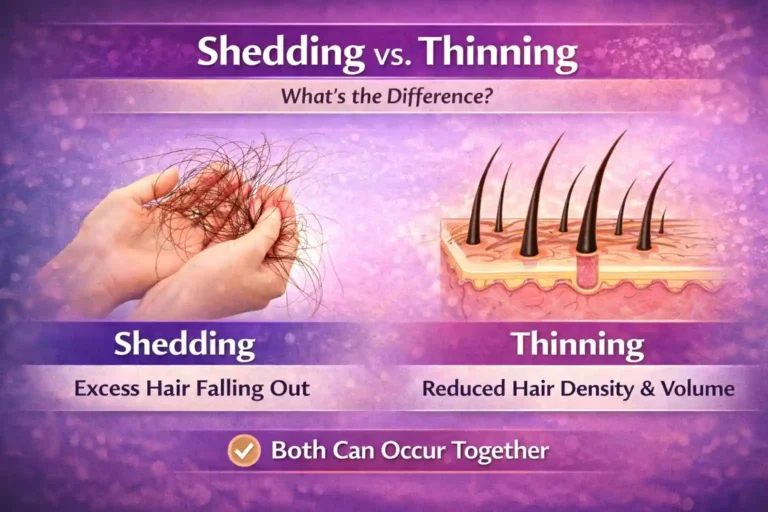
Women often use the term ‘diffuse thinning’ to describe visible changes, but clinicians recognise two broad diffuse patterns:
- Shedding-dominant diffuse thinning, where hair appears thinner because more hairs enter shedding phases simultaneously
- Patterned diffuse thinning, often related to female pattern hair loss, where hair density and strand thickness slowly decrease over time, commonly noticeable as a widening hair part or thinning at the crown (Olsen, 2025; Cleveland Clinic, 2024).
A helpful distinction when thinking about hair shedding vs thinning:
- Shedding describes hair leaving the scalp
- Thinning describes reduced scalp coverage and volume
How Common Is Diffuse Hair Thinning in Women?
Diffuse thinning is extremely common and may occur at multiple life stages. Hair follicles are sensitive to physiologic changes, including postpartum transitions, illness, metabolic stress, and midlife hormonal shifts (Olsen, 2025). It is also one of the most frequent reasons women seek medical care for hair concerns (Cleveland Clinic, 2024).
Despite its frequency, diffuse hair thinning should not be dismissed. Research consistently shows that hair loss in women can significantly affect emotional well-being and daily functioning (Olsen, 2025).
Hair Growth Cycle Changes in Diffuse Thinning
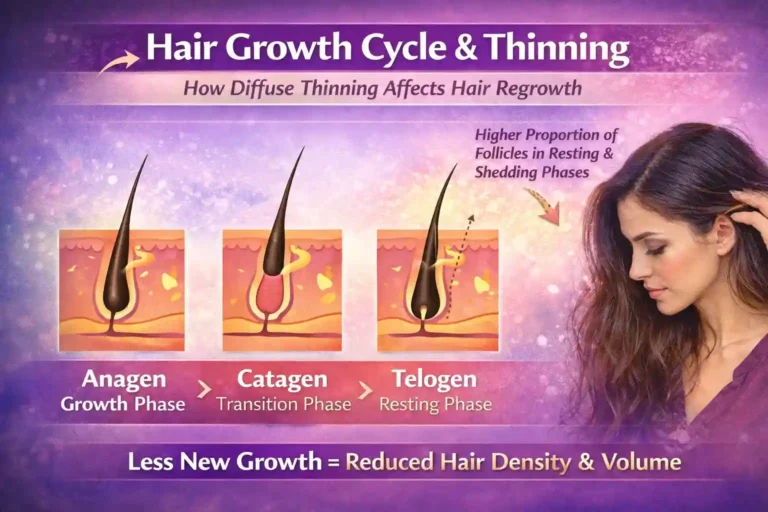
Understanding diffuse hair thinning means requiring a basic understanding of the hair growth cycle:
- Anagen phase (growth)
- Catagen phase (transition)
- Telogen phase (resting)
- Hair release (shedding) (Hughes & Khetarpal, 2024).
When a higher proportion of follicles shift into the telogen phase, women may experience noticeable hair density reduction and decreased hair volume, even though follicles remain capable of regrowth (Hughes & Khetarpal, 2024).
In other cases, gradual changes in cycling and follicle output lead to sustained thinning over time (Olsen, 2025).
Areas of the Scalp Commonly Affected
Although often described as generalised female hair thinning, certain visual patterns are common:
- Widening central part
- Increased scalp visibility at the crown
- Reduced ponytail volume
- Diffuse thinning over the top of the scalp, with relative preservation of the frontal hairline (Olsen, 2025; Cleveland Clinic, 2024).
These observations closely match how women recognise and describe early diffuse thinning.
Is Diffuse Hair Thinning Temporary or Permanent?

Medically accurate guidance includes:
- Diffuse thinning is often temporary when driven by a reversible shift in the hair growth cycle.
- Diffuse thinning may be long-term or progressive when related to patterned follicle changes, particularly when thinning advances slowly over years (Olsen, 2025).
Even when regrowth occurs, visible improvement typically takes several months, reflecting the slow nature of the hair growth cycle (Hughes & Khetarpal, 2024; Olsen, 2025).
When Should Women Be Concerned About Diffuse Thinning?
Early professional evaluation may be appropriate if thinning:
- Progresses rapidly over weeks to months
- Is associated with marked shedding and visible density loss
- Occurs with scalp symptoms such as pain or inflammation
- Coincides with systemic health changes
- Causes significant distress or affects quality of life
Impact of Diffuse Hair Thinning on Quality of Life
Diffuse hair thinning can profoundly affect self-image and emotional well-being. Studies consistently show that women with hair loss experience measurable impacts on confidence, social engagement, and mental health (Olsen, 2025; AJMC Staff, 2025).
Acknowledging this impact is essential to patient-centred, trustworthy medical education.
Medical Disclaimer
This content is provided for educational and informational purposes only and is not intended to replace professional medical advice, diagnosis, or treatment. Hair thinning patterns and outcomes can vary between individuals. If you are experiencing persistent or concerning hair changes, please consult a qualified healthcare professional for personalised evaluation and guidance.
Frequently Asked Questions (FAQs):
1. What does diffuse hair thinning in women mean?
It refers to a general reduction in hair volume across the scalp rather than localized bald patches, often noticed as a widening part or smaller ponytail.
2. How is diffuse hair thinning different from hair shedding?
Hair shedding refers to hair strands falling out, while diffuse thinning refers to reduced scalp coverage and density. The two can occur together.
3. Is diffuse hair thinning permanent?
Not always. In many women it is temporary and improves over time, though some patterns may be long-term or progressive.
4. Can diffuse hair thinning grow back?
Yes, regrowth is possible when hair follicles remain healthy, but visible improvement usually takes several months.
5. When should I seek medical advice for diffuse thinning?
If thinning progresses quickly, is accompanied by other symptoms, or significantly affects quality of life, professional evaluation is recommended.
References
- Olsen, E. A. (2025). Hair loss in women. The New England Journal of Medicine, 393(15), 1509–1520. https://doi.org/10.1056/NEJMcp2412146
- Hughes, E. C., & Khetarpal, S. (2024). Telogen effluvium. In StatPearls. StatPearls Publishing. https://www.ncbi.nlm.nih.gov/books/NBK430848/
- Cleveland Clinic. (2024). Hair loss in women: Causes, treatment & prevention. https://my.clevelandclinic.org/health/diseases/16921-hair-loss-in-women
- (2023). Diffuse alopecia. https://dermnetnz.org/topics/diffuse-alopecia
- AJMC Staff. (2025). The psychological burden of alopecia significantly impacts quality of life. The American Journal of Managed Care. https://www.ajmc.com