

Minoxidil for Women: Is 2% or 5% Better for Hair Regrowth?
Written by: Dr. Muhammad Ihsan Ullah, PhD
Medical Writer and Pharmacology Researcher
Medically reviewed by: Dr. Muhammad Mudassar Hassan Bhatti, MD
Dermatologist and Medical Reviewer
Last medically reviewed: 13th July, 2026

Choosing between 2% and 5% minoxidil can be confusing. The 5% formulation sounds stronger and therefore better, while the 2% version is often presented as the gentler option for women. The clinical evidence is more nuanced: both strengths can support hair regrowth, 5% may offer greater benefits for some women, and 2% may remain the better choice when tolerability or unwanted facial hair becomes a problem.
2% vs. 5% Minoxidil for Women: Quick Answer
For many women, once-daily 5% minoxidil foam offers the best balance of effectiveness, convenience, and treatment adherence. However, 2% minoxidil solution can still produce meaningful hair regrowth and may be more suitable for women who develop irritation, excessive dryness, or unwanted facial hair while using 5%.
Clinical trials show that both strengths can work. The best option is not simply the product with the higher number—it is the formulation that can be used correctly, consistently, and comfortably for the long term.
Which Minoxidil Strength May Suit You Best?
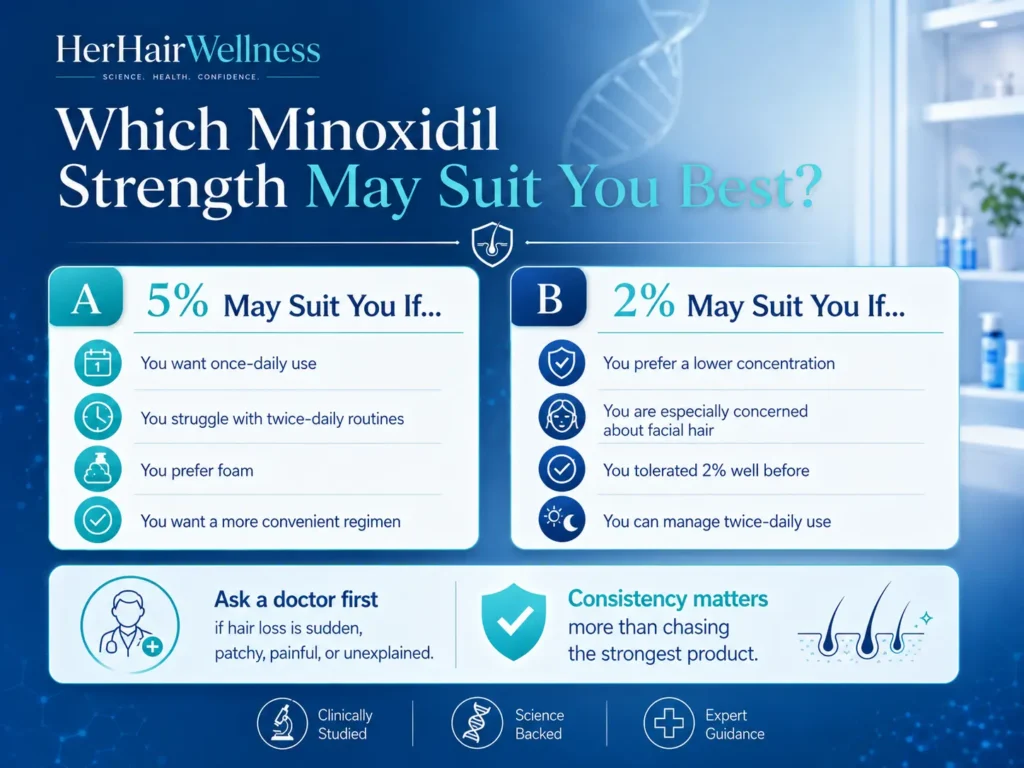
- Consider 5% minoxidil foam when you want once-daily application, find twice-daily treatment difficult, or experience irritation from propylene-glycol-containing liquid solutions.
- Consider 2% minoxidil solution when you prefer a lower concentration, are especially concerned about facial hypertrichosis, or cannot tolerate 5%.
- Seek professional guidance when hair loss is sudden, patchy, painful, associated with scalp inflammation, or has not been properly diagnosed.
Is 2% or 5% Minoxidil Better for Women?
For most women seeking a simple once-daily treatment, 5% minoxidil foam is usually the more practical option. It provides a higher concentration of minoxidil while reducing the treatment schedule from twice daily to once daily.
That does not mean 5% is universally better.
A woman who experiences persistent itching, redness, dryness, or unwanted facial hair with 5% may obtain a better real-world result from 2% because she is more likely to continue using it. A medication cannot work when side effects lead to irregular application or complete discontinuation.
The typical comparison is:
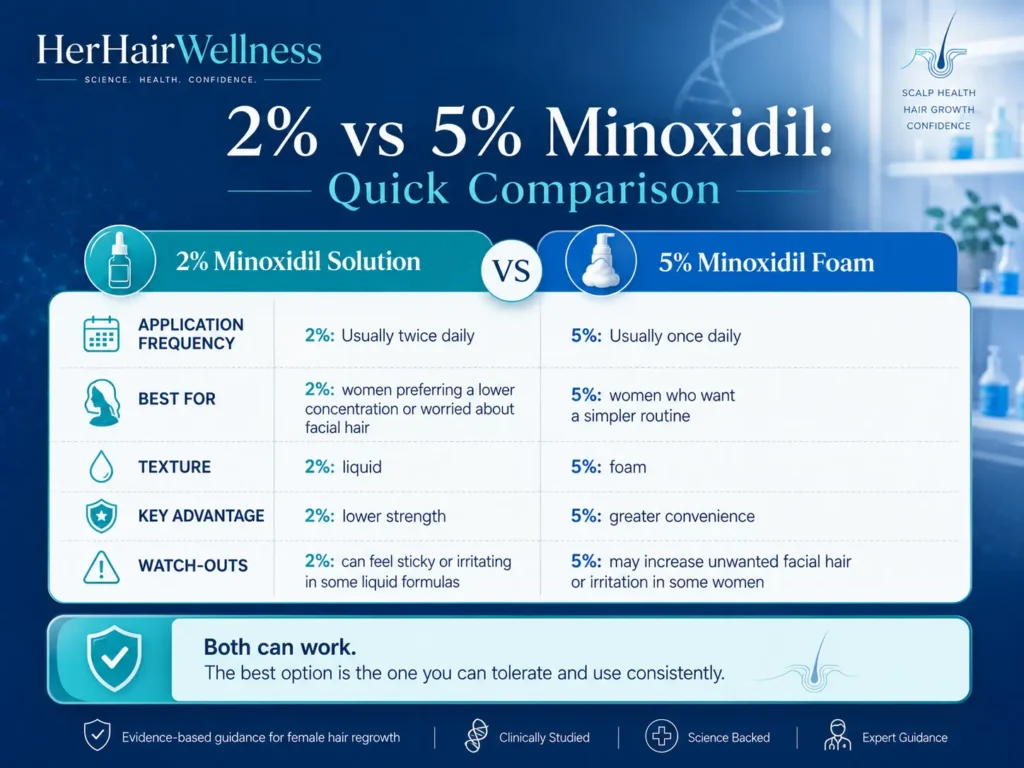
- 2% minoxidil solution: Usually applied twice daily
- 5% minoxidil foam: Usually applied once daily
These regimens differ in more than concentration. They also differ in formulation, inactive ingredients, drying time, cosmetic feel, and application frequency.
Therefore, comparing 2% liquid with 5% foam is not simply a comparison between two percentages. It is a comparison between two complete treatment routines.
2% vs. 5% Minoxidil Comparison Table
Feature | 2% Minoxidil Solution | 5% Minoxidil Foam |
Minoxidil concentration | 2% | 5% |
Typical application frequency | Twice daily | Once daily |
Common formulation | Liquid solution | Topical foam |
Evidence of hair regrowth | Yes | Yes |
Convenience | Requires two daily applications | Requires one daily application |
Propylene glycol | Often present in liquid products | Usually absent from foam |
Scalp irritation | Possible | Possible |
Unwanted facial hair | Possible | May be more likely |
Drying and cosmetic feel | Can feel wet, sticky, or greasy | Often dries faster and more cleanly |
Best practical use | Women who tolerate liquid and can apply it twice daily | Women who prefer a once-daily routine |
Product formulations vary between manufacturers and countries. Always follow the directions printed on the specific product rather than assuming every 2% or 5% formulation has identical instructions.
What Does the Research Say About 2% vs. 5% Minoxidil in Women?
The most important evidence comes from direct clinical trials in women with female-pattern hair loss.
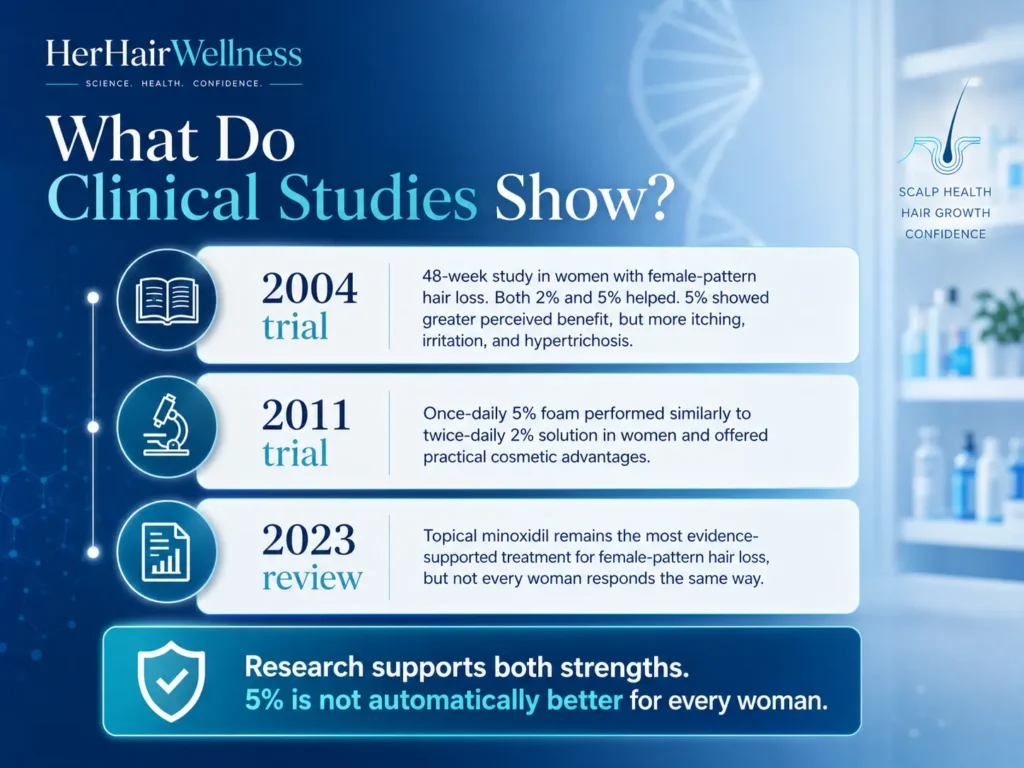
A 48-week randomized, placebo-controlled trial included 381 women who received 5% minoxidil solution, 2% minoxidil solution, or placebo. Both active treatments produced improvements, while 5% minoxidil demonstrated stronger results than placebo across the main efficacy measures. Women using 5% also reported greater treatment benefit than those using 2% at the end of the study.
However, the higher concentration caused more:
- Scalp itching
- Local irritation
- Unwanted hair growth
- Facial or body hypertrichosis
The study therefore supports a possible efficacy advantage for 5% in some women, but that advantage came with a greater adverse-effect burden (1).
A later randomized trial directly compared:
- 5% minoxidil foam used once daily
- 2% minoxidil solution used twice daily
The researchers concluded that once-daily 5% foam was noninferior to twice-daily 2% solution for stimulating hair growth. The foam formulation also offered practical and cosmetic advantages, including easier application and less interference with hairstyling (2).
A subsequent phase III comparison found that both regimens produced hair regrowth, although the study did not meet its prespecified statistical threshold for formally proving noninferiority. This is an important detail because it shows why the evidence should not be reduced to the simplistic statement that both products are always identical—or that 5% always produces dramatically better results.
A 2023 therapeutic review concluded that topical minoxidil remains the treatment with the strongest evidence for female-pattern hair loss. It also emphasized that a substantial percentage of women do not achieve satisfactory improvement, regardless of the concentration selected (3).
Is 5% Minoxidil More Effective Than 2% for Women?
It may be more effective for some women, but the difference is not large or consistent enough to guarantee a better result for everyone.
The major 48-week concentration trial found greater patient-reported benefit with 5% than with 2%. However, studies comparing once-daily 5% foam with twice-daily 2% solution have generally found that both regimens can produce clinically meaningful regrowth (1,2).
Effectiveness depends on several factors:
- The sensitivity of the follicles to minoxidil
- Consistency of daily application
- How long treatment is continued
- Whether the medication reaches the scalp
- The extent and duration of thinning
- Scalp tolerance
- The formulation used
- Individual biological response
The higher concentration cannot overcome poor application.
For example, 5% minoxidil applied inconsistently three times a week is not necessarily more effective than 2% minoxidil applied correctly every day. Similarly, applying minoxidil heavily to the hair shafts instead of the scalp wastes medication without meaningfully increasing follicular exposure.
A stronger formulation only provides a potential advantage when it is used correctly and tolerated well.
Does 5% Minoxidil Regrow More Hair Than 2%?
Some evidence suggests that 5% can produce greater perceived improvement, but direct comparisons have not shown a dramatic or universal difference in objective hair regrowth.
The pivotal 2004 trial favored 5% on certain efficacy and patient-assessment outcomes. However, later foam-versus-solution comparisons showed that once-daily 5% foam and twice-daily 2% solution could produce broadly comparable regrowth (1,2).
This apparent contradiction has a reasonable explanation.
The earlier trial compared different minoxidil concentrations in solution form, while later trials compared:
- Different concentrations
- Different vehicles
- Different dosing frequencies
- Different inactive ingredients
A 5% foam used once daily is not pharmacologically or practically identical to a 5% liquid used twice daily.
When reading claims that “5% grows substantially more hair,” check what was actually compared. Results from men, 5% solutions used twice daily, oral minoxidil, and combination treatments should not be presented as direct evidence for once-daily 5% foam in women.
Is 5% Minoxidil Once Daily as Effective as 2% Twice Daily?
Evidence suggests that once-daily 5% foam can provide results similar to twice-daily 2% solution for many women.
The 2011 randomized trial found that once-daily 5% foam was noninferior and similarly effective to twice-daily 2% solution. Participants also reported practical advantages with the foam formulation (2).
These findings matter because treatment adherence is a major weakness of topical hair-loss therapy.
Twice-daily application can become difficult when a woman needs to:
- Apply the liquid before work
- Wait for the scalp to dry
- Restyle the hair
- Repeat the process at night
- Avoid lying down before the solution dries
- Continue the routine indefinitely
Once-daily treatment reduces the daily burden. For some women, that convenience may produce a better long-term result than the concentration difference itself.
However, once-daily use should not be interpreted as permission to apply an excessive amount. More minoxidil does not produce proportionally faster hair growth and may increase irritation or unwanted hair growth.
Does 5% Minoxidil Work Faster Than 2%?
It might appear to work earlier for some women, but there is no dependable rule that 5% will always produce faster visible regrowth.
Hair follicles move slowly through the growth cycle. Even when minoxidil begins affecting follicular activity early, visible changes usually take months.
A realistic treatment timeline is:
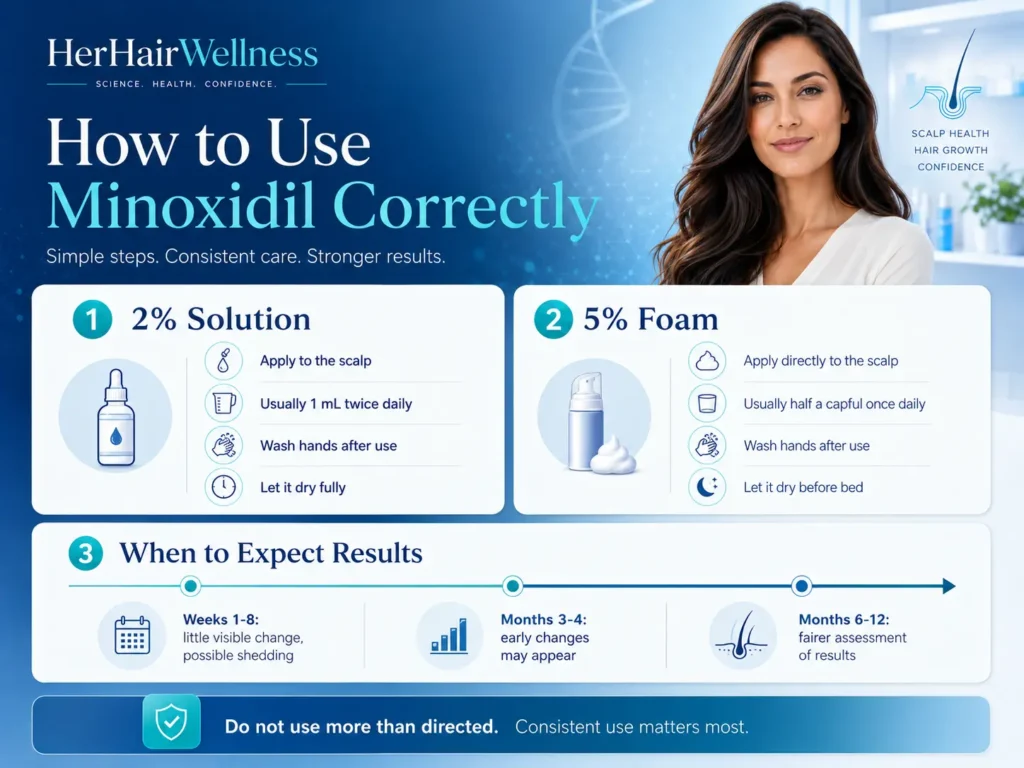
During the first 4 to 8 weeks
Most women will not see obvious regrowth. Some may notice temporary increased shedding as follicles transition through the hair cycle.
Around months 3 to 4
Fine or short new hairs may become visible. Changes can be subtle and difficult to judge without standardized photographs.
Around month 6
This is a more useful point for assessing whether the treatment appears to be stabilizing thinning or improving coverage.
Between months 6 and 12
Hair density, part width, and scalp coverage can be assessed more reliably. Maximum improvement may take longer than six months.
Product information may suggest slightly different timelines for 2% and 5%, but those label estimates should not be treated as proof that one strength will work a precise number of weeks faster than the other.
Individual variation is substantial. Some women respond early, some respond slowly, and others do not obtain meaningful visible improvement despite correct use.
Is 5% Minoxidil Foam Better Than 2% Minoxidil Solution?
For many women, 5% foam is better from a practical and cosmetic perspective.
The foam often:
- Dries faster
- Leaves less visible residue
- Feels less greasy
- Requires only one daily application
- Avoids propylene glycol
- Interferes less with hairstyling
Many liquid minoxidil solutions contain propylene glycol. This ingredient helps dissolve minoxidil and deliver it across the scalp, but it can also contribute to itching, redness, burning, scaling, or allergic contact dermatitis in susceptible users.
The foam formulation was developed without propylene glycol, which may make it easier to tolerate for some women (2).
However, 5% foam is not automatically gentler.
It still contains minoxidil at a higher concentration and commonly includes alcohol and other inactive ingredients that can dry or irritate the scalp. A woman may tolerate 2% liquid better than 5% foam, particularly when her reaction is concentration-related rather than caused by propylene glycol.
The correct conclusion is:
Foam may be more cosmetically acceptable and better tolerated when propylene glycol is the problem, but individual scalp response matters more than formulation marketing.
Which Has More Side Effects: 2% or 5% Minoxidil?
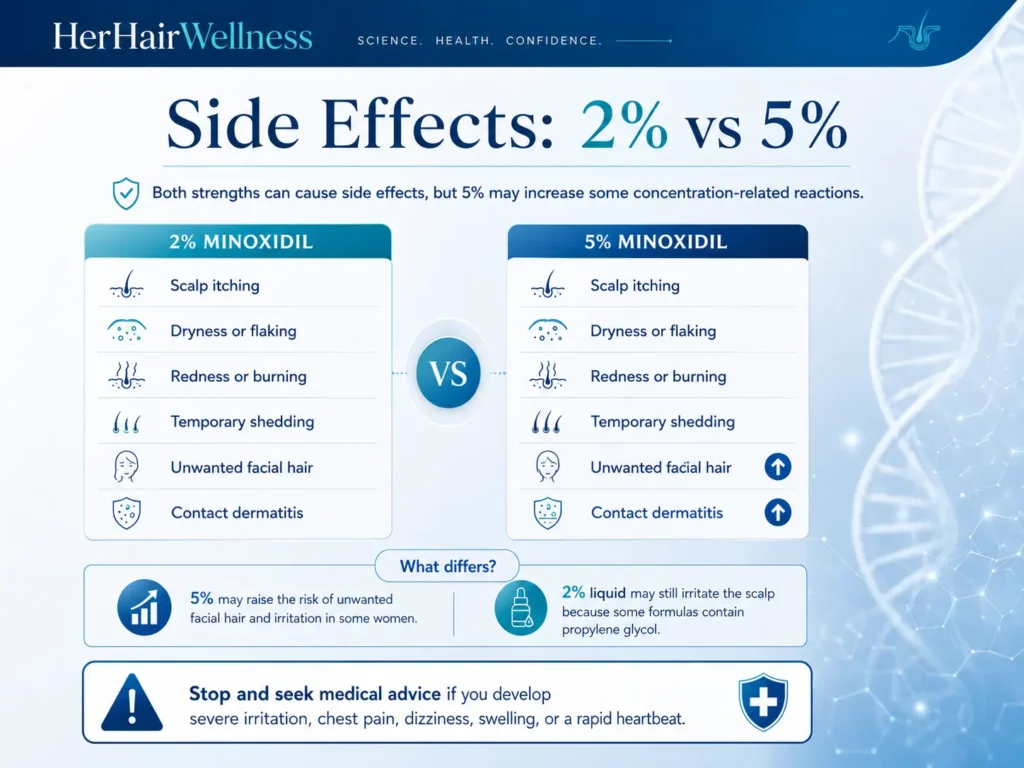
Both strengths can cause side effects, but 5% may increase the risk of certain concentration-related reactions.
In the direct 48-week comparison, women using 5% solution experienced more local irritation, pruritus, and hypertrichosis than those using 2% solution (1).
Possible side effects of either strength include:
- Scalp itching
- Redness
- Burning or stinging
- Dryness
- Flaking
- Changes in hair texture
- Temporary shedding
- Irritant contact dermatitis
- Allergic contact dermatitis
- Unwanted facial or body hair
The formulation complicates the comparison. Although 5% has a higher active-drug concentration, 2% liquid may contain propylene glycol, which can cause significant irritation in sensitive individuals.
Therefore:
- 5% may cause more concentration-related adverse effects.
- 2% liquid may cause more vehicle-related irritation in some users.
- 5% foam may be better tolerated than 2% liquid when propylene glycol is responsible.
Persistent inflammation should not be ignored. Severe redness, scaling, burning, or swelling is not a normal sign that minoxidil is “working.”
Does 5% Minoxidil Cause More Facial Hair Than 2%?
Yes, the risk of unwanted facial hair appears to be higher with 5%, although it can occur with either concentration.
This side effect is known as hypertrichosis. It refers to increased hair growth in areas other than the intended scalp treatment area.
Possible reasons include:
- Higher exposure to minoxidil
- The product running onto the forehead or temples
- Medication remaining on the hands
- Transfer to a pillow before drying
- Accidental contact with the face
- Individual sensitivity
- Limited systemic absorption
The pivotal concentration trial reported more hypertrichosis with 5% minoxidil than with 2% (1).
To reduce accidental facial exposure:
- Part the hair carefully before application.
- Place the medication directly on the scalp.
- Avoid saturating the hair.
- Do not apply excessive amounts.
- Keep the treatment away from the forehead.
- Wash the hands immediately afterward.
- Allow the scalp to dry before going to bed.
- Clean any product spilled on the face, neck, sink, or pillowcase.
Women who develop distressing facial hair should not simply continue using the same amount indefinitely. Reducing accidental transfer, changing formulation, lowering the concentration, or discussing another regimen with a clinician may be appropriate.
Does 5% Minoxidil Cause More Initial Shedding Than 2%?
There is no strong evidence that every woman using 5% will experience more severe initial shedding than a woman using 2%.
Temporary shedding can occur after starting either strength. Minoxidil can alter the timing of the follicular growth cycle, causing older resting hairs to shed as follicles transition toward a new growth phase.
Initial shedding:
- Does not occur in everyone
- May begin during the first several weeks
- Is usually temporary
- Does not guarantee future success
- Does not automatically mean the treatment is failing
The higher concentration could theoretically produce a more noticeable early change in follicular cycling in some users, but individual experiences cannot establish that 5% always causes a worse shed.
Severe or persistent shedding should not automatically be blamed on minoxidil. A healthcare professional should evaluate shedding that is:
- Sudden
- Extensive
- Patchy
- Associated with scalp pain
- Accompanied by redness or inflammation
- Continuing without stabilization
- Significantly different from the original pattern
Is 2% Minoxidil Better for Women With a Sensitive Scalp?
It can be, but the lower concentration does not guarantee better tolerance.
Two separate factors need to be considered:
- The concentration of minoxidil
- The inactive ingredients in the formulation
A woman who is sensitive to higher minoxidil exposure may tolerate 2% better. However, a woman reacting to propylene glycol may find 5% foam less irritating than 2% liquid.
Possible scenarios include:
- 5% causes irritation but 2% does not: The higher minoxidil concentration may be contributing.
- 2% liquid causes irritation but 5% foam does not: Propylene glycol or the liquid vehicle may be responsible.
- Both products cause irritation: Minoxidil, alcohol, or another shared ingredient may be the problem.
- Only one brand causes irritation: Inactive ingredients may differ between manufacturers.
Do not repeatedly switch products without allowing the scalp to recover or identifying the cause of the reaction. Persistent dermatitis can worsen adherence and may make the scalp difficult to evaluate.
Can Women Use Men’s 5% Minoxidil?
The active ingredient may be identical, but the package directions can differ.
Minoxidil itself is not a male or female molecule. A men’s 5% foam and a women’s 5% foam may contain the same concentration of active ingredient. However, products marketed for men and women may differ in:
- Labeled application frequency
- Approved use
- Instructions
- Applicator design
- Inactive ingredients
- Package warnings
A woman should not assume that the dosing instructions printed on a men’s product are appropriate for her.
For example, a men’s 5% product may instruct twice-daily use, while a women’s 5% foam is generally used once daily. Applying a men’s product twice daily simply because the carton says so may unnecessarily increase exposure and side effects.
Women considering a men’s product for cost or availability reasons should compare the full ingredient list and obtain professional advice about the correct frequency.
Can Women Use 5% Minoxidil Twice a Day?
Women should not increase once-daily 5% foam to twice-daily use without medical direction.
Using 5% twice daily may increase:
- Scalp irritation
- Dryness
- Facial hypertrichosis
- Product transfer
- Treatment cost
- Medication exposure
- Difficulty maintaining the routine
There is no reliable evidence that doubling the labeled frequency will double hair growth.
Hair-follicle response is not linear. Once adequate exposure has been achieved, applying more medication may primarily increase adverse effects rather than clinical benefit.
Do not:
- Apply two doses at once after missing an application.
- Use more than the measured amount.
- combine 5% foam and 5% liquid without medical instructions.
- Apply the product to inflamed or damaged skin.
- Assume a burning sensation indicates stronger effectiveness.
The goal is consistent exposure—not maximum possible exposure.
Should Beginners Start With 2% or 5% Minoxidil?
For many adult women with confirmed female-pattern hair loss, once-daily 5% foam is a reasonable starting option because it is convenient and supported by clinical evidence.
However, 2% may be worth considering when a woman:
- Is highly concerned about facial hair
- Has previously reacted to 5%
- Is sensitive to higher medication concentrations
- Has been specifically advised to use 2%
- Can realistically maintain twice-daily application
- Has achieved satisfactory results with 2% before
A simple decision guide is:
Situation | More practical option to discuss |
Wants the simplest routine | 5% foam once daily |
Often forgets one of two daily applications | 5% foam |
Experienced irritation from propylene-glycol liquid | 5% foam may be preferable |
Developed facial hypertrichosis with 5% | Consider 2% |
Sensitive to higher minoxidil concentrations | Consider 2% |
Tolerates 2% and is seeing improvement | Continuing 2% may be reasonable |
Has not obtained a diagnosis | Seek evaluation before choosing either |
Has sudden or patchy hair loss | Do not self-treat blindly |
The best starting choice is not necessarily the strongest product. It is the lowest-burden regimen likely to provide adequate benefit without causing unacceptable side effects.
Can Women Switch From 2% to 5% Minoxidil?
Yes. Switching from 2% to 5% is common, particularly when twice-daily treatment is inconvenient or 2% has not produced a satisfactory response after consistent use.
A switch may be considered when:
- 2% has been used correctly for several months.
- Twice-daily application is difficult to sustain.
- The liquid leaves unwanted residue.
- The woman wants a once-daily foam.
- A clinician believes the higher concentration is appropriate.
Do not declare 2% ineffective after only a few weeks. Hair regrowth is slow, and early treatment periods are dominated by normal hair-cycle variation.
When switching:
- Follow the new product’s labeled dose.
- Do not overlap full doses of both formulations.
- Avoid increasing the total daily amount.
- Photograph the scalp before making the change.
- Monitor irritation and facial hair.
- Keep the rest of the hair-care routine reasonably stable.
There is no universally proven transition schedule requiring gradual percentage increases. Complicated self-designed regimens usually make adherence worse and results harder to interpret.
Will Switching From 2% to 5% Cause Another Shedding Phase?
It might, but it does not happen to every woman.
Changing concentration, formulation, or total daily exposure may influence the follicular growth cycle. Some users report increased shedding after switching, but there is limited high-quality evidence defining exactly how often this occurs.
A temporary shed after switching does not automatically mean that the new strength is damaging the follicles. However, it should not be dismissed when it is severe or prolonged.
To evaluate the change properly:
- Record the switch date.
- Take baseline photographs.
- Avoid changing several other treatments simultaneously.
- Monitor shedding for several weeks.
- Check for scalp inflammation.
- Seek help if shedding becomes extreme or patchy.
Internet anecdotes can be useful for understanding common concerns, but they cannot predict an individual clinical response.
Can Women Switch From 5% Back to 2%?
Yes. Moving back to 2% may be appropriate when 5% causes unacceptable side effects.
Common reasons include:
- Persistent itching
- Scalp burning
- Excessive dryness
- Facial hair growth
- Difficulty applying foam
- Poor cosmetic tolerance
- Preference for the previous regimen
It cannot be guaranteed that 2% will maintain every improvement achieved with 5%. Some women may notice no difference, while others may lose part of the benefit after reducing exposure.
The decision should be based on the overall balance:
- Is 5% producing visibly better results?
- Are the side effects manageable?
- Is the treatment being used consistently?
- Did symptoms begin only after the switch?
- Could the reaction be caused by the formulation rather than the concentration?
A theoretically stronger result is not worthwhile when the side effects make long-term use unrealistic.
Can Women Alternate Between 2% and 5% Minoxidil?
Alternating strengths is not a standard evidence-based over-the-counter regimen.
Examples of improvised schedules include:
- 2% in the morning and 5% at night
- 5% every second day
- 2% during the week and 5% on weekends
- 5% only when shedding appears worse
These approaches create several problems:
- Inconsistent exposure
- Greater risk of dosing mistakes
- Difficulty identifying side effects
- Poor adherence
- Inability to judge whether either regimen works
Unless a dermatologist has recommended a specific individualized schedule, it is more sensible to use one clearly defined regimen consistently.
How Should Women Apply 2% Minoxidil Correctly?
Follow the specific manufacturer’s directions. A typical 2% solution routine involves:
- Begin with a dry or towel-dried scalp.
- Part the hair to expose the thinning area.
- Measure the recommended amount, commonly 1 mL.
- Place the solution directly on the scalp.
- Spread it gently over the affected area.
- Avoid allowing the liquid to run onto the face.
- Wash the hands immediately.
- Allow the scalp to dry before lying down.
- Repeat at the labeled frequency, commonly twice daily.
The medication should reach the scalp rather than coat the hair.
Using extra liquid because the hair absorbs part of the dose is the wrong solution. Better parting and targeted application are more useful than increasing the amount.
How Should Women Apply 5% Minoxidil Foam Correctly?
A typical once-daily 5% foam routine involves:
- Start with a dry scalp.
- Part the hair to clearly expose the thinning area.
- Dispense the labeled amount, commonly half a capful.
- Use cool, dry fingers so the foam does not melt immediately.
- Place small amounts directly across the scalp.
- Massage gently over the treatment area.
- Avoid transferring foam onto the forehead or face.
- Wash the hands thoroughly.
- Allow the product to dry before sleeping or wearing a tight head covering.
Applying the foam directly to the scalp may be harder in women with dense, long, curly, or tightly coiled hair. Creating several narrow parts can improve scalp access without increasing the dose.
What Application Mistakes Make Minoxidil Less Effective?
Common mistakes include:
- Applying it mainly to the hair
- Using an unmeasured amount
- Skipping applications frequently
- Doubling the next dose
- Washing the scalp shortly after application
- Lying down before the product dries
- Applying it to irritated or broken skin
- Switching formulations every few weeks
- Expecting visible regrowth within one month
- Stopping during temporary early shedding
- Using more product in areas that appear thinner
- Allowing the medication to drip onto the face
Another major mistake is judging results only by daily mirror checks.
Hair changes are gradual, lighting is inconsistent, and hairstyles can alter the appearance of scalp coverage. Standardized monthly photographs are more reliable.
How Long Should Women Try 2% Before Switching to 5%?
A meaningful trial generally requires several months of correct and consistent use.
A sensible monitoring schedule is:
Before starting
Take photographs of:
- The center part
- The frontal scalp
- The top of the head
- The crown
Use the same lighting, camera, angle, distance, and hairstyle each time.
At three months
Review:
- Treatment consistency
- Scalp tolerance
- Initial shedding
- Facial hair
- Early photographic changes
Three months may still be too early for a final judgment.
At six months
Assess:
- Hair density
- Part width
- Scalp coverage
- Shedding stability
- Ease of use
- Side effects
This is a more reasonable point for discussing whether to continue, switch, or seek reassessment.
Between six and twelve months
Evaluate the overall result. Some women experience gradual improvement beyond six months.
Changing to 5% after inconsistent 2% use does not prove that the lower concentration failed. First establish whether 2% was actually used as directed.
How Can Women Tell Whether 2% or 5% Is Working?
Look for trends rather than dramatic overnight changes.
Signs of a possible positive response include:
- Reduced progression of thinning
- Less visible scalp under consistent lighting
- A narrower-looking center part
- Short new hairs within the thinning area
- Improved hair density
- Better scalp coverage
- Stabilized shedding
Not every successful response produces obvious new hair. Slowing further thinning can also be clinically meaningful.
To compare results fairly:
- Use monthly photographs.
- Keep the hair part consistent.
- Record the exact formulation.
- Track missed applications.
- Note itching or redness.
- Avoid judging wet hair against dry hair.
- Do not compare different lighting conditions.
A 2023 review reported that a considerable proportion of women do not obtain satisfactory improvement from topical minoxidil (3). Lack of response does not justify using unlimited quantities or increasing frequency without guidance.
What Happens If a Woman Stops Using Minoxidil?
Benefits generally fade after treatment is discontinued.
Minoxidil supports follicles only while treatment continues. It does not permanently cure female-pattern hair loss or permanently reset the hair-growth cycle.
After stopping:
- Newly maintained or regrown hair may gradually shed.
- The previous thinning pattern may return.
- Loss may become noticeable within several months.
- Restarting may not immediately restore the previous result.
This applies to both 2% and 5%.
The need for long-term use should influence the original choice. A once-daily regimen may be more sustainable, while another woman may prefer 2% because she tolerates it better.
The most effective long-term option is the one that can realistically become part of a stable routine.
Final Verdict: Is 2% or 5% Minoxidil Better for Female Hair Regrowth?
For many women, 5% minoxidil foam once daily is the most practical overall choice. It reduces application frequency, avoids propylene glycol, and may provide stronger perceived benefit for some users.
However, the evidence does not support declaring 5% universally superior.
The pivotal concentration trial found greater treatment benefit with 5%, but it also found more irritation and hypertrichosis. A direct trial comparing once-daily 5% foam with twice-daily 2% solution found similar effectiveness and practical advantages with foam (1,2).
The strongest reasons to consider 5% foam are:
- Once-daily convenience
- Better treatment adherence
- Faster-drying formulation
- Absence of propylene glycol
- Potentially stronger benefit in some women
The strongest reasons to consider 2% solution are:
- Lower minoxidil concentration
- Concern about unwanted facial hair
- Poor tolerance of 5%
- Previous satisfactory response to 2%
- Preference for the liquid formulation
The correct question is not simply, “Which percentage is stronger?”
It is:
Which formulation offers enough effectiveness while remaining comfortable and practical enough to use consistently for months and potentially years?
For many women, that answer will be 5% foam. For others, 2% solution will provide the better balance. Both are legitimate evidence-based options, and neither can guarantee regrowth.
Medical Disclaimer
This article is for educational purposes only and is not a substitute for professional medical advice, diagnosis, or treatment. Consult a qualified healthcare professional before using minoxidil, especially if you are pregnant, breastfeeding, have heart disease, use other scalp medications, or have sudden, patchy, painful, or unexplained hair loss.
Frequently Asked Questions
Is 2% or 5% minoxidil better for women?
For many women, 5% foam is more convenient because it is usually used once daily. However, 2% solution may be preferable when 5% causes irritation or unwanted facial hair.
Is 5% minoxidil safe for women?
Yes, women can use appropriately labeled 5% minoxidil foam as directed. Possible side effects include scalp irritation, temporary shedding, dryness, and unwanted facial hair.
Is 5% minoxidil once daily as effective as 2% twice daily?
Clinical evidence suggests that once-daily 5% foam can produce results comparable to twice-daily 2% solution in many women.
Does 5% minoxidil cause more side effects than 2%?
It may increase itching, irritation, or facial hypertrichosis. However, 5% foam may be easier to tolerate than 2% liquid when propylene glycol causes the irritation.
Can women switch from 2% to 5% minoxidil?
Yes. A switch may be considered when twice-daily 2% is inconvenient or has not provided satisfactory improvement after consistent use.
How long does minoxidil take to work in women?
Early changes may appear after three to four months, but six to twelve months of consistent use usually provides a more reliable assessment.
References
- Lucky AW, Piacquadio DJ, Ditre CM, et al. A randomized, placebo-controlled trial of 5% and 2% topical minoxidil solutions in the treatment of female pattern hair loss. Journal of the American Academy of Dermatology. 2004;50(4):541–553. doi: 10.1016/j.jaad.2003.06.014.
- Blume-Peytavi U, Hillmann K, Dietz E, Canfield D, Garcia Bartels N. A randomized, single-blind trial of 5% minoxidil foam once daily versus 2% minoxidil solution twice daily in the treatment of androgenetic alopecia in women. Journal of the American Academy of Dermatology. 2011;65(6):1126–1134.e2. doi: 10.1016/j.jaad.2010.09.724.
- Müller Ramos P, Melo DF, Radwanski H, de Almeida RFC, Miot HA. Female-pattern hair loss: therapeutic update. Anais Brasileiros de Dermatologia. 2023;98(4):506–519. doi: 10.1016/j.abd.2022.09.006.