

Oral vs Topical Minoxidil for Women: Which Works Better?
Written by: Dr. Muhammad Ihsan Ullah, PhD Pharmacology
Medically reviewed by: Dr. Muhammad Mudassar Hassan Bhatti, MD (Dermatology)
Medication safety reviewed by: Dr. Asma Fareed Khan, PhD Clinical Pharmacy
Last updated: July 13, 2026.
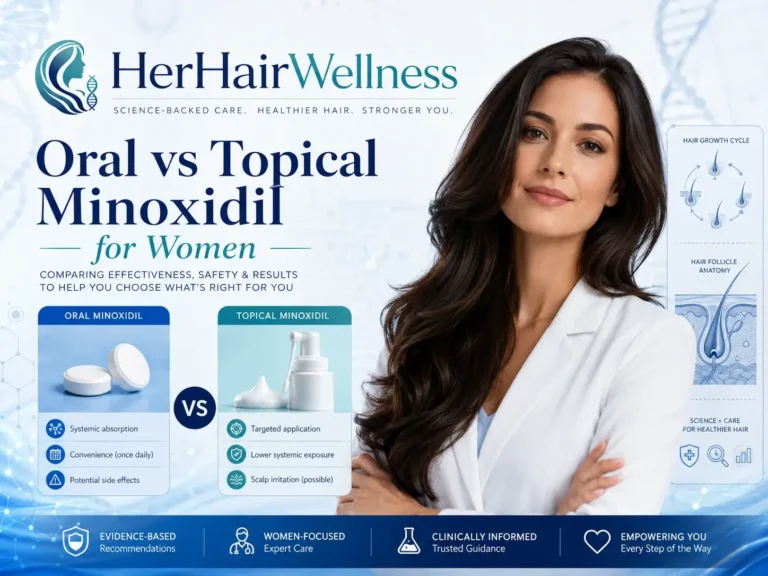
- Topical minoxidil may be preferablefor women starting treatment, those who want to avoid systemic medication, and those with low blood pressure or cardiovascular concerns.
- Low-dose oral minoxidil may be worth discussingwhen topical treatment causes persistent scalp irritation, is difficult to apply consistently, or has not produced satisfactory results after an adequate trial.
- Neither form is universally superior.The decision depends on treatment adherence, medical history, tolerance, personal preference, and individual response.
Choosing between oral and topical minoxidil is not simply a matter of picking the “stronger” treatment. Both can improve female pattern hair loss, but they differ in how they are used, how much of the body is exposed to the medicine, and what side effects they may cause. The best option is the one that offers a reasonable balance of effectiveness, safety, convenience, and long-term consistency for the individual woman.
Quick Clinical Answer
For most women, topical minoxidil remains the preferred first treatment because it is approved for female pattern hair loss, has a long history of use, and limits systemic drug exposure. Low-dose oral minoxidil may provide similar results and is often easier to use, but it is prescribed off-label and requires medical supervision. Current evidence does not prove that oral minoxidil works better for every woman.
Best Choice by Situation
- Topical minoxidil may be preferablefor women starting treatment, those who want to avoid systemic medication, and those with low blood pressure or cardiovascular concerns.
- Low-dose oral minoxidil may be worth discussingwhen topical treatment causes persistent scalp irritation, is difficult to apply consistently, or has not produced satisfactory results after an adequate trial.
- Neither form is universally superior.The decision depends on treatment adherence, medical history, tolerance, personal preference, and individual response.
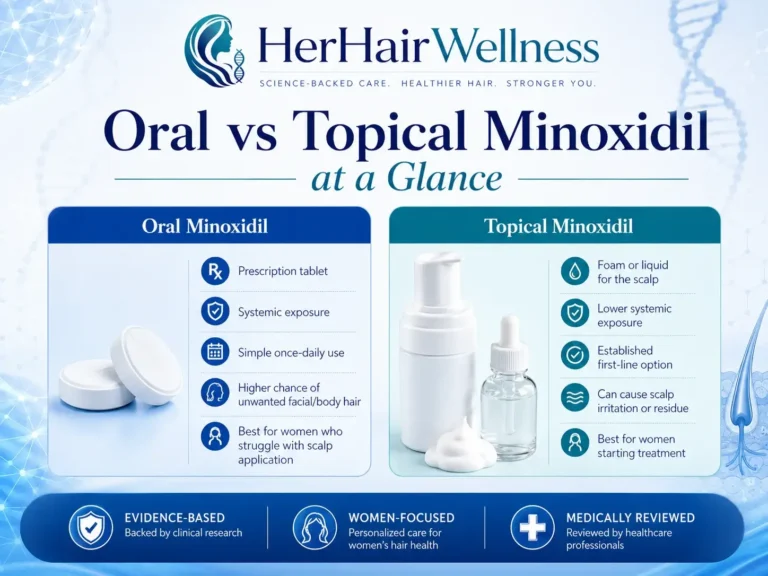
Oral vs Topical Minoxidil for Women at a Glance
Comparison factor | Low-dose oral minoxidil | Topical minoxidil |
Form | Prescription tablet | Foam or liquid applied to the scalp |
Hair-loss approval | Used off-label | Approved for female pattern hair loss |
Drug exposure | Systemic, affecting the whole body | Mainly localized to the scalp |
Convenience | Usually taken once daily | Requires regular scalp application |
Evidence base | Promising but still developing | Longer and more established |
Scalp irritation | Uncommon | Possible, especially with liquid formulations |
Unwanted facial or body hair | More common | Possible but generally less common |
Blood-pressure effects | Possible | Uncommon when correctly applied |
Medical monitoring | Often appropriate | Usually less intensive |
Best suited for | Selected women under medical supervision | Many women beginning minoxidil treatment |
What the Latest Research Actually Shows
The strongest recent comparison is a 2025 meta-analysis of four randomized clinical trials involving 279 patients with androgenetic alopecia. Follow-up periods ranged from 24 to 39 weeks.
The researchers found:
- No meaningful difference between oral and topical minoxidil in improvement in hair density.
- No meaningful difference in improvement in hair diameter.
- No statistically significant difference in reported hypotension.
- A significantly higher risk of hypertrichosis, or unwanted facial and body hair, with oral minoxidil.
The risk of hypertrichosis was approximately twice as high in the oral minoxidil groups. The authors concluded that the two routes produced similar overall effectiveness, while oral treatment carried a greater risk of unwanted hair growth. (1)
This result matters because online discussions often describe oral minoxidil as automatically stronger. That claim is not supported by the available comparative evidence.
The meta-analysis also had limitations:
- Only four randomized trials were included.
- The total number of participants was relatively small.
- Follow-up was shorter than the years many women may use minoxidil.
- The studies included androgenetic alopecia patients and were not exclusively designed around women.
- Oral doses and topical regimens varied between studies.
The evidence supports oral minoxidil as a legitimate alternative, but not as a proven upgrade for every woman.
How the Two Forms Deliver Minoxidil Differently
Both oral and topical minoxidil ultimately act on hair follicles, but the routes of administration create different patterns of exposure.
Topical minoxidil
Topical minoxidil is placed directly on thinning areas of the scalp. Only a small portion is normally absorbed into the bloodstream, so its effects are concentrated mainly around the application area.
This limited systemic exposure is its main safety advantage. Its main weakness is that results depend heavily on correct and consistent application.
Topical treatment may underperform when it is:
- Applied mainly to the hair rather than the scalp.
- Used irregularly.
- Washed off too soon.
- Applied in an inadequate amount.
- Stopped repeatedly because of residue or styling concerns.
- Discontinued because of itching, dryness, or irritation.
Low-dose oral minoxidil
Oral minoxidil is swallowed and absorbed systemically. The medicine reaches hair follicles through the bloodstream rather than relying on direct scalp application.
This makes daily treatment simpler, but it also exposes other tissues to the drug. That is why oral minoxidil can cause effects such as unwanted body hair, lightheadedness, swelling, palpitations, or changes in blood pressure.
Oral minoxidil tablets were originally developed to treat severe hypertension. Their use in hair loss involves substantially lower doses, commonly described as low-dose oral minoxidil or LDOM. However, using a smaller dose does not make medical screening irrelevant.
Is Low-Dose Oral Minoxidil More Effective Than 5% Topical Minoxidil?
Current research does not establish low-dose oral minoxidil as more effective than 5% topical minoxidil.
Some individual studies have shown a numerical trend favoring oral treatment, particularly in reducing shedding. However, the differences have generally not been strong enough to prove clear superiority.
The 2025 meta-analysis found equivalent improvements in hair density and hair diameter across oral and topical groups. (1)
Oral minoxidil may still appear more effective in real life when a woman has difficulty using topical treatment consistently. A tablet taken regularly can outperform a foam or liquid that is applied only occasionally.
That is an adherence advantage, not necessarily evidence that the oral molecule works better at the follicle.
There is also no direct dose conversion between:
- 1 mg oral minoxidil and 5% topical minoxidil.
- 625 mg oral minoxidil and 2% topical solution.
- Any tablet dose and a topical percentage.
A tablet dose is measured in milligrams, while topical strength describes the concentration of medicine in a product. Systemic exposure, follicular delivery, metabolism, and side-effect risk are different. The numbers cannot be compared directly.
What Works Faster: Oral or Topical Minoxidil?
Neither oral nor topical minoxidil should be judged after a few weeks.
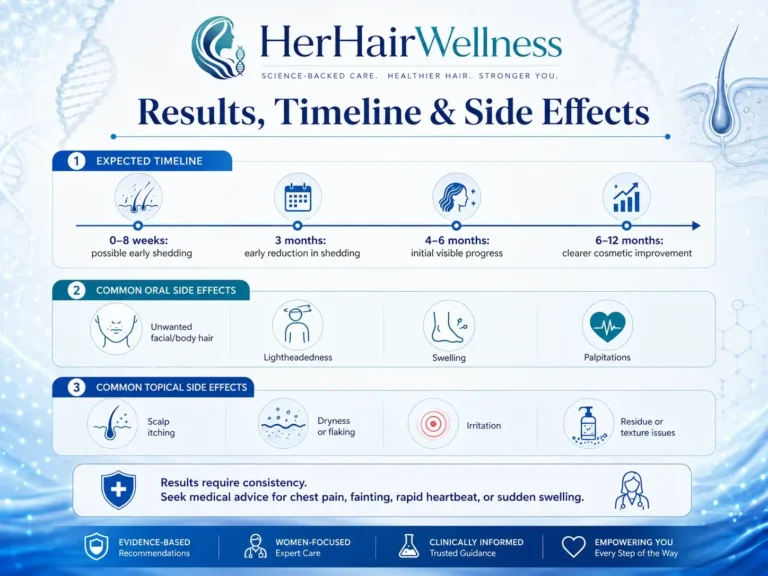
A realistic treatment timeline is:
- First several weeks:Hair shedding may temporarily increase.
- Around three months:Some responders notice less shedding or early fine growth.
- Four to six months:A more meaningful initial assessment can usually be made.
- Six to twelve months:Changes in density and scalp coverage may become easier to evaluate.
Oral minoxidil is sometimes described as faster because women may use it more consistently. The available comparative research does not prove that oral treatment reliably produces visible regrowth sooner than topical treatment.
Daily mirror checking is a poor way to judge results. Hair growth is gradual, and changes in lighting, hair styling, washing, or part width can distort perception.
A better approach is to take standardized photographs:
- Use the same room and lighting.
- Keep the same hairstyle and part.
- Use the same camera distance.
- Photograph the same scalp areas.
- Compare images every eight to twelve weeks rather than every day.
Minoxidil Pills vs Foam for Women: Which Is Easier to Use?
For convenience, oral minoxidil usually wins.
A tablet avoids:
- Wet or greasy hair.
- Product residue.
- Waiting for the scalp to dry.
- Interference with hairstyling.
- Difficulty applying medication through dense or curly hair.
- Accidental transfer to the forehead, face, pillow, or hands.
Topical foam may still be preferable for women who want to minimize whole-body exposure. Many also find foam easier to tolerate than liquid solution because some liquid products contain ingredients that can irritate sensitive skin.
The practical question is not whether pills or foam sound easier. It is whether the woman can follow the treatment consistently for months and potentially years.
A theoretically effective treatment provides little benefit when it is rarely used.
Oral Minoxidil vs Topical Minoxidil Side Effects in Women
The two forms have different adverse-effect profiles.
Possible low-dose oral minoxidil side effects
Oral treatment may cause:
- Hypertrichosis on the face or body.
- Dizziness when standing.
- Ankle, leg, or facial swelling.
- Fluid retention.
- Faster heartbeat.
- Lower blood pressure.
- Rare but potentially serious cardiovascular complications.
A large multicenter safety study reviewed 1,404 patients treated with low-dose oral minoxidil for at least three months. Hypertrichosis was the most frequently reported adverse effect, occurring in 15.1% of patients.
Reported systemic effects included:
- Lightheadedness in 1.7%.
- Fluid retention in 1.3%.
- Tachycardia in 0.9%.
- Headache in 0.4%.
- Swelling around the eyes in 0.3%.
- Insomnia in 0.2%.
Approximately 1.7% discontinued treatment because of adverse effects. However, this was a retrospective study involving different types of hair loss and both sexes. These figures should not be treated as exact risk estimates for every woman. (2)
Possible topical minoxidil side effects
Topical treatment may cause:
- Scalp itching.
- Dryness or flaking.
- Burning or tenderness.
- Irritant contact dermatitis.
- Allergic contact dermatitis.
- Temporary increased shedding.
- Changes in hair texture.
- Unwanted facial hair from transfer or absorption.
Topical minoxidil may reach the face when it runs down the forehead, is transferred by the hands, or rubs onto a pillow before drying.
To reduce accidental transfer:
- Apply it only to the scalp.
- Avoid excessive amounts.
- Wash the hands immediately afterward.
- Allow the product to dry fully.
- Avoid applying it immediately before lying down.
- Do not apply it to broken, inflamed, or severely irritated skin without medical advice.
Is Topical Minoxidil Safer Than Oral Minoxidil for Women?
Topical minoxidil generally has the simpler safety profile because it produces lower systemic exposure.
That does not mean it is completely risk-free. Excessive application, damaged scalp skin, accidental ingestion, or unusual sensitivity may increase the chance of systemic effects.
Oral minoxidil requires greater caution because the medicine circulates throughout the body. Before prescribing it, a clinician may consider:
- Baseline blood pressure.
- Resting heart rate.
- Previous fainting or recurrent dizziness.
- History of palpitations or abnormal heart rhythm.
- Heart disease.
- Kidney disease.
- Fluid retention or unexplained swelling.
- Other blood-pressure-lowering medicines.
- Pregnancy plans.
- Breastfeeding status.
A 2025 international expert consensus involving 43 hair-loss specialist dermatologists from 12 countries reached agreement on patient selection, precautions, contraindications, baseline evaluation, monitoring, dosing, and situations in which oral treatment may be considered instead of topical minoxidil.
The same consensus emphasized that long-term safety and comparative oral-versus-topical effectiveness still require stronger evidence. (3)
That is the correct way to frame oral minoxidil: increasingly used and potentially valuable, but not fully settled science.
Does Oral Minoxidil Work When Topical Minoxidil Fails?
It can, but “topical minoxidil failed” is often declared too quickly.
Topical treatment has not received an adequate trial when it was:
- Used for only a few weeks.
- Applied inconsistently.
- Frequently stopped and restarted.
- Placed on the hair rather than the scalp.
- Used in the wrong amount.
- Discontinued because of cosmetic inconvenience.
- Judged without standardized photographs.
- Used for a condition that was incorrectly assumed to be female pattern hair loss.
A genuine nonresponse means the correct product was applied properly and consistently for long enough, but meaningful improvement was still absent.
Oral minoxidil may help some topical nonresponders because:
- It avoids scalp-application problems.
- It provides consistent systemic delivery.
- It is not affected by product residue or styling difficulties.
- It may overcome some individual variation in local drug activation.
However, a woman who responds poorly to minoxidil itself may obtain limited benefit from either route. Switching is not a guarantee of regrowth.
Should Women Switch From Topical to Oral Minoxidil?
A medically supervised switch may be reasonable when topical treatment causes:
- Persistent scalp dermatitis.
- Severe itching or flaking.
- Unacceptable residue.
- Hair-texture problems.
- Repeated missed doses.
- Difficulty reaching the affected scalp.
- Inadequate improvement after a properly completed trial.
Before switching, the clinician should confirm that the problem is truly lack of efficacy rather than poor application, insufficient treatment duration, or an incorrect diagnosis.
There is no single switching schedule for every woman. A clinician may stop topical treatment, overlap the two forms temporarily, or taper one while starting the other. The plan depends on tolerance, medical history, and the reason for switching.
Buying oral minoxidil online and selecting a dose without medical supervision is reckless. The correct dose is not determined by copying someone else’s prescription, social-media routine, or before-and-after post.
Can Women Use Oral and Topical Minoxidil Together?
A dermatologist may sometimes prescribe both, but combination treatment is not automatically better.
Using oral and topical minoxidil together may be considered when:
- Response to one route is incomplete.
- A transition between formulations is underway.
- A particular scalp region remains difficult to treat.
- The potential additional benefit outweighs added burden and side effects.
The main problem is that stronger exposure does not guarantee stronger regrowth.
Combining the two may increase:
- Unwanted facial or body hair.
- Scalp irritation.
- Treatment cost.
- Daily complexity.
- Risk of inconsistent use.
- Systemic exposure.
Evidence directly proving that oral-plus-topical treatment is superior to a well-chosen single route remains limited. Combination therapy should be an individualized medical decision, not a self-directed experiment.
Who May Be a Better Candidate for Topical Minoxidil?
Topical minoxidil may be more suitable for a woman who:
- Is beginning minoxidil treatment for the first time.
- Wants an approved treatment for female pattern hair loss.
- Prefers to avoid systemic medication.
- Has naturally low blood pressure.
- Has cardiovascular concerns.
- Takes medicines that may lower blood pressure.
- Can apply treatment consistently.
- Does not have significant scalp sensitivity.
- Is particularly concerned about facial or body hypertrichosis.
Topical treatment is not “weaker” simply because it is applied externally. For many women, it offers the best balance between evidence, safety, and effectiveness.
Who May Be a Better Candidate for Low-Dose Oral Minoxidil?
A clinician may consider low-dose oral minoxidil when a woman:
- Cannot tolerate topical minoxidil.
- Develops repeated scalp irritation.
- Finds foam or liquid impractical.
- Has difficulty applying treatment through dense hair.
- Continues to miss topical applications.
- Has completed an adequate topical trial without satisfactory results.
- Understands that oral treatment is off-label.
- Accepts the possibility of unwanted facial or body hair.
- Has no major medical contraindication.
Convenience alone is not enough. A woman may prefer a tablet, but her blood pressure, cardiovascular history, kidney function, current medicines, and pregnancy plans can change the risk-benefit decision.
Pregnancy and Breastfeeding Considerations
Minoxidil is generally avoided during pregnancy.
Women who are pregnant, trying to conceive, or planning pregnancy should speak with their clinician before starting or continuing either form. Oral minoxidil is particularly unsuitable for casual use because it causes systemic exposure.
Breastfeeding decisions also require professional guidance. The absence of obvious symptoms in the mother does not prove that infant exposure is acceptable.
Do not rely on social-media reports, online forums, or product reviews for medication decisions during pregnancy or breastfeeding.
What Happens After Stopping Minoxidil?
The benefits of oral and topical minoxidil generally depend on continued treatment.
Minoxidil supports susceptible follicles while treatment is maintained. It does not permanently remove the biological tendency toward follicular miniaturization.
After treatment is stopped:
- Shedding may gradually increase.
- Regrown hair may be lost.
- Hair density may move back toward its untreated pattern.
- Changes may become noticeable over several months.
Stopping because the treatment “worked” often leads to loss of the improvement it produced.
Temporary interruptions may sometimes be medically necessary, particularly because of pregnancy, adverse effects, surgery, or changes in health. Those decisions should be discussed with the prescribing clinician.
How to Choose Between Oral and Topical Minoxidil
Use this decision framework rather than searching for a universal winner.
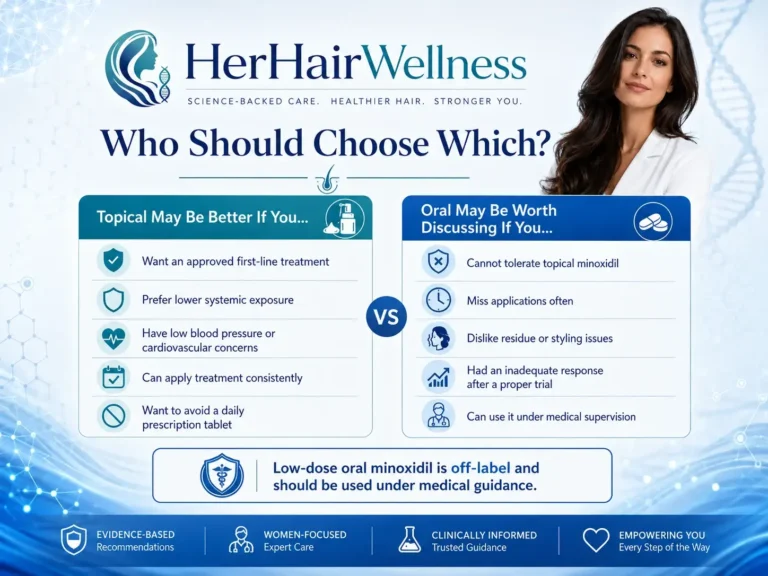
Topical minoxidil is usually the more logical choice when:
- You are trying minoxidil for the first time.
- You can apply it consistently.
- You want lower systemic exposure.
- You have low blood pressure.
- You have heart or kidney concerns.
- You want to avoid a prescription tablet.
- You are worried about widespread hypertrichosis.
Oral minoxidil may be worth discussing when:
- Topical minoxidil repeatedly irritates your scalp.
- Daily scalp application is unrealistic.
- Product residue interferes with your routine.
- You cannot apply it consistently.
- A properly completed topical trial has been inadequate.
- Your clinician considers systemic treatment appropriate.
Neither should be started casually when:
- Hair loss is sudden, patchy, painful, or associated with scalp inflammation.
- You are pregnant or planning pregnancy.
- You have unexplained swelling.
- You experience fainting or significant dizziness.
- You have a serious cardiovascular history.
- You are taking medicines that may interact with blood-pressure treatment.
The route should follow an accurate diagnosis and risk assessment—not the popularity of a product online.
Final Verdict
Oral minoxidil does not currently outperform topical minoxidil by a clear, clinically proven margin.
Recent randomized evidence indicates that the two routes produce similar improvements in hair density and hair diameter. Oral minoxidil is easier for many women to use, but it causes more unwanted facial or body hair and exposes the whole body to the medicine. (1)
For that reason:
- Topical minoxidil remains the better first option for many women.
- Low-dose oral minoxidil is a reasonable off-label alternative for carefully selected women.
- Oral treatment should not be presented as a stronger or safer replacement for everyone.
The best treatment is the one that is medically appropriate, tolerable, and realistic enough to use consistently over the long term.
Medical Disclaimer
This article is for educational purposes only and does not replace professional medical advice, diagnosis, or treatment. Oral minoxidil is an off-label prescription treatment for hair loss and should only be used under medical supervision. Consult a qualified healthcare professional before starting, stopping, combining, or changing minoxidil treatment, especially if you are pregnant, breastfeeding, have low blood pressure, heart or kidney disease, or take cardiovascular medicines.
Frequently Asked Questions(FAQs)
1. Do women need a prescription for oral minoxidil?
Yes. Oral minoxidil is a prescription medicine and is used off-label for hair loss. It should be prescribed after an appropriate medical assessment.
2. How long should a woman try minoxidil before judging the results?
Most women need at least four to six months of consistent treatment. Clearer cosmetic improvement may take six to twelve months.
3. Can minoxidil cause increased shedding at first?
Yes. Temporary early shedding can occur as follicles shift through the hair-growth cycle. Persistent or severe shedding should be medically evaluated.
4. Which form is more likely to cause facial hair?
Oral minoxidil is more likely to cause unwanted facial or body hair because it produces systemic exposure.
5. Does topical minoxidil require blood-pressure monitoring?
Routine monitoring is not usually required for healthy users, but symptoms such as dizziness, rapid heartbeat, swelling, or chest discomfort require medical attention.
6. Is oral minoxidil usually the first treatment offered to women?
Not usually. Topical minoxidil remains the more established first option, while oral minoxidil is generally considered when topical treatment is unsuitable, poorly tolerated, or ineffective.
References
- Sobral MVS, Moreira JLM, Rodrigues LK, et al. Efficacy and safety of oral minoxidil versus topical solution in androgenetic alopecia: A meta-analysis of randomized clinical trials. International Journal of Dermatology.2025;64(3):479–484. doi:10.1111/ijd.17524.
- Vañó-Galván S, Pirmez R, Hermosa-Gelbard A, et al. Safety of low-dose oral minoxidil for hair loss: A multicenter study of 1404 patients. Journal of the American Academy of Dermatology.2021;84(6):1644–1651. doi:10.1016/j.jaad.2021.02.054.
- Akiska YM, Mirmirani P, Roseborough I, et al. Low-Dose Oral Minoxidil Initiation for Patients With Hair Loss: An International Modified Delphi Consensus Statement. JAMA Dermatology.2025;161(1):87–95. doi:10.1001/jamadermatol.2024.4593.