

Hair Loss Patterns Unique to Females
Written by: Dr Muhammad Ihsan Ullah, PhD
Reviewed by: Dr. Muhammad Mudassar Hassan Bhatti, MD (Dermatology)
Last updated on February 19, 2026
A Visual Field Guide to Female Distribution Patterns

When women search for hair loss patterns unique to females, they’re not asking about treatments first. They’re trying to understand what pattern they’re seeing on their scalp. Female hair loss doesn’t usually appear as a single bald patch. Instead, it follows recognizable distribution maps across the central scalp, midline part, vertex/crown, and fronto-vertical region.
Modern dermatology describes these maps using stable entities like the Ludwig classification, Sinclair scale, Olsen pattern, and Hamilton-type expression in women. These aren’t marketing labels. They’re clinical pattern languages that help describe how thinning spreads, not why it happens (Olsen, 2025).
The Core Idea: Female Hair Loss Is About Distribution, Not Bald Spots
The most important thing to understand is this:
👉 Female pattern hair loss is defined by where density reduces, not by total hair disappearance.
Clinicians repeatedly describe female patterns as central-scalp thinning with or without frontal accentuation. In plain language, that means the change usually starts somewhere around the midline, vertex, or central scalp, and spreads in predictable shapes (Olsen, 2025).
To make this easy to follow, think of the scalp like a topographic map:
- The midline part is the central reference line
- The vertex/crown is the highest density checkpoint
- The fronto-vertical region shows directional spread
- The temples (bitemporal area) reveal outline changes
Every female pattern described in research is built from how thinning interacts with these zones.
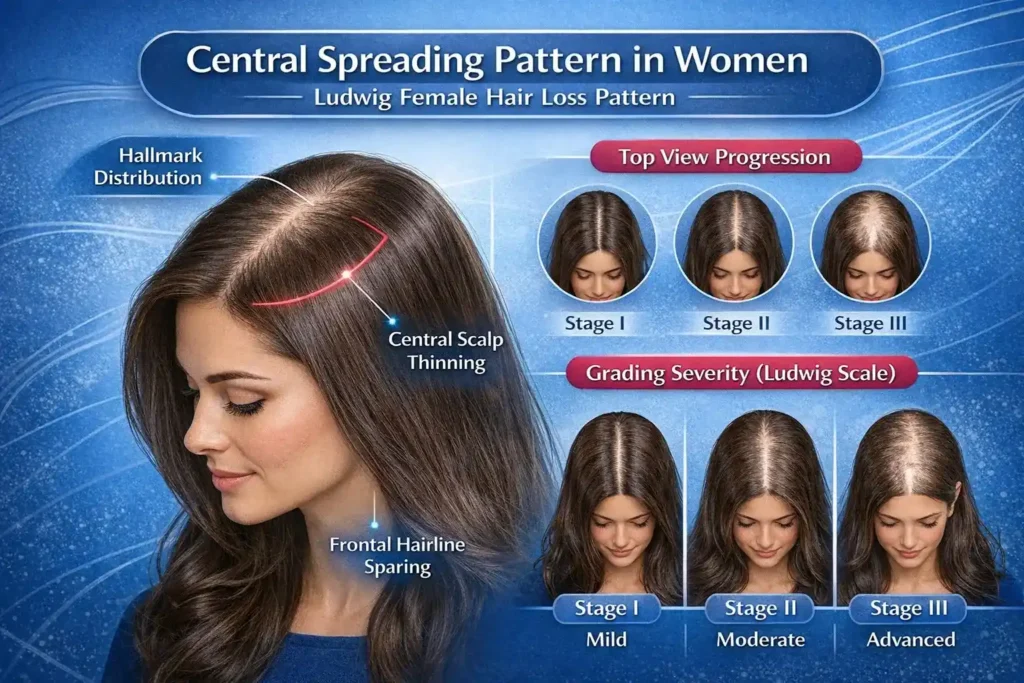
Pattern 1: Central Spreading Pattern (Ludwig-Type Distribution)
This is the most classic and widely recognized female pattern.
What it looks like
Density reduces across the central scalp especially the vertex/crown and mid-frontal scalp while the frontal hairline remains relatively preserved.
Women often describe this as:
“My crown looks thinner, but my front hairline is still there.”
That description aligns almost perfectly with the Ludwig distribution model.
Key visual cues
- Scalp show-through strongest at the vertex/crown
- Thinning spreads diffusely, not in patches
- The hairline edge remains visible
- The occipital region (back of scalp) looks fuller by comparison
How clinicians grade it
The Ludwig classification maps increasing central thinning into structured stages.
The Sinclair scale may also be used when the midline part widening becomes measurable (Long, B., et al. 2026).
Pattern 2: Central Part Widening Pattern (Sinclair-Aligned Presentation)
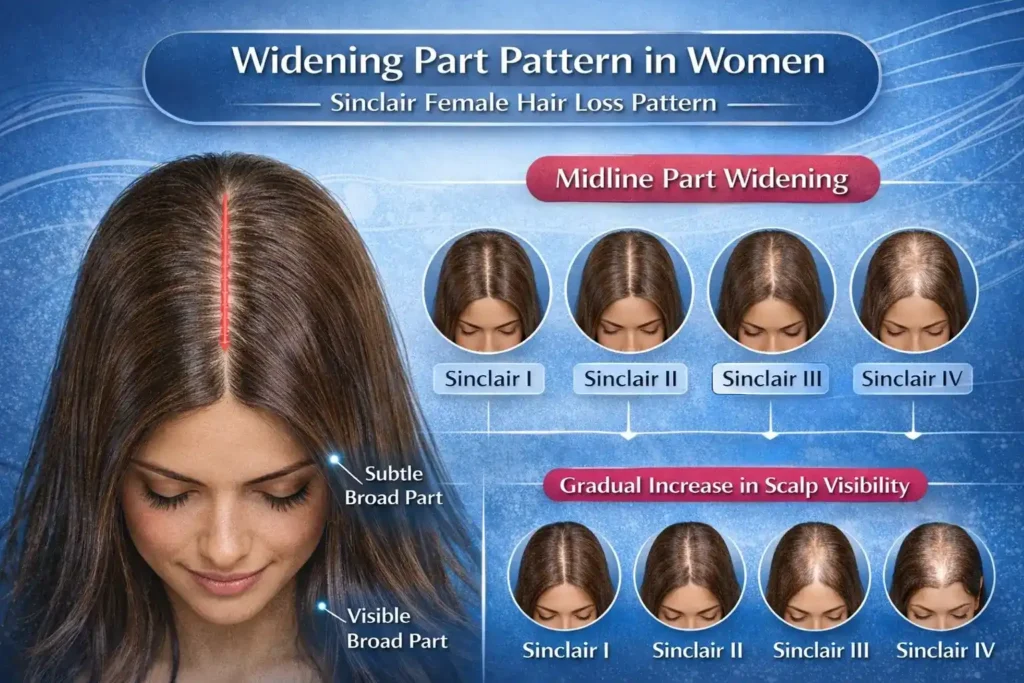
Many women don’t first notice their crown. They notice their part.
What it looks like
The central part line gradually broadens. Hair on both sides of the part appears less dense, making the scalp more visible.
It’s subtle early on. But once you notice it, you can’t unsee it.
Why this pattern is powerful
The part gives readers a mental comparison tool:
- Today vs. last year
- Crown vs. front
- Midline vs. sides
This is exactly why the Sinclair scale exists — it grades central part widening using visual benchmarks (Long, B., et al. 2026).
Pattern cues
- The part becomes visually wider
- Hair adjacent to the part loses volume
- The top scalp appears flatter and less dense
This is often the earliest form of female diffuse thinning pattern that women detect.
Pattern 3: Frontal Accentuation Pattern (Olsen “Christmas Tree” Pattern)
This is the pattern most readers describe emotionally:
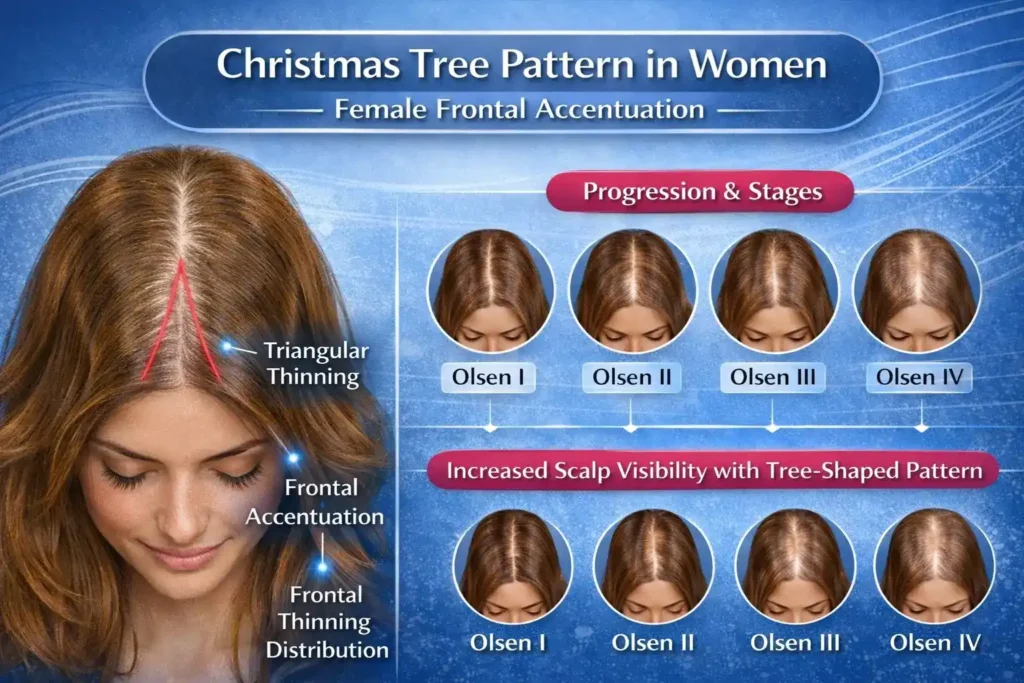
“It looks like a triangle opening toward my forehead.”
Clinically, that’s the Olsen pattern — often called the Christmas tree pattern hair loss in women.
What it looks like
The central part widens, but the widening becomes more pronounced toward the front, forming a triangular fronto-vertical accentuation.
Instead of even central thinning, the pattern is front-weighted.
Visual description
- Part widens progressively toward the frontal scalp
- Thinning looks triangular from above
- The pattern “opens” toward the hairline
- Crown may thin, but the front draws attention
Pattern 4: Vertex/Crown-Predominant Diffuse Thinning
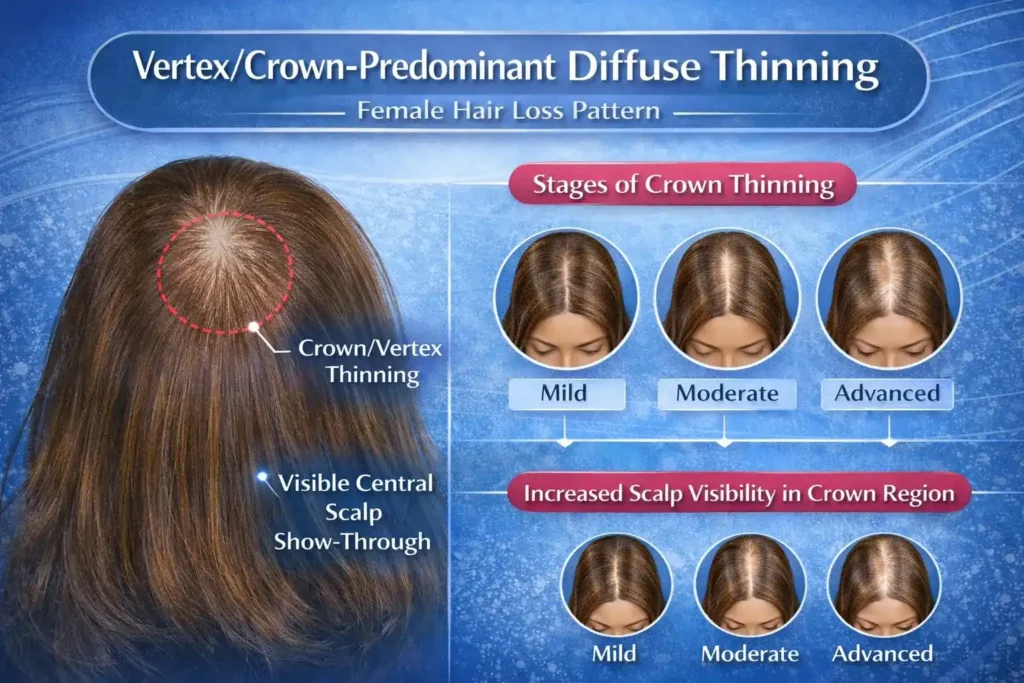
Some women don’t notice their part first. They notice the crown.
They search things like:
- female crown thinning pattern
- hair thinning at top of head female
- vertex hair loss women
What it looks like
The vertex/crown becomes the visual anchor of thinning. Even if part widening exists, the crown draws attention first.
Pattern cues
- Crown scalp visibility increases
- Hair appears flatter at the top
- Density drop is diffuse, not patchy
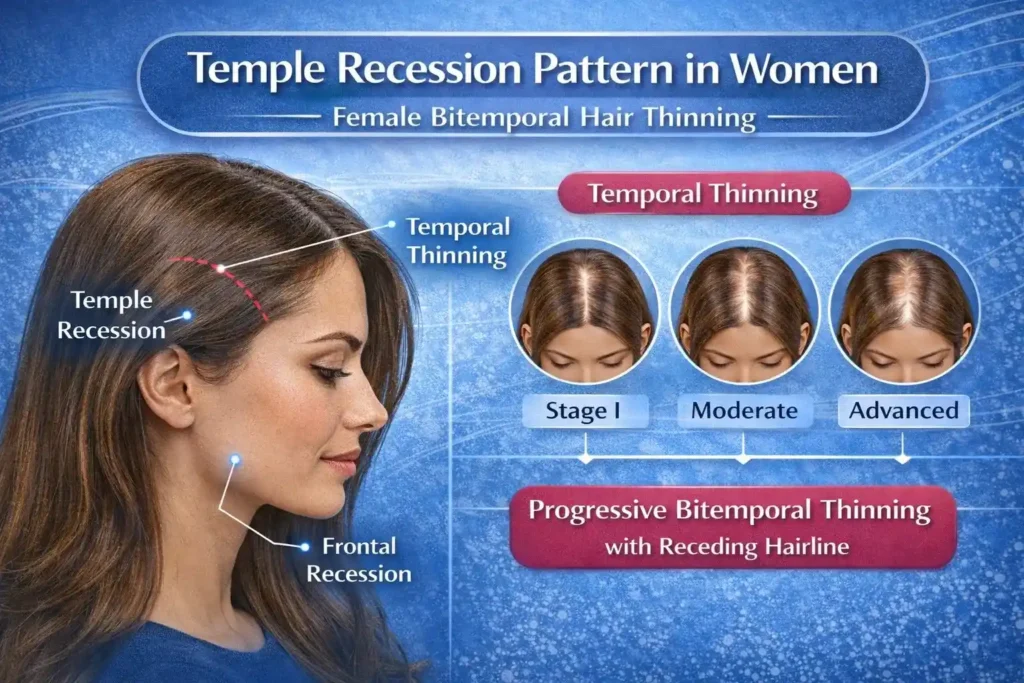
Pattern 5: Bitemporal Recession Pattern (Hamilton-Type Expression in Women)
This pattern surprises many readers because it resembles a male outline.
What it looks like
- Recession at the temples
- Hairline shape changes
- Possible vertex involvement
This is known as a Hamilton-type expression in women, a recognized but less common distribution (Vañó-Galván, S., et al. 2024).
The temples become the visual anchor rather than the crown.
Medical Disclaimer
This article explains visual hair distribution patterns only. Pattern recognition does not equal medical diagnosis. Hair thinning can occur for many reasons, and similar patterns may appear in different scalp conditions. Any rapid change, inflammation, pain, or scarring signs should be evaluated by a qualified medical professional.
Frequently Asked Questions (FAQs)
1) What is the most common hair loss pattern in females?
The most common pattern is central spreading thinning, where hair density reduces over the central scalp and crown/vertex while the front hairline stays mostly intact.
2) What does “widening part” hair loss mean in women?
It means the midline/central part line gradually becomes broader, making more scalp visible along the part—often one of the earliest noticeable female patterns.
3) What is the “Christmas tree” pattern in female hair loss?
It’s a triangular fronto-vertical thinning pattern where the part widens more toward the front, creating a shape that looks like a triangle opening toward the forehead.
4) Can female hair loss start at the temples?
Yes. Some women show bitemporal recession, where the temples recede and the hairline outline changes—this is sometimes described as a Hamilton-type pattern in women.
5) Which hair loss pattern scale is commonly used for women?
The Sinclair scale is commonly used to grade midline part widening, while Ludwig and Olsen are used to describe broader distribution patterns.
References
- Olsen, E. A. (2025). Hair loss in women. New England Journal of Medicine, 393(15), 1509–1520. https://doi.org/10.1056/NEJMcp2412146
- Long, B., et al. (2026). Trichoscopic features in female pattern hair loss. Clinical, Cosmetic and Investigational Dermatology. https://doi.org/10.2147/CCID.S585446
- Singh, S., et al. (2023). Trichoscopic findings in female pattern hair loss. International Journal of Trichology. https://doi.org/10.4103/ijt.ijt_40_22
- Kothari, C. R., & Patil, S. (2024). Trichoscopic features in FPHL. Clinical Dermatology Review. https://doi.org/10.4103/cdr.cdr_123_21
- Vañó-Galván, S., et al. (2024). Androgenetic alopecia consensus. Actas Dermo-Sifiliográficas. https://doi.org/10.1016/j.ad.2023.10.043