

Does Nizoral Shampoo Help With Female Pattern Hair Loss?
Written by: Dr.Muhammad Ihsan Ullah, PhD
Medically reviewed by: Dr. Muhammad Mudassar Hassan Bhatti, MD (Dermatology)
Last updated on September 21, 2026

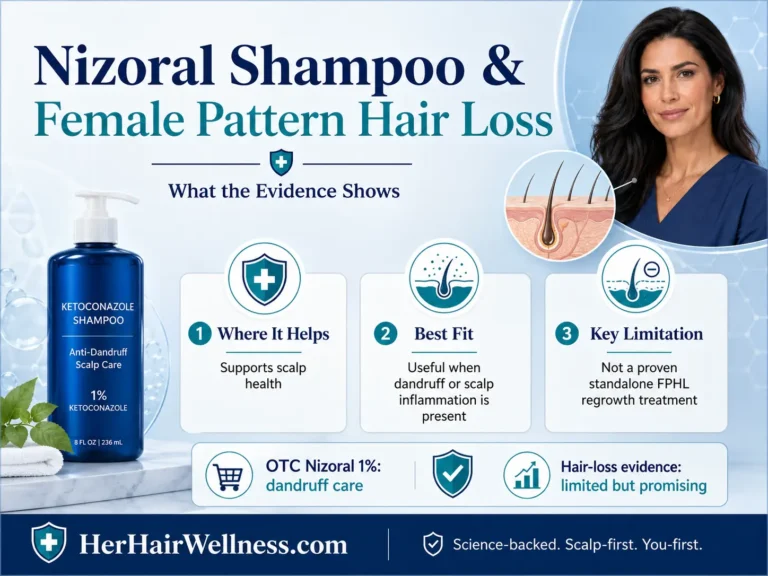
Nizoral shampoo may be useful as a supporting treatment for some women with female pattern hair loss (FPHL), but it is not a proven standalone treatment for regrowing hair. Its active ingredient, ketoconazole, is best established as an antifungal treatment for dandruff and seborrheic dermatitis. Research also suggests anti-inflammatory and possible local anti-androgenic effects that may make ketoconazole useful within a broader androgenetic alopecia treatment plan (1).
The distinction matters: improving an unhealthy, inflamed scalp may reduce additional shedding, but that is not the same as reversing the follicular miniaturization responsible for female pattern hair loss.
Does Ketoconazole Shampoo Actually Help Female Pattern Hair Loss?
There is a scientific rationale for using ketoconazole in androgenetic alopecia, but the clinical evidence is still much weaker than it is for established FPHL therapies.
A 2025 review of topical ketoconazole reported that research has linked its use with improvements in measures such as hair density, hair shaft diameter and the proportion of hairs in the anagen growth phase. The authors also highlighted its established ability to control dandruff and seborrheic dermatitis and its potential to reduce chronic scalp inflammation (1).
More recent expert guidance is cautiously supportive. A 2025 Canadian consensus on androgenetic alopecia found near-consensus among specialists for ketoconazole shampoo as part of a treatment regimen. It was not placed among the interventions receiving full consensus as primary treatments, which reflects the limitations of the current evidence (2).
The most reasonable interpretation is therefore that ketoconazole shampoo may complement FPHL treatment, but evidence is insufficient to rely on it alone.
Can Nizoral Shampoo Regrow Hair in Women?
Nizoral should not be expected to produce substantial hair regrowth by itself.
The most directly relevant female study involved 40 women with FPHL. Researchers compared 2% minoxidil with a specially prepared 2% topical ketoconazole microemulsion for six months. The ketoconazole group showed clinical and trichoscopic improvement, although improvement occurred later than in the minoxidil group (3).
This study is encouraging, but it has two major limitations:
- Only 40 women participated.
- The researchers used a 2% ketoconazole microemulsion, not ordinary OTC Nizoral shampoo.
That means the results cannot simply be interpreted as proof that washing with Nizoral will regrow thinning hair.
Is Nizoral a DHT-Blocking Shampoo for Women?
Ketoconazole has possible anti-androgenic activity, but describing Nizoral as a clinically proven DHT blocker for women would overstate the evidence.
Laboratory and pharmacologic research suggests that ketoconazole may interfere with androgen-related pathways. This has led to interest in its potential effects around androgen-sensitive hair follicles. The 2025 review also discusses anti-androgenic activity as one possible reason ketoconazole could have value in androgenetic alopecia (1).
However, the biology of female pattern hair loss is complex, and not every woman with FPHL has measurable androgen excess.
For that reason, possible anti-androgenic activity should be viewed as a proposed supporting mechanism rather than proof that Nizoral blocks enough scalp DHT to stop female pattern hair loss.
Does Nizoral Help More When Dandruff or Scalp Inflammation Is Present?
This is probably where ketoconazole has its clearest practical value.
Ketoconazole is highly effective against Malassezia-associated dandruff and seborrheic dermatitis. These conditions can produce:
- scaling,
- itching,
- irritation,
- inflammation, and
- increased hair shedding.
The 2025 review concluded that ketoconazole shampoo may help reduce shedding associated with dandruff and seborrheic dermatitis while improving the scalp environment (1).
For a woman who has both FPHL and an inflamed or flaky scalp, treating the scalp disorder may therefore remove an additional contributor to shedding.
That benefit should not be confused with treating the underlying FPHL itself. A healthier scalp can support hair management, but controlling dandruff does not automatically reverse miniaturized follicles.
Nizoral 1% vs Ketoconazole 2% for Female Pattern Hair Loss
The concentration and formulation are important when interpreting hair-loss research.
Formulation | Evidence for female pattern hair loss | Best-supported role |
Nizoral 1% shampoo | Direct FPHL evidence is very limited | Dandruff control and scalp care |
Ketoconazole 2% shampoo | Some evidence exists in androgenetic alopecia, but female-specific data remain limited | Possible adjunctive therapy |
2% topical ketoconazole microemulsion | Directly studied in a small trial of women with FPHL | Experimental evidence of potential benefit |
Ketoconazole as sole FPHL therapy | Not supported by robust evidence | Should not replace established treatment |
This distinction is easy to miss. Evidence from a 2% leave-on preparation cannot automatically be transferred to a rinse-off 1% shampoo.
Can Nizoral Be Used Alongside Minoxidil for Female Pattern Hair Loss?
In clinical practice, ketoconazole makes more sense as an adjunct than as a replacement for proven FPHL therapy.
The 2025 Canadian consensus gave topical minoxidil full consensus support for androgenetic alopecia, while ketoconazole shampoo achieved near-consensus as part of a regimen (2).
For a woman using minoxidil who also has dandruff, seborrheic dermatitis or troublesome scalp inflammation, a clinician may consider ketoconazole shampoo as part of scalp care.
The products serve different purposes. Minoxidil is used to promote hair growth, while ketoconazole is primarily useful for controlling fungal overgrowth, dandruff and associated inflammation, with possible additional effects on androgenetic alopecia.
How Often Should Nizoral Be Used for Female Pattern Hair Loss?
There is no scientifically established Nizoral shampoo schedule specifically for treating FPHL.
Frequency should therefore be based on the product directions, the scalp condition being treated and advice from a dermatologist when ketoconazole is being incorporated into a hair-loss regimen.
Using it more frequently does not mean faster hair growth. Excessive shampooing may also increase dryness or irritation in susceptible scalps.
Women using prescription-strength ketoconazole should follow the regimen provided by their healthcare professional rather than adapting schedules from online hair-loss routines.
Is Nizoral Worth Using for Female Pattern Hair Loss?
For the right woman, it can be useful—but expectations matter.
Nizoral or another ketoconazole shampoo may be worth considering when female pattern hair loss occurs alongside dandruff, seborrheic dermatitis, itching, scaling or scalp inflammation. Current research also provides a plausible basis for ketoconazole as an adjunctive treatment for androgenetic alopecia (1, 2).
What the evidence does not show is that ordinary Nizoral shampoo reliably regrows substantial amounts of hair or works as a replacement for established FPHL treatment.
The most evidence-aligned conclusion is simple: ketoconazole can support scalp health and may provide additional benefits within a comprehensive FPHL regimen, but it should not be presented as a standalone cure.
Medical Disclaimer
This article is for educational purposes only and does not replace professional medical advice, diagnosis, or treatment. Use Nizoral or other ketoconazole products according to their label or your healthcare professional’s instructions. Consult a dermatologist or other qualified clinician before using ketoconazole specifically for hair loss, particularly if you are pregnant, breastfeeding, have a scalp disorder, or develop persistent irritation.
Frequently Asked Questions(FAQs)
1. Does Nizoral shampoo regrow hair in women?
Evidence that standard Nizoral shampoo directly regrows female pattern hair loss is limited. It is better regarded as a possible supportive treatment.
2. Is ketoconazole shampoo effective for female pattern hair loss?
Research suggests potential benefit, but evidence is not strong enough to consider ketoconazole a proven standalone FPHL treatment.
3. Is Nizoral 1% the same as ketoconazole 2% for hair loss?
No. Concentration and formulation matter, and studies involving 2% ketoconazole cannot automatically be applied to OTC 1% Nizoral shampoo.
4. Can Nizoral be used with minoxidil?
They may be used within the same treatment plan when appropriate because they serve different roles. A clinician can advise on a suitable regimen.
5. Does Nizoral block DHT in women?
Ketoconazole has possible anti-androgenic effects, but Nizoral has not been proven to function as a reliable DHT-blocking treatment for women.
6. Is Nizoral enough to treat female pattern hair loss by itself?
No. Current evidence supports ketoconazole more strongly as an adjunctive treatment than as sole therapy for FPHL.
References
- Gupta AK, De Doncker P, Talukder M. Role of Topical Ketoconazole in Therapeutic Hair Care Beyond Seborrhoeic Dermatitis and Dandruff. JEADV Clinical Practice. 2025;4(4):710–718. DOI: 10.1002/jvc2.70026.
- Landells I, Chow E, Gupta AK, et al. A Canadian Consensus on Androgenetic Alopecia: Approach and Management. Journal of Cutaneous Medicine and Surgery. 2025;29(5 Suppl):5S–14S. DOI: 10.1177/12034754251368849.
- El-Garf A, Mohie M, Salah E. Trichogenic effect of topical ketoconazole versus minoxidil 2% in female pattern hair loss: a clinical and trichoscopic evaluation. Biomedical Dermatology. 2019;3:8. DOI: 10.1186/s41702-019-0046-y.