

Spironolactone and Minoxidil Together: Do Women Get Better Results? A Science-Based Guide to Combination Therapy for Female Hair Loss
Written by:
Dr. Muhammad Ihsan Ullah, PhD
(Medical Writer | Researcher)
Medically Reviewed by:
Dr. Muhammad Mudassar Hassan Bhatti, MD
(Dermatology)
Medical Reviewer, HerHairWellness.com

Female hair loss is more common than many people realize, and for many women it is a progressive condition that affects not only appearance but also confidence and emotional well-being. Among the different types of hair loss, female pattern hair loss (FPHL), also known as female androgenetic alopecia, is one of the most frequently encountered causes of gradual thinning.
Women searching for effective solutions often come across two medications repeatedly: minoxidil and spironolactone. Minoxidil has long been recognized as a treatment that supports hair follicle growth, while spironolactone has gained attention because of its anti-androgen properties and potential role in women whose hair loss is influenced by hormonal factors.
This leads to one of the most common questions asked by women experiencing hair thinning:
Can spironolactone and minoxidil together provide better results than using either treatment alone?
The answer is not simply yes or no. The effectiveness of this combination depends on the underlying cause of hair loss, hormonal sensitivity, treatment consistency, and individual response.
Current evidence suggests that combining spironolactone and minoxidil for women’s hair loss may be beneficial for selected patients, particularly women with androgen-sensitive follicles or those who experience incomplete improvement with minoxidil alone. However, treatment decisions should always be personalized and guided by a healthcare professional.
This comprehensive review explains how this combination works, what research shows, expected timelines, potential benefits, safety considerations, and which women may be most likely to benefit.
Quick Answer: Can Spironolactone and Minoxidil Work Better Together for Women’s Hair Loss?
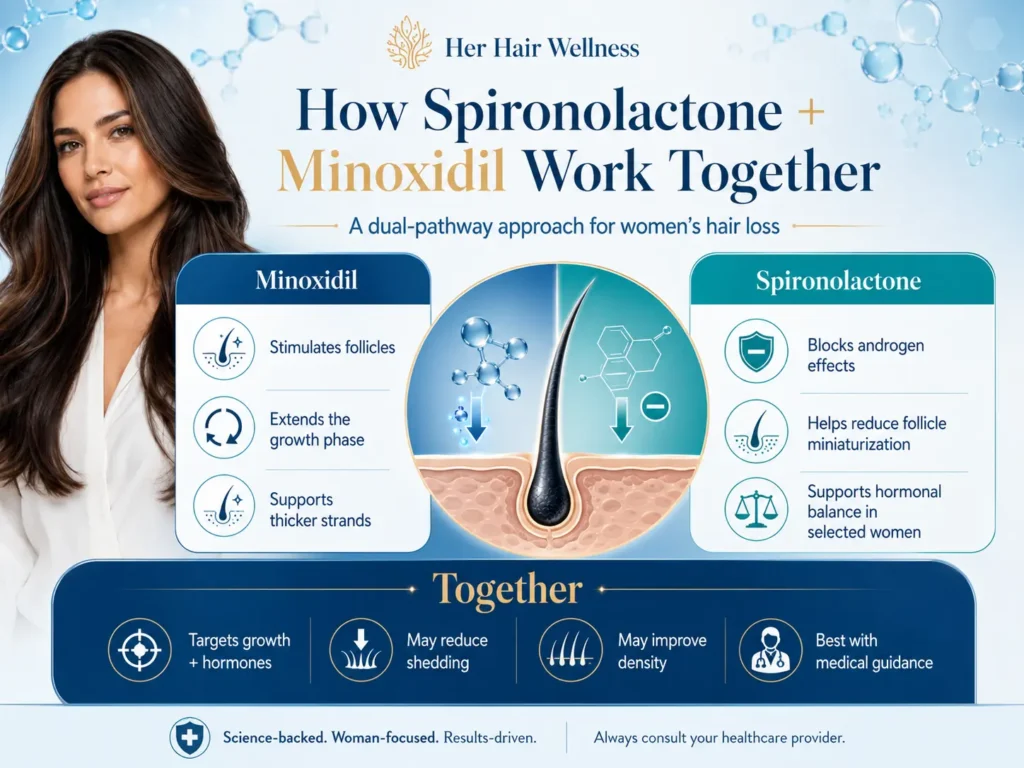
Spironolactone and minoxidil can complement each other because they target different mechanisms involved in female pattern hair loss. Minoxidil mainly stimulates hair follicle activity and supports the growth phase of the hair cycle, while spironolactone may reduce androgen-related effects that contribute to follicle miniaturization. In selected women, combination therapy may improve hair density and reduce shedding compared with using only one approach.
Treatment | How It Works | Potential Role in Female Hair Loss |
Minoxidil | Stimulates follicular activity and prolongs the growth phase | Supports new and thicker hair growth |
Spironolactone | Blocks androgen effects on susceptible follicles | Helps reduce hormone-related follicle changes |
Combination therapy | Addresses growth stimulation and hormonal pathways together | May provide broader treatment support for selected women |
Why Are Doctors Combining Spironolactone and Minoxidil for Women’s Hair Loss?
Hair follicles affected by female pattern hair loss may undergo:
Progressive miniaturization
Shortened growth cycles
Reduced production of thicker terminal hairs
Increased sensitivity to circulating androgens
Because minoxidil and spironolactone work through different mechanisms, combining them may provide a more complete approach.
Minoxidil focuses primarily on stimulating follicular growth, whereas spironolactone focuses on reducing androgen activity at the follicular level.
In simple terms:
Minoxidil encourages weakened follicles to grow.
Spironolactone may help protect androgen-sensitive follicles from further hormonal influence.
This complementary mechanism is why many dermatologists consider oral minoxidil with spironolactone for women’s hair growth as a potential option for carefully selected patients.
Can Women Use Spironolactone and Minoxidil Together for Hair Loss?
Yes, some women can use spironolactone and minoxidil together under medical supervision.
This combination is generally considered when a woman has signs suggesting that more than one pathway may be contributing to hair loss.
Examples include:
Female pattern hair loss with progressive thinning
Increased androgen sensitivity
Persistent shedding despite minoxidil use
Hair loss associated with hormonal imbalance
The medications are not interchangeable because they work differently.
Minoxidil: The Hair Growth Stimulator
Minoxidil is available in two main forms:
Topical minoxidil applied directly to the scalp
Low-dose oral minoxidil prescribed by some clinicians
Its effects may include:
Increasing blood flow around hair follicles
Stimulating follicular activity
Extending the anagen (active growth) phase
Supporting thicker hair shaft production
Minoxidil does not specifically target hormones. Instead, it helps follicles function more effectively.
Spironolactone: The Anti-Androgen Approach
Spironolactone is a medication with anti-androgen activity. Although originally used as a diuretic and blood pressure medication, dermatologists often use it in selected women because of its hormonal effects.
Spironolactone may:
Block androgen receptors
Reduce androgen stimulation of sensitive follicles
Slow hormone-related follicle miniaturization
This may be particularly relevant for women whose hair loss is associated with androgen sensitivity.
Does Spironolactone Improve Minoxidil Results?
Spironolactone does not directly increase the pharmacological effect of minoxidil. Instead, it may improve overall outcomes by addressing another contributing factor involved in hair loss.
For example:
A woman may use minoxidil and receive growth stimulation, but if her follicles remain highly sensitive to androgen effects, ongoing miniaturization may continue.
Adding spironolactone may help address that hormonal pathway.
This is why some experts describe the combination as a dual-mechanism strategy:
Minoxidil → stimulates growth activity
Spironolactone → reduces androgen-driven follicle stress
Research investigating low-dose oral minoxidil combined with spironolactone has reported encouraging improvements in women with female pattern hair loss, although larger controlled studies are still needed to define the ideal candidates and long-term outcomes. (1)
Is Spironolactone Plus Minoxidil Better Than Minoxidil Alone?
It may be better for some women, but not necessarily for everyone.
The benefit of combination therapy is most likely when androgen sensitivity plays an important role in hair thinning.
Women who may experience greater benefit include those with:
Female pattern hair loss
Signs of hormonal influence
Persistent thinning despite minoxidil use
Increased shedding associated with androgen sensitivity
However, women with other causes of hair loss, such as nutritional deficiencies, inflammatory scalp disorders, or temporary shedding conditions, may require a different treatment approach.
A correct diagnosis is therefore essential before choosing combination therapy.
How Does Spironolactone and Minoxidil Combination Therapy Work?
To understand why this combination is being studied, it helps to understand the hair growth cycle.
Each hair follicle goes through three major phases:1. Anagen Phase (Growth Phase)
During this phase, the follicle actively produces hair.
Minoxidil may help extend this phase, allowing follicles to produce hair for longer periods.
2. Catagen Phase (Transition Phase)
The follicle temporarily stops growing and prepares for renewal.
3. Telogen Phase (Resting Phase)
Old hairs are released, allowing new growth cycles to begin.
In female pattern hair loss, follicles may gradually become smaller and produce thinner hairs.
Spironolactone and minoxidil may work together by targeting two different problems:
Supporting follicular growth
Reducing androgen-related effects on vulnerable follicles
What Results Can Women Expect From Spironolactone and Minoxidil Together?
It is important to understand that hair growth treatments require patience because hair follicles operate on a slow biological cycle. Unlike medications that produce immediate effects, changes in hair density usually become noticeable over several months.
Potential improvements may include:
Reduced daily hair shedding
Improved hair thickness
Increased scalp coverage
Stabilization of progressive thinning
Better preservation of existing hair density
Individual outcomes vary depending on:
The severity and duration of hair loss
Age
Hormonal status
Genetic factors
Treatment adherence
Underlying medical conditions
Women who begin combination therapy should ideally monitor progress with standardized photographs taken every few months because gradual changes can be difficult to notice in day-to-day life.
How Long Does Spironolactone and Minoxidil Take to Work Together?
Hair follicles require time to respond because the hair growth cycle is naturally slow.
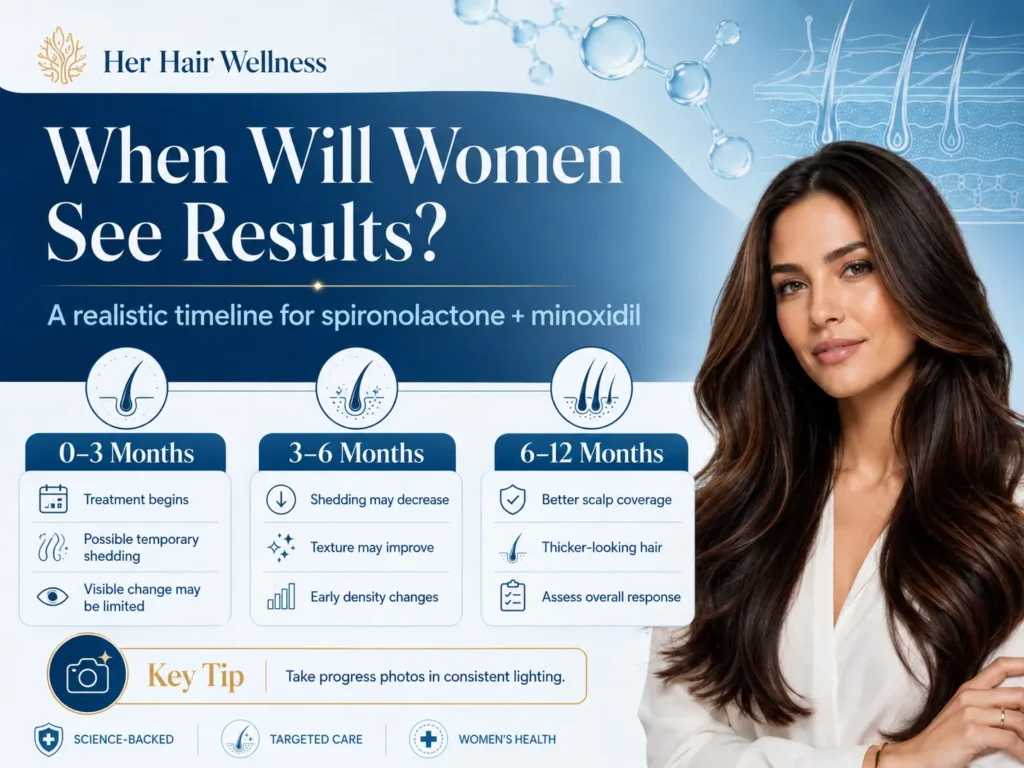
A general timeline may look like this:
First 1–3 Months
Some women may experience:
Temporary shedding
Early adjustment to treatment
Minimal visible change
Temporary shedding after starting minoxidil can occur because weaker hairs may fall out as follicles transition into a new growth cycle.
Around 3–6 Months
Possible changes include:
Reduced shedding
Early improvement in hair texture
Initial signs of increased density
Around 6–12 Months
Many patients evaluate:
Overall improvement in thickness
Hair density changes
Treatment effectiveness
Maximum results may require longer periods of consistent treatment.
Who May Benefit Most From Spironolactone and Minoxidil Combination Therapy?

Combination therapy is not suitable for every woman with hair loss. The most appropriate candidates are usually those whose pattern of hair loss matches the biological pathways targeted by these medications.Women who may benefit include:
Women With Female Pattern Hair Loss (FPHL)
Female pattern hair loss commonly presents as:
Widening of the central part
Reduced volume on the top of the scalp
Gradual thinning rather than complete bald patches
This condition often involves follicle sensitivity to androgen hormones.
Women With Androgen-Related Hair Thinning
Some women have increased sensitivity to androgen activity even when hormone levels appear normal.
In these cases, spironolactone may help reduce the impact of androgen signaling on susceptible follicles.
Women With Incomplete Response to Minoxidil Alone
Some women use minoxidil consistently but continue experiencing:
Ongoing thinning
Increased shedding
Limited improvement
For these patients, addressing additional pathways may be considered.
Women With Hyperandrogenic Features
Spironolactone may be considered in women who have signs associated with increased androgen activity, such as:
Acne
Increased facial hair growth
Irregular menstrual cycles
What Does Research Say About Spironolactone and Minoxidil Together?
Scientific interest in spironolactone and minoxidil combination therapy for women’s hair loss has increased because female pattern hair loss often involves both follicular growth problems and hormonal influences.
One clinical investigation evaluated low-dose oral minoxidil combined with spironolactone in women with female pattern hair loss and reported improvements in hair shedding scores and clinical severity after treatment. (1)
Another randomized clinical trial evaluating topical minoxidil combined with oral spironolactone in women with androgenic alopecia provided further evidence that combination approaches may have therapeutic potential. (2)
However, current research still has limitations:
Some studies involve relatively small patient groups
Treatment protocols vary
Larger randomized controlled trials are needed
Long-term comparative data remain limited
Therefore, current evidence supports combination therapy as a promising option rather than a guaranteed solution for every patient.
What Are the Side Effects of Combining Spironolactone and Minoxidil?
Because both medications affect the body differently, understanding safety is essential.
Possible Side Effects of Minoxidil
Depending on whether topical or oral minoxidil is used, possible effects may include:
Temporary increased shedding
Scalp irritation (topical form)
Unwanted facial hair growth
Fluid retention
Changes in blood pressure
Increased heart rate in some patients using oral forms
Possible Side Effects of Spironolactone
Possible effects include:
Increased urination
Breast tenderness
Menstrual irregularities
Fatigue
Dizziness
Changes in potassium levels
Women using spironolactone may require medical monitoring depending on their health status, dosage, and other medications.
Can You Take Oral Minoxidil and Spironolactone Together Long Term?
Many women ask:
“Can spironolactone and oral minoxidil be used together long term?”
For some patients, long-term combination therapy may be appropriate when monitored by a healthcare professional.
Female pattern hair loss is often a chronic condition. Like many chronic treatments, maintaining improvement may require ongoing therapy.
Long-term management may involve:
Monitoring treatment response
Reviewing possible side effects
Adjusting medication if needed
Regular evaluation of overall health
Stopping treatment may allow the underlying hair loss process to gradually resume.
Spironolactone vs Minoxidil: Which One Is Better for Women’s Hair Loss?
There is no universal “better” medication because they address different mechanisms.
Feature | Minoxidil | Spironolactone |
Main purpose | Stimulates hair growth | Reduces androgen effects |
Primary target | Hair follicle growth cycle | Hormonal influence on follicles |
Common use | Female pattern hair loss | Androgen-sensitive hair loss |
Best suited for | Women needing follicle stimulation | Women with androgen involvement |
For some women:
Minoxidil alone may be enough.
Spironolactone may provide additional benefit.
Combination therapy may offer a broader approach.
The best choice depends on diagnosis, medical history, and individual goals.
Key Factors That Influence Treatment Success
Even the most advanced treatment approach works best when combined with proper hair care and medical evaluation.
Important factors include:
Correct Diagnosis
Not all hair loss is female pattern hair loss. Other conditions may require different treatments.
Consistent Use
Hair treatments usually require months of regular use before effectiveness can be assessed.
Realistic Expectations
The goal is often:
Improving density
Reducing shedding
Preventing progression
rather than restoring all lost hair completely.
Medical Monitoring
Because these are prescription medications, professional guidance helps balance benefits and risks.
Final Takeaway: Do Women Get Better Results From Spironolactone and Minoxidil Together?
The combination of spironolactone and minoxidil for women’s hair loss represents an increasingly studied approach because it targets two important aspects of female pattern hair loss.
Minoxidil supports follicular growth and helps maintain the active growth phase, while spironolactone may reduce androgen-related effects that contribute to follicle miniaturization.
Current evidence suggests that selected women, particularly those with androgen-sensitive hair loss or limited response to minoxidil alone, may benefit from combination therapy.
However, there is no single treatment that works for every woman. The most effective approach begins with understanding the underlying cause of hair loss and creating a personalized plan with appropriate medical supervision.
Medical Disclaimer
This article is intended for educational purposes only and does not replace professional medical advice, diagnosis, or treatment. Spironolactone and minoxidil are prescription medications that should be used under the guidance of a qualified healthcare professional. Individual results may vary depending on medical history, underlying causes of hair loss, and personal health factors.
Frequently Asked Questions
Can women use spironolactone and minoxidil together for hair loss?
Yes. Some women use spironolactone and minoxidil together under medical supervision because they work through different mechanisms involved in female pattern hair loss.
Does spironolactone improve minoxidil results?
Spironolactone may improve outcomes in women whose hair loss involves androgen sensitivity by addressing hormonal factors that minoxidil does not directly target.
How long does spironolactone and minoxidil take to work together?
Most women need several months before noticeable improvement occurs. A realistic assessment usually requires 6–12 months of consistent treatment.
Is spironolactone plus minoxidil better than minoxidil alone?
Combination therapy may provide additional benefits for some women, especially those with androgen-related hair thinning, but results vary between individuals.
What are the side effects of combining spironolactone and minoxidil?
Possible side effects include temporary shedding, unwanted facial hair growth, dizziness, menstrual changes, breast tenderness, and blood pressure-related effects.
Who may benefit most from spironolactone and minoxidil combination therapy?
Women with female pattern hair loss, androgen sensitivity, or inadequate response to minoxidil alone may be considered potential candidates after medical evaluation.
References
1. Sinclair RD.
Female pattern hair loss: A pilot study investigating combination therapy with low-dose oral minoxidil and spironolactone. International Journal of Dermatology. 2018;57(1):104–109.
doi: 10.1111/ijd.13838
2. Bazargan AS, Tavana Z, Dehghani A, et al.
The efficacy of combination therapy with topical minoxidil and oral spironolactone in women with androgenic alopecia: A blinded randomized clinical trial. Journal of Cosmetic Dermatology. 2024;23(2):543–551.
doi: 10.1111/jocd.15979
3. Gupta AK, Wang T, Bamimore MA, Talukder M.
Relative efficacy of therapies for female pattern hair loss: A systematic review and network meta-analysis. Journal of Cosmetic Dermatology. 2024;23:154–160.
doi: 10.1111/jocd.15910