

Rosemary Oil vs Minoxidil: Which One Actually Regrows Hair?
Written by:
Dr. Muhammad Ihsan Ullah, PhD (Pharmacology)
Medical Writer | Researcher
Medically Reviewed by
Dr. Muhammad Mudassar Hassan Bhatti, MD (Dermatology)
Medical Reviewer
Last Updated: 18 July, 2026
Evidence-Based Comparison of Natural Hair Oil and Clinically Studied Hair Growth Treatment
Hair thinning and progressive hair loss can be frustrating experiences, especially when searching for a solution that is both effective and safe. In recent years, rosemary oil for hair growth has gained enormous popularity as a natural option, while minoxidil has remained one of the most widely recommended treatments for pattern hair loss.
This has led to an important question:
Can rosemary oil regrow hair as effectively as minoxidil, or is minoxidil still the better-supported option?
The answer is more nuanced than many online claims suggest.
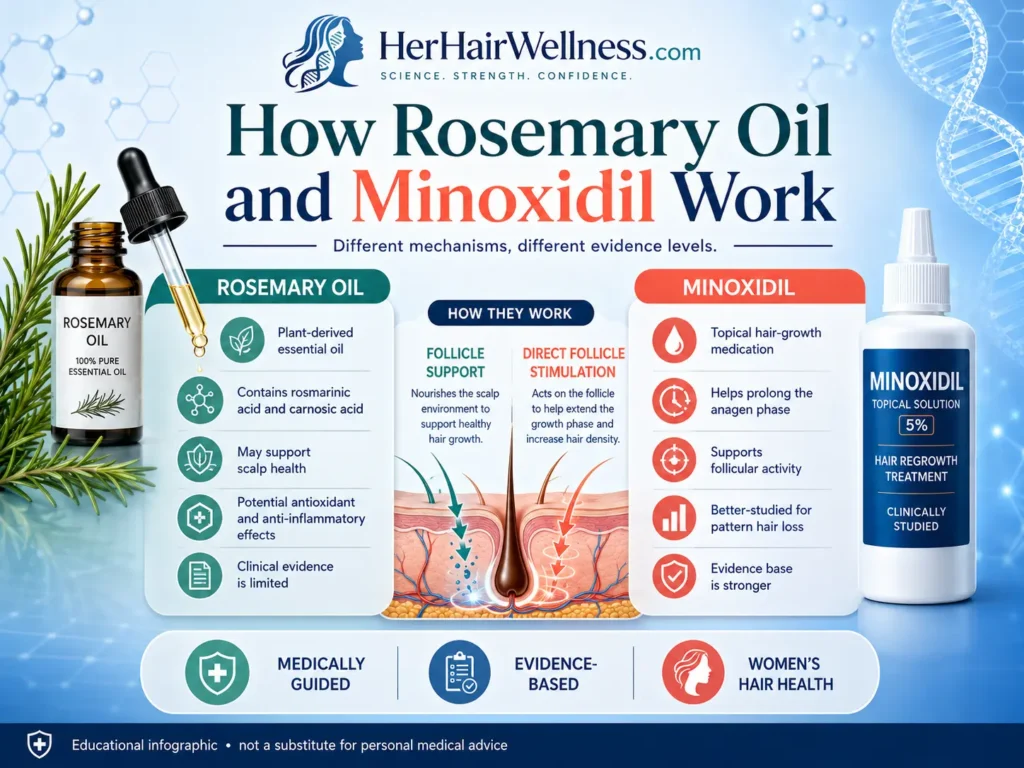
Rosemary oil contains naturally occurring compounds such as rosmarinic acid and carnosic acid, which may have antioxidant and anti-inflammatory properties that could support scalp health. Minoxidil, on the other hand, is a clinically studied medication that directly influences hair follicle activity and has decades of research supporting its use in conditions such as female pattern hair loss (FPHL) and androgenetic alopecia.
While both options may have a role, they are not equivalent. Understanding the differences in mechanism, evidence, safety, and expected results can help women make informed decisions about their hair health.
This comprehensive guide compares rosemary oil vs minoxidil for women’s hair loss, explains what scientific studies actually show, and discusses which option may be more appropriate depending on individual needs.
Quick Answer: Rosemary Oil vs Minoxidil
Minoxidil currently has stronger scientific evidence for hair regrowth and remains one of the most studied treatments for pattern hair loss. Rosemary oil may support scalp health and shows promising early evidence, but clinical research is still limited compared with minoxidil. Rosemary oil should not be considered a proven replacement for minoxidil.
Key Differences Between Rosemary Oil and Minoxidil
Feature | Rosemary Oil | Minoxidil |
Type | Natural essential oil | FDA-approved topical medication |
Main compounds | Rosmarinic acid, carnosic acid, antioxidants | Minoxidil active pharmaceutical ingredient |
Primary action | May support scalp environment and follicle function | Stimulates follicular activity and prolongs growth phase |
Evidence strength | Limited clinical research | Extensive clinical evidence |
Best studied for | Androgen-related hair thinning (limited studies) | Female and male pattern hair loss |
Expected results | Variable | Better established response timeline |
Medical classification | Cosmetic/natural product | Evidence-based hair-loss treatment |
What Is Rosemary Oil and How Does It Affect Hair Growth?
Rosemary oil is an essential oil extracted from the leaves of Rosmarinus officinalis (rosemary plant).
It has traditionally been used in cosmetic and wellness products because of its aromatic and antioxidant properties. More recently, researchers have explored whether rosemary oil may influence biological processes involved in hair growth.
Potential mechanisms being studied include:
Supporting scalp circulation
Healthy hair follicles require adequate oxygen and nutrient delivery. Some researchers suggest rosemary oil may influence scalp microcirculation, although the exact clinical impact remains uncertain.
Antioxidant activity
Rosemary contains bioactive compounds including:
- Rosmarinic acid
- Carnosic acid
- Phenolic compounds
These compounds may help reduce oxidative stress, which is one factor involved in follicle aging and scalp inflammation.
Anti-inflammatory effects
Chronic scalp inflammation may negatively influence follicle health. Rosemary-derived compounds have demonstrated anti-inflammatory properties in laboratory research.
However, it is important to understand that biological activity does not always translate into proven clinical hair regrowth.
A compound showing potential in laboratory studies does not automatically mean it performs the same way as an established medical treatment.
What Is Minoxidil and How Does It Work?
Minoxidil is a topical medication that has been extensively studied for hair growth.
Originally developed as a medication for high blood pressure, researchers discovered that one of its effects was increased hair growth. It was later developed as a topical treatment for hair loss.
Minoxidil is believed to work through several mechanisms:
Extending the anagen phase
Hair grows through different phases:
- Anagen phase: active growth phase
- Catagen phase: transition phase
- Telogen phase: resting/shedding phase
Minoxidil helps prolong the active growth phase, allowing follicles to produce hair for a longer period.
Supporting follicle activity
Minoxidil may stimulate smaller, weakened follicles and encourage the production of thicker hair strands.
Improving follicular environment
Research suggests minoxidil may influence:
- Potassium channels
- Local blood flow
- Growth factors involved in follicle activity
Unlike rosemary oil, minoxidil has been evaluated in numerous clinical trials involving people with pattern hair loss.
Is Rosemary Oil as Effective as Minoxidil for Hair Growth?
This is the central question behind the rosemary oil versus minoxidil debate.
The short answer:
Current evidence suggests rosemary oil may have potential benefits, but minoxidil has stronger and more extensive clinical evidence for hair regrowth.
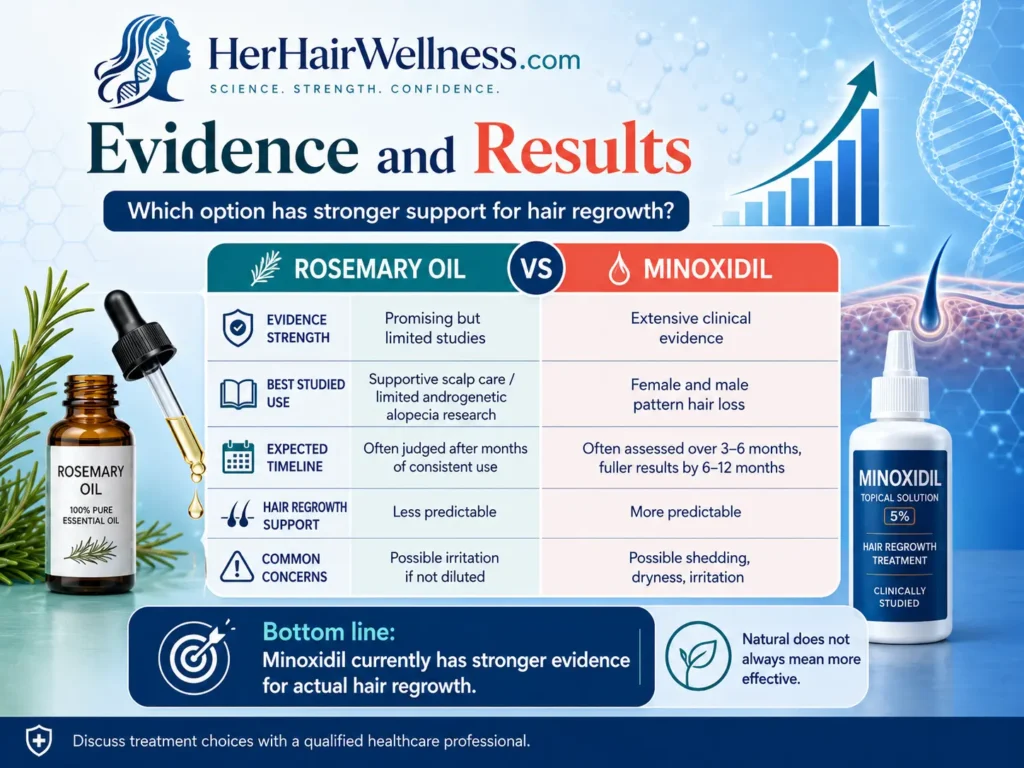
The most frequently discussed study comparing rosemary oil with minoxidil was a randomized clinical trial that evaluated rosemary oil against 2% minoxidil in individuals with androgenetic alopecia. After six months, both groups showed increased hair count, suggesting rosemary oil may have potential benefits (1).
However, the study had important limitations:
- Small sample size
- Limited treatment duration
- Not specifically focused on women
- Compared with 2% minoxidil rather than commonly used 5% formulations
Therefore, the results should be interpreted carefully.
The study does not prove that rosemary oil works the same as minoxidil.
Instead, it suggests rosemary oil may deserve further investigation as a supportive hair-care approach.
Rosemary Oil vs Minoxidil: What Does the Research Actually Show?
When comparing treatments, the quality of evidence matters.
Minoxidil evidence
Minoxidil has:
- Decades of clinical research
- Multiple controlled studies
- Regulatory approval for certain hair-loss indications
- Established safety information
It remains one of the most researched treatments for:
- Female pattern hair loss
- Male pattern hair loss
Rosemary oil evidence
Rosemary oil has:
- A smaller number of human studies
- Promising biological mechanisms
- Limited clinical trials
- Less information about long-term effectiveness
The difference is not necessarily that rosemary oil has no value.
The difference is that the amount and quality of available evidence are not equal.
Rosemary Oil vs Minoxidil for Women: Which Is Better?
Women often have different causes and patterns of hair loss compared with men.
Female pattern hair loss (FPHL) commonly presents as:
- Gradual widening of the part line
- Reduced density at the crown
- Overall thinning rather than complete bald patches
For women with confirmed female pattern hair loss:
Minoxidil advantages
- Stronger evidence base
- Specifically studied in women
- Established treatment protocols
Rosemary oil advantages
- Natural ingredient
- May appeal to individuals seeking non-drug options
- Contains antioxidant and anti-inflammatory compounds
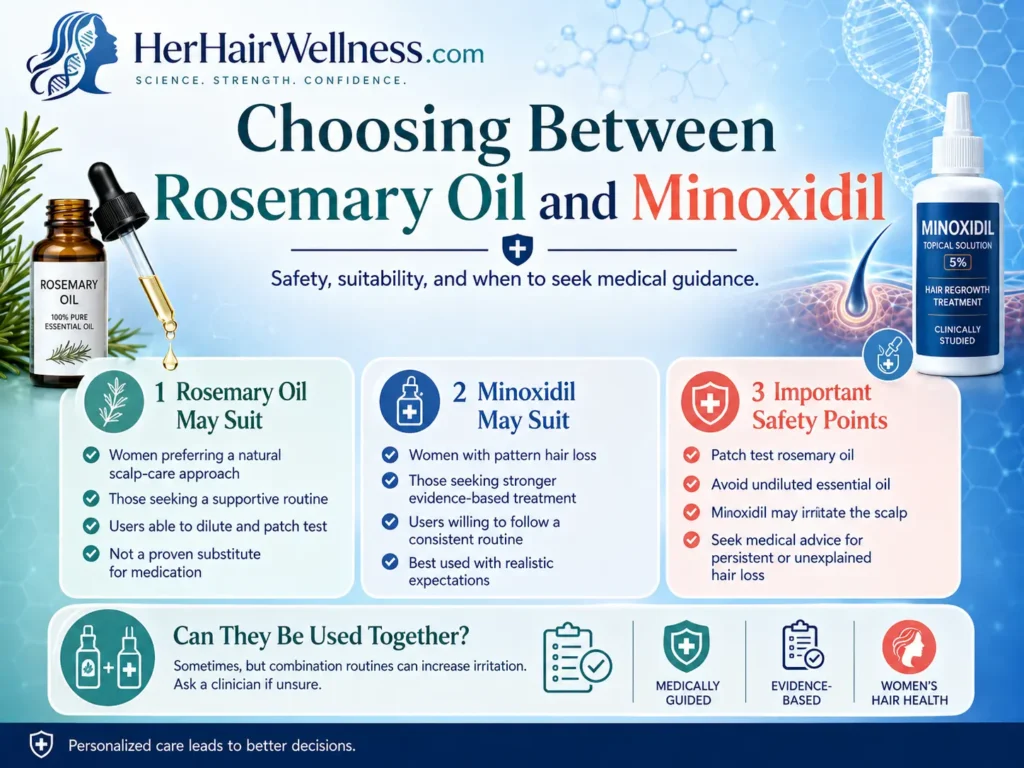
However, choosing between rosemary oil and minoxidil depends on:
- Severity of hair loss
- Cause of thinning
- Treatment expectations
- Individual tolerance
- Medical history
A natural product is not automatically more effective, and a medication is not automatically unsafe. The right choice depends on evidence, safety, and personal circumstances.
Can Rosemary Oil Replace Minoxidil?
The popularity of rosemary oil has led many people to ask whether it can completely replace minoxidil.
The answer depends on what a person expects from treatment.
For someone with mild scalp dryness or who wants to support general scalp care, rosemary oil may be a reasonable cosmetic option. However, for someone experiencing progressive female pattern hair loss or androgenetic alopecia, current evidence does not show that rosemary oil provides the same level of predictable hair regrowth as minoxidil.
Minoxidil has a much stronger clinical foundation because it has been studied extensively in people with pattern hair loss.
Rosemary oil may be considered:
- A complementary scalp-care approach
- An option for individuals who prefer plant-based products
- A supportive treatment alongside evidence-based care
However, replacing minoxidil with rosemary oil should be an informed decision based on:
- The severity of hair loss
- The underlying cause
- Treatment goals
- Medical advice when appropriate
A major difference is that minoxidil is designed specifically to influence hair follicle growth, while rosemary oil’s effects are still being investigated.
Rosemary Oil and Minoxidil Together: Can They Be Used at the Same Time?
Some people consider combining rosemary oil with minoxidil to potentially gain benefits from both approaches.
The idea behind combination use is:
- Minoxidil provides a clinically studied hair-growth effect.
- Rosemary oil may provide scalp-supporting properties.
However, combining products requires caution.
Potential concerns include:
- Increased scalp irritation
- Contact dermatitis
- Difficulty identifying which product causes a reaction
- Reduced consistency if the routine becomes complicated
If someone wants to use both, practical considerations include:
- Avoid applying undiluted essential oils directly to the scalp.
- Perform a patch test before regular use.
- Discuss combination treatment with a dermatologist, especially for sensitive skin or existing scalp conditions.
A simpler, consistent routine is often more effective than using multiple products irregularly.
Rosemary Oil vs Minoxidil: Which One Has Faster Results?
Hair growth is naturally slow because follicles operate through long biological cycles.
Neither rosemary oil nor minoxidil produces overnight results.
Expected minoxidil timeline
Many users evaluate minoxidil after:
3–4 months
- Early reduction in shedding may occur.
- Some users experience temporary increased shedding as follicles transition.
6 months
- Improvements in density may become more noticeable.
12 months
- Maximum response is often easier to assess.
Expected rosemary oil timeline
Because rosemary oil has fewer clinical studies, the timeline is less clearly established.
The commonly referenced clinical study evaluated outcomes after approximately six months of use.
However, individual results can vary depending on:
- Hair-loss pattern
- Genetics
- Consistency of application
- Overall scalp health
Does Rosemary Oil Cause Less Shedding Than Minoxidil?
Temporary shedding is one of the concerns people have when starting hair-growth treatments.
Minoxidil shedding
Some people experience increased shedding during the early weeks of minoxidil use.
This may occur because:
- Older hairs enter the shedding phase.
- Follicles transition into a new growth cycle.
Early shedding does not necessarily mean treatment failure.
Rosemary oil shedding
There is less clinical information available regarding rosemary oil-related shedding.
Because rosemary oil does not work through the same mechanism as minoxidil, users may experience a different response pattern.
However, any sudden increase in hair shedding should be evaluated, especially if it is significant or persistent.
Is Rosemary Oil Safer Than Minoxidil?
Safety depends on the individual and how the product is used.
A common misconception is:
“Natural means completely risk-free.”
This is not always true.
Rosemary oil possible concerns
Although generally well tolerated when properly diluted, rosemary oil may cause:
- Scalp irritation
- Burning sensation
- Redness
- Allergic contact dermatitis
Essential oils are concentrated substances and should not usually be applied directly without appropriate dilution.
Minoxidil possible concerns
Commonly reported effects include:
- Scalp dryness
- Itching
- Irritation
- Temporary shedding
- Unwanted facial hair growth in some women
Rarely, systemic effects may occur, particularly if excessive amounts are used or if there is increased absorption.
The safest option depends on:
- Skin sensitivity
- Medical history
- Hair-loss diagnosis
- Proper product use
Rosemary Oil vs Minoxidil for Female Pattern Hair Loss: What Should Women Consider?
Women experiencing hair thinning often want an option that is effective but also fits their lifestyle and preferences.
Before choosing rosemary oil or minoxidil, important factors include:
Identify the cause of hair loss
Female hair loss may result from:
- Female pattern hair loss
- Hormonal changes
- Nutritional deficiencies
- Thyroid problems
- Stress-related shedding
A treatment targeting the wrong cause may not provide meaningful improvement.
Consider evidence strength
For women with confirmed female pattern hair loss:
Minoxidil currently has the stronger evidence base.
Rosemary oil may be considered when:
- Someone prefers a natural approach
- Hair loss is mild
- It is used as supportive scalp care
Consider long-term commitment
Both approaches require consistency.
Hair treatments generally need:
- Regular application
- Several months of use
- Realistic expectations
Stopping effective treatment may allow the original hair-loss process to continue.
Rosemary Oil vs Minoxidil: Mechanism Comparison
Mechanism | Rosemary Oil | Minoxidil |
Main action | Supports scalp environment through bioactive compounds | Directly stimulates follicular growth activity |
Key compounds | Rosmarinic acid, carnosic acid | Minoxidil |
Effect on follicles | Potential supportive effects | Promotes growth-phase activity |
Evidence level | Early and limited | Extensive clinical evidence |
Best studied use | Supportive hair care and limited androgenetic alopecia studies | Pattern hair loss treatment |
Can Rosemary Oil Help With DHT-Related Hair Loss?
DHT (dihydrotestosterone) plays an important role in androgen-related hair follicle miniaturization.
Some online discussions suggest rosemary oil may block DHT similarly to medications such as finasteride. However, this claim is not supported by strong clinical evidence in humans.
Laboratory findings and biological mechanisms should not be confused with proven treatment effects.
For women with female androgenetic alopecia, treatment decisions should consider evidence-based options such as:
- Minoxidil
- Medical evaluation
- Hormonal management when appropriate
Rosemary oil may support scalp wellness, but it should not be presented as a proven DHT-blocking replacement therapy.
Which One Actually Regrows Hair: Rosemary Oil or Minoxidil?
The most balanced scientific conclusion is:
Minoxidil currently has the stronger evidence for actual hair regrowth. Rosemary oil is promising but requires more research before it can be considered equivalent.
A practical comparison:
Question | Better Supported Option |
Strongest clinical evidence | Minoxidil |
Natural ingredient preference | Rosemary oil |
Female pattern hair loss | Minoxidil has stronger evidence |
Scalp wellness support | Rosemary oil may help |
Predictable regrowth results | Minoxidil |
Long-term research data | Minoxidil |
The choice should be based on individual goals, not simply whether a treatment is “natural” or “medical.”
Final Medical Perspective
Rosemary oil and minoxidil are often compared as if they are identical alternatives, but they represent very different approaches.
Minoxidil is a clinically studied medication with a well-established role in supporting hair growth. Rosemary oil is a promising natural compound with interesting biological properties but a much smaller evidence base.
For women with progressive hair thinning, especially female pattern hair loss, the most important step is understanding the cause of hair loss before choosing treatment.
A personalized approach that considers:
- Diagnosis
- Evidence
- Safety
- Lifestyle preferences
- Long-term expectations
offers the best chance of achieving meaningful results.
Medical Disclaimer
This article is intended for educational purposes only and does not replace personalized medical advice, diagnosis, or treatment from a qualified healthcare professional. Rosemary oil and minoxidil may not be suitable for everyone, and individual results can vary depending on the cause of hair loss, scalp condition, and overall health. Always consult a dermatologist or healthcare provider before starting, stopping, or combining hair-loss treatments.
Frequently Asked Questions
Is rosemary oil as effective as minoxidil for hair growth?
Current evidence suggests that minoxidil has stronger scientific support for hair regrowth. Rosemary oil may have potential benefits for scalp health and hair growth, but more clinical research is needed.
Which is better for hair regrowth: rosemary oil or minoxidil?
Minoxidil currently has more reliable evidence for improving hair density in pattern hair loss. Rosemary oil may be a supportive option for people who prefer natural scalp-care approaches.
Can rosemary oil replace minoxidil?
Rosemary oil should not be considered a direct replacement for minoxidil. The best choice depends on the cause of hair loss, treatment goals, and individual circumstances.
How long does rosemary oil take to work compared with minoxidil?
Both treatments require consistent use over several months. Minoxidil has a more established timeline, while rosemary oil results are less predictable because fewer clinical studies are available.
Can rosemary oil and minoxidil be used together?
Some people combine rosemary oil with minoxidil, but doing so may increase the risk of scalp irritation. It is best to discuss combination use with a healthcare professional.
Is rosemary oil safer than minoxidil?
Both can cause side effects. Rosemary oil may cause irritation or allergic reactions, while minoxidil may cause scalp irritation, temporary shedding, or unwanted facial hair growth in some users.
References
Panahi Y, Taghizadeh M, Marzony ET, Sahebkar A.
Rosemary oil vs minoxidil 2% for the treatment of androgenetic alopecia: a randomized comparative trial. Skinmed. 2015;13(1):15–21.
DOI: Not assigned (PubMed-indexed clinical trial)
Suchonwanit P, Thammarucha S, Leerunyakul K.
Minoxidil and its use in hair disorders: a review. Drug Design, Development and Therapy. 2019;13:2777–2786.
DOI: 10.2147/DDDT.S214907
Varothai S, Bergfeld WF.
Androgenetic alopecia: an evidence-based treatment update. American Journal of Clinical Dermatology. 2014;15:217–230.
DOI: 10.1007/s40257-014-0078-5