

Minoxidil Shedding: How Long Does the Dread Shed Last?
Written by: Dr. Muhammad Ihsan Ullah, PhD
Medical Writer and Pharmacology Researcher
Medically reviewed by: Dr. Muhammad Mudassar Hassan Bhatti, MD
Dermatologist and Medical Reviewer
Last medically reviewed: July 13, 2026

Starting minoxidil and then finding more hair in the shower can be frightening. This temporary increase in hair fall—often called the minoxidil dread shed—usually begins during the first few weeks of treatment. Current evidence suggests that shedding commonly peaks around week four, starts easing during weeks six to eight, and moves back toward its usual level by about week 12.
Minoxidil Dread Shed at a Glance
Minoxidil shedding commonly starts within two to four weeks, peaks at approximately week four, and lasts about two to six weeks. For many users, hair fall begins slowing by weeks six to eight and returns close to baseline by week 12.
Not everyone experiences a noticeable shed. No shedding does not mean minoxidil is failing, while severe or prolonged shedding does not automatically mean the treatment is working.
What a Typical Early-Shedding Pattern Looks Like
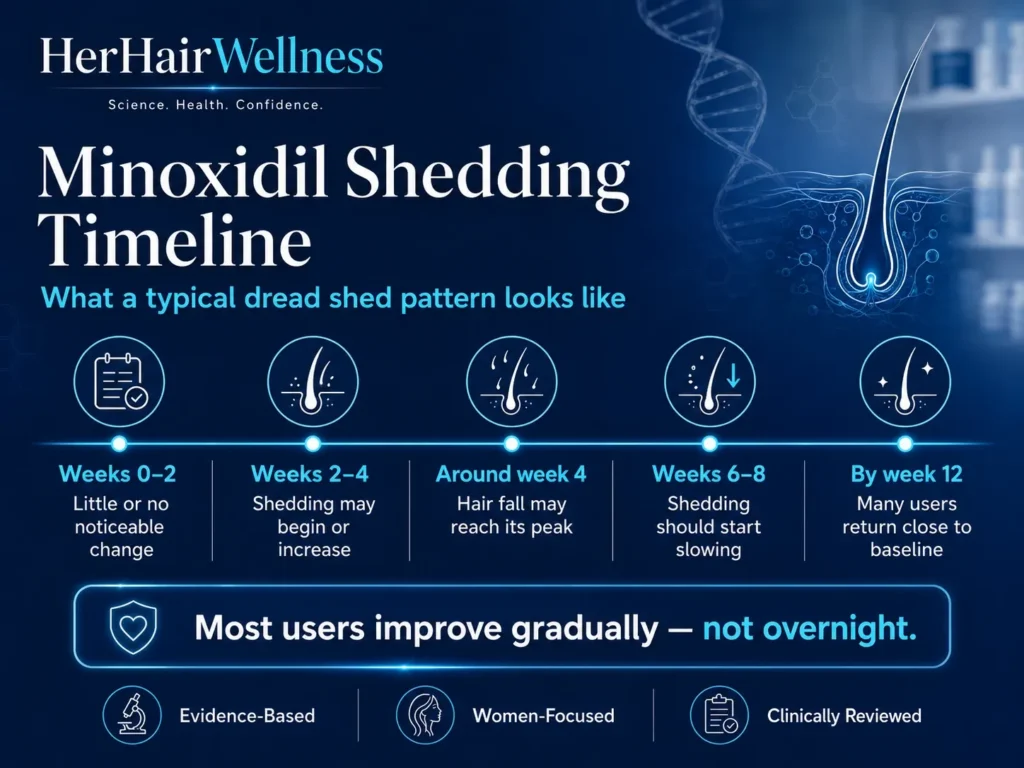
- Weeks 0–2: Little or no noticeable change
- Weeks 2–4: Shedding may begin or increase
- Around week 4: Hair fall may reach its highest level
- Weeks 4–6: Increased shedding may continue
- Weeks 6–8: Shedding should start slowing
- Weeks 8–12: Many users move back toward baseline
- Months 3–4: Early regrowth may become visible
- Months 6–12: Changes in density can be assessed more reliably
This is a general pattern rather than a strict deadline. Individual timelines vary according to the underlying hair-loss condition, treatment route, dose, adherence, and other health factors.
How Long Does Minoxidil Shedding Last?
For people who experience it, the active minoxidil shedding phase commonly lasts about two to six weeks.
The most useful recent evidence comes from a 2025 multicenter prospective cohort study involving 132 evaluable people with androgenetic alopecia, including 72 women. Participants used topical minoxidil for three months and completed repeated standardized wash tests.
Researchers found that:
- Shedding increased between weeks two and four.
- It peaked at week four.
- The average increase at the peak was 21.1 shed hairs above baseline.
- Maximum shedding increased by a median of 36.5%.
- Hair fall began declining between weeks six and eight.
- By week 12, 65.83% of participants had returned to baseline shedding or below.
- Average shedding at week 12 was lower than it had been before treatment. (1)
The researchers concluded that the temporary increase induced by topical minoxidil generally persisted for two to six weeks before recovering. However, the study involved a specific Chinese population and used 2% minoxidil for women and 5% for men, so its findings should not be treated as an exact prediction for every individual.
The most realistic answer is:
The dread shed often lasts several weeks, but the full process of rising, peaking, and returning toward baseline may extend across the first 12 weeks.
Minoxidil Shedding Timeline Week by Week
Weeks 0–2: Treatment begins
During the first two weeks, many users notice no obvious difference in daily hair fall.
Some may see an earlier increase, particularly if many follicles were already near the end of the resting phase. Others will never experience a visible dread shed at all.
This is too early to judge whether minoxidil will work.
Weeks 2–4: Shedding may become noticeable
This is the most common period for the initial minoxidil shed to begin.
You may notice:
- More strands during washing
- Increased hair on the brush
- Hair collecting on clothing or pillows
- A temporarily wider-looking part
- Greater concern on wash days
Long hair can make the volume look worse than it is. Twenty long strands create a far larger-looking bundle than twenty short hairs.
Around week 4: The dread shed may peak
The 2025 prospective study found that shedding peaked around week four. This does not mean every user will have one dramatic peak on an exact day.
Hair fall may fluctuate depending on:
- How often you wash your hair
- Whether you brushed before washing
- Your hair length and density
- Curl pattern
- Detangling habits
- Protective hairstyles
- The interval since the previous wash
Compare similar wash days rather than comparing one daily wash with another after seven days.
Weeks 4–6: Increased hair fall may continue
Shedding may remain elevated for several more weeks after the peak.
This stage is often emotionally difficult because visible regrowth has usually not appeared yet. Old hairs may be falling, while new anagen hairs remain too short to contribute to coverage.
Weeks 6–8: Hair fall should start slowing
For many users, the amount of shed hair begins decreasing during this period.
The change may be gradual. Do not expect shedding to stop overnight.
More reassuring signs include:
- Fewer hairs in the drain
- Less hair on clothing
- Reduced hair fall during brushing
- Stable rather than worsening scalp visibility
- No pain, inflammation, or bald patches
Weeks 8–12: Stabilization becomes more likely
By three months, shedding should generally be improving or moving back toward its previous level.
In the prospective study, almost two-thirds of participants had returned to baseline shedding or below at week 12. That still means not every participant had fully normalized, so week 12 is not a universal cutoff. (1)
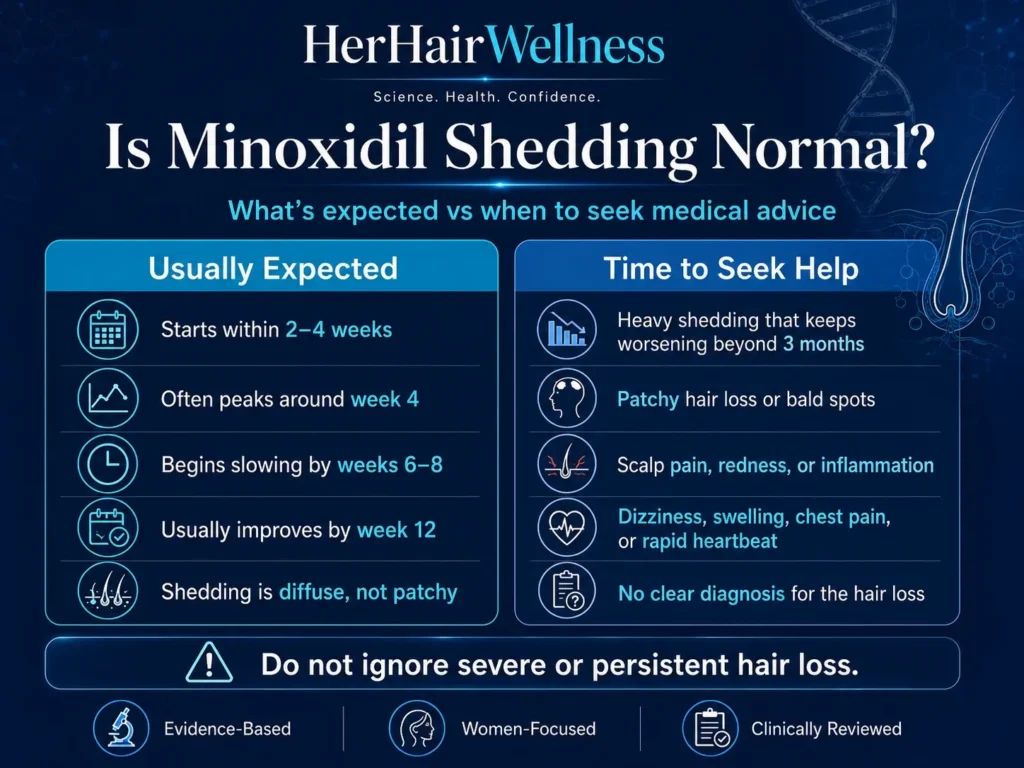
However, heavy shedding that is still intensifying after three months should not be dismissed automatically as a harmless dread shed.
Months 3–6: Early regrowth may appear
Current women’s 5% topical minoxidil labeling states that results may begin at around three months, although some women need at least six months of consistent once-daily use before seeing regrowth. The label also makes clear that minoxidil does not work for every woman.
Early regrowth may look:
- Short
- Fine
- Soft
- Lighter in color
- Uneven across the treated area
These hairs need time to lengthen and thicken before they improve visible scalp coverage.
Months 6–12: Results can be judged more fairly
Six to twelve months is a more meaningful window for assessing:
- Part width
- Overall density
- Scalp coverage
- Stabilization of thinning
- Hair-shaft thickness
- Treatment tolerability
Daily mirror checking is unreliable. Lighting, hair oil, styling, wash timing, and camera angle can make the same scalp look dramatically different.
When Does Minoxidil Shedding Start?
Minoxidil shedding most often starts two to four weeks after treatment begins.
A 2025 retrospective study of 49 people using 2% or 5% topical minoxidil also detected a temporary increase in shedding during the first 12 weeks. The authors reported that the increase lasted longer in the 2% group than in the 5% group, although the small study size means this finding should be considered preliminary. (2)
Shedding may begin earlier or later depending on:
- The proportion of follicles already in telogen
- The severity of existing miniaturization
- Previous use of minoxidil
- A dose or concentration change
- Treatment consistency
- Simultaneous use of other treatments
- An overlapping episode of telogen effluvium
A new shed that begins six months after starting an unchanged treatment is less likely to represent the original dread shed.
When Does Minoxidil Shedding Peak?
The best current prospective evidence places the average peak at approximately week four.
At that point, some users may feel their hair looks thinner than it did before treatment. That visual change can occur because resting hairs are released before their replacements have grown long enough to provide coverage.
A temporary increase does not mean the follicles have been permanently damaged.
However, the word “temporary” matters. Expected treatment-related shedding should eventually show a direction:
- It begins.
- It increases.
- It reaches a peak.
- It declines.
- It stabilizes.
Shedding that continuously worsens without a peak or slowdown deserves reassessment.
Why Does Minoxidil Cause the Dread Shed?
The leading explanation involves a change in the hair-growth cycle.
Each follicle moves through several phases:
- Anagen: active growth
- Catagen: transition
- Telogen: resting
- Exogen: release of the old hair
Minoxidil appears to encourage resting follicles to move toward a new anagen phase. Older telogen hairs may then be released earlier than they would have been without treatment.
This accelerated release is sometimes described as immediate telogen release.
The 2025 prospective study proposed that minoxidil may accelerate the telogen-to-anagen transition through pathways including Wnt/β-catenin and Sonic Hedgehog signaling. These mechanisms remain biological explanations rather than a complete account of why one person sheds heavily and another does not. (1)
The dread shed is therefore not usually minoxidil “killing” healthy follicles. It is more likely a temporary shift in follicular timing.
Does Everyone Experience Minoxidil Shedding?
No.
Some users experience a clear increase in hair fall, while others notice:
- No change
- A mild increase
- A short shed
- A later shed after a dose change
- Increased fall visible only on wash days
The exact frequency remains uncertain because studies define and measure shedding differently.
In a 2024 retrospective study of 115 people starting low-dose oral minoxidil, only six patients—5.2%—reported dread shed. Because this was based on retrospective medical records and patient reports, mild or unreported cases may have been missed. (3)
The absence of shedding does not mean minoxidil is not affecting the follicles.
Does Shedding Mean Minoxidil Is Working?
Not necessarily.
A temporary shed may indicate that minoxidil is changing follicular cycling. The 2025 retrospective study found an association between greater early shedding and later improvement in androgenetic alopecia severity. In the 5% group, the level of shedding was also associated with some improvements in trichoscopic measurements. (2)
That does not prove that more shedding always produces more regrowth.
The evidence is limited because:
- The study included only 49 people.
- It was retrospective.
- Associations do not prove cause and effect.
- Individual responses vary.
- Not every person who sheds obtains satisfactory regrowth.
The medically responsible conclusion is:
Early shedding may accompany a treatment response, but it is not a reliable test of whether minoxidil will work.
Likewise, no dread shed does not equal treatment failure.
How Do You Know When the Dread Shed Is Ending?
The end is usually gradual.
Possible signs include:
- Less hair collecting during washing
- Fewer strands on clothing or bedding
- Reduced fall during brushing
- A stable center part
- No further increase in visible scalp
- Short new hairs within the treated area
- More consistent shedding from week to week
Do not confuse the end of shedding with complete regrowth.
When the old hair falls, the replacement hair must still emerge and grow. Scalp hair grows slowly, so visible density may lag behind the reduction in shedding by several months.
Is Minoxidil Shedding Normal After Two Months?
Shedding at two months may still fall within the expected timeline, especially when it has already started slowing.
The prospective cohort found that shedding generally declined between weeks six and eight, but not everyone had returned to baseline by that point. (1)
At two months, focus on the pattern.
More consistent with an expected shed
- Hair fall peaked earlier and is now decreasing
- Loss remains diffuse
- There is no scalp pain or inflammation
- No distinct bald patches are appearing
- The treatment is being used consistently
Less consistent with a routine dread shed
- Hair fall is becoming more severe each week
- The scalp is painful, red, infected, or scarred
- New patches of complete hair loss appear
- The hairline is receding rapidly
- There has been illness, childbirth, major weight loss, or medication change
- The original diagnosis was never established
The direction matters more than one frightening wash day.
Is Minoxidil Shedding Normal After Three Months?
By three months, shedding should usually be improving, stable, or close to baseline.
Persistent shedding at week 12 does not automatically mean something dangerous is happening. However, heavy hair fall that has not slowed should prompt a review of other possible contributors.
These may include:
- Telogen effluvium
- Iron deficiency
- Thyroid dysfunction
- Recent childbirth
- Fever or significant illness
- Surgery
- Major psychological or physical stress
- Rapid weight loss
- Restrictive dieting
- Medication changes
- Hormonal changes
- Progression of female-pattern hair loss
- Inconsistent minoxidil use
- Stopping another effective treatment
Women’s minoxidil labeling advises against self-treatment when hair loss is sudden, patchy, associated with childbirth, unexplained, or accompanied by a red, inflamed, infected, irritated, or painful scalp.
Do not keep calling every prolonged shed “normal” simply because minoxidil was started months earlier.
How Long Is Too Long for Minoxidil Shedding?
There is no perfect universal cutoff.
As a practical boundary, heavy shedding that remains unchanged or continues worsening beyond 12 weeks deserves medical assessment.
Seek help sooner when shedding is:
- Sudden and extreme
- Patchy
- Associated with broken hairs
- Accompanied by itching, pain, burning, or inflammation
- Producing rapidly worsening scalp visibility
- Occurring during pregnancy or breastfeeding
- Associated with another medication change
- Accompanied by systemic symptoms
Get prompt medical advice and stop topical minoxidil as directed by the product label if you develop:
- Chest pain
- Rapid heartbeat
- Faintness
- Dizziness
- Sudden unexplained weight gain
- Swelling of the hands or feet
- Significant scalp redness or irritation
These warnings appear on current women’s 5% minoxidil labels.
Should You Stop Minoxidil Because of Shedding?
Expected early shedding is not usually a reason to stop immediately.
Stopping during the first few weeks may prevent you from giving the treatment enough time to work. It may also fail to stop hairs that have already entered the release phase.
However, “continue no matter what” is bad advice.
Before changing treatment, consider:
- When the shedding began
- Whether it has peaked or is still worsening
- Whether the pattern is diffuse or patchy
- Whether the scalp is inflamed
- Whether other health changes occurred
- Whether topical or oral minoxidil is being used
- Whether the dose was recently increased
Do not reduce, double, alternate, or overlap doses without professional guidance.
What Happens If You Stop During the Dread Shed?
Stopping minoxidil does not guarantee that shedding will stop immediately.
Hairs already released from the follicle may continue falling. If minoxidil had begun supporting other follicles, discontinuation may also remove that benefit.
Current women’s 5% foam labeling states that continued use is necessary to maintain regrowth and that hair loss will begin again after treatment is stopped. It also warns that using more product or applying it more often does not improve results.
Initial dread shed and discontinuation loss are not the same:
- Initial shedding occurs after starting or changing treatment.
- Discontinuation loss occurs after withdrawing treatment support.
How Long Does Topical Minoxidil Shedding Last?
The strongest current topical-minoxidil timeline is:
- Likely onset: weeks two to four
- Average peak: around week four
- Elevated shedding: approximately two to six weeks
- Typical slowdown: weeks six to eight
- Movement toward baseline: often by week 12
This pattern comes from direct prospective monitoring rather than internet anecdotes. (1)
The 2025 retrospective study also found a temporary increase within the first 12 weeks, but it should not be used to promise that every person will recover on the same schedule. (2)
How Long Does Oral Minoxidil Dread Shed Last?
Direct evidence for a precise oral-minoxidil timeline is weaker.
Temporary shedding after starting low-dose oral minoxidil is commonly described as beginning within the first few weeks and lasting several weeks. In the 2024 study of 115 patients, 5.2% reported dread shed. Continuing topical minoxidil while starting oral minoxidil did not significantly reduce that risk. (3)
Oral minoxidil requires a different level of caution because it is a systemic medication used off-label for hair loss.
Possible systemic adverse effects include:
- Dizziness
- Fluid retention
- Ankle swelling
- Increased heart rate
- Blood-pressure changes
- Headache
- Excessive facial or body hair
Do not start, stop, overlap, or change oral minoxidil based only on an online timeline. It should be prescribed and monitored by a qualified clinician.
Is the Dread Shed Worse in Women?
There is no strong evidence proving that women universally shed more or for longer than men.
It may appear more dramatic in women because:
- Long hairs create a larger-looking bundle.
- Diffuse thinning affects a broad area.
- A widening part is highly visible.
- Weekly washing concentrates several days of hair fall.
- Female-pattern hair loss may coexist with telogen effluvium.
- Hormonal, thyroid, nutritional, or postpartum factors may contribute.
The 2025 prospective study included 72 women, but it did not establish a separate universal timeline for women. (1)
A female-specific assessment matters because not every shed after starting minoxidil is caused solely by minoxidil.
Can Minoxidil Shedding Last Six Months?
Continuous heavy shedding for six months is not a typical initial dread shed.
At that point, the situation needs reassessment.
Questions to investigate include:
- Was the diagnosis correct?
- Is treatment being used consistently?
- Was the strength or route changed?
- Was another treatment stopped?
- Was oral minoxidil started or increased?
- Has there been illness, surgery, childbirth, or weight loss?
- Could iron or thyroid problems be contributing?
- Is there scalp inflammation or scarring?
- Is thinning diffuse, patterned, or patchy?
Do not accept “dread shed” as a permanent explanation for ongoing deterioration.
Is There a Second Minoxidil Shed?
The phrase second minoxidil shed is common online, but it is not a clearly defined or predictable clinical stage.
Later shedding may follow:
- A concentration increase
- An oral-dose increase
- A switch from topical to oral treatment
- Restarting after inconsistent use
- Stopping another therapy
- Illness or significant stress
- Hormonal changes
- A new telogen effluvium trigger
A later episode should not automatically be treated as harmless synchronization of the hair cycle.
If shedding returns after months of stability, assess it as a new event rather than assuming it is an inevitable second dread shed.
How Can You Monitor Shedding Without Panicking?
Daily counting usually creates more anxiety than useful information.
Take standardized monthly photographs
Photograph the:
- Center part
- Frontal scalp
- Top of the head
- Crown
Keep the same:
- Lighting
- Camera
- Distance
- Hair part
- Hairstyle
- Wash-day timing
Record important treatment details
Track:
- Start date
- Product strength
- Foam or liquid
- Topical or oral route
- Application frequency
- Missed doses
- Dose changes
- Other medications
Compare equivalent wash days
A wash after seven days will naturally collect more hair than a wash after one day.
Look for a trend
Ask:
- Is shedding increasing?
- Has it peaked?
- Is it slowing?
- Is density still worsening?
- Are there new short hairs?
- Are warning signs present?
One bad shower is not a clinical trend.
Final Answer: When Does the Minoxidil Dread Shed Stop?
The clearest evidence-based answer is:
Minoxidil shedding commonly begins during weeks two to four, peaks at approximately week four, and remains elevated for about two to six weeks. It usually starts easing during weeks six to eight, and many users return to baseline shedding or below by week 12.
Not everyone experiences a dread shed.
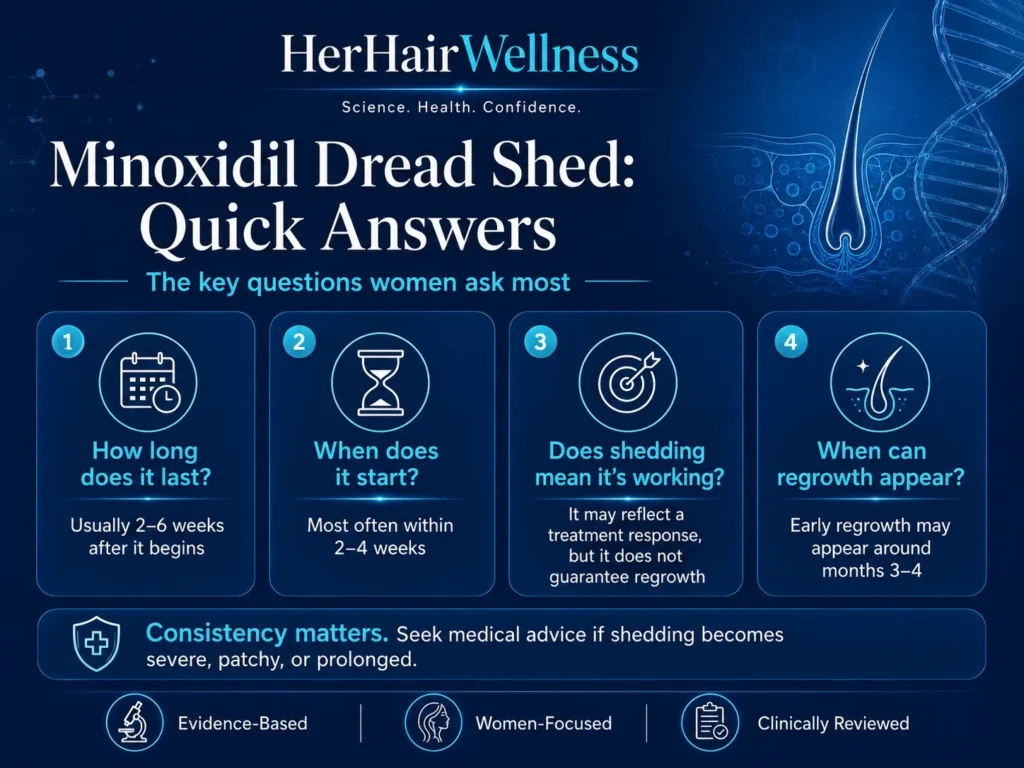
Shedding may reflect a change in follicular cycling, but it is not guaranteed proof that minoxidil will produce visible regrowth. The absence of shedding does not mean treatment failure.
The pattern matters more than the fear-inducing name.
An expected minoxidil dread shed should have a beginning, peak, decline, and stabilization. Heavy shedding that continues worsening beyond three months, becomes patchy, causes marked loss of density, or occurs with scalp inflammation or systemic symptoms requires medical evaluation.
Medical Disclaimer
This article is for educational purposes only and does not replace professional medical advice, diagnosis, or treatment. Consult a qualified healthcare professional if minoxidil shedding is severe, prolonged, patchy, painful, or associated with scalp inflammation, dizziness, swelling, chest pain, or a rapid heartbeat.
Frequently Asked Questions
What is the usual duration of minoxidil shedding?
The active shedding phase commonly lasts two to six weeks. For many users, hair fall returns closer to baseline by week 12.
How soon can the dread shed begin?
It commonly begins within two to four weeks of starting minoxidil.
At what point does shedding usually peak?
Current evidence suggests that shedding often reaches its highest level around week four.
Is shedding proof that minoxidil is working?
No. It may reflect a change in the hair cycle, but it does not guarantee regrowth. Minoxidil can also work without causing noticeable shedding.
When should severe shedding be assessed?
Seek medical advice if shedding keeps worsening, becomes patchy or painful, causes scalp inflammation, or remains heavy beyond approximately three months.
How soon after shedding can regrowth appear?
Early regrowth may become visible around months three to four. Clearer changes in density often require six to twelve months of consistent treatment.
References
- Zhang Y, Wu L, Zhao W, et al. Monitoring and evaluation of temporary increase in hair shedding induced by topical minoxidil in androgenetic alopecia: a multicenter prospective cohort study. Journal of the American Academy of Dermatology. 2025;93(6):1602–1604. doi: 10.1016/j.jaad.2025.08.025.
- Bi L, Kan H, Wang J, Fan W. Whether the transient hair shedding phase exists after minoxidil treatment and whether it predicts treatment efficacy: a retrospective study in patients with androgenetic alopecia. Journal of Dermatological Treatment. 2025. doi: 10.1080/09546634.2025.2480739.
- Nohria A, Desai D, Sikora M, et al. Combating “dread shed”: the impact of overlapping topical and oral minoxidil on temporary hair shedding during oral minoxidil initiation. JAAD International. 2024;15:220–224. doi: 10.1016/j.jdin.2024.03.005.