

Minoxidil Results for Women: What to Expect After 3, 6, and 12 Months
Written by: Dr. Muhammad Ihsan Ullah, PhD
Medical Writer and Pharmacology Researcher
Medically reviewed by: Dr. Muhammad Mudassar Hassan Bhatti, MD
Dermatologist and Medical Reviewer
Medical review date: July 16, 2026

Minoxidil results rarely appear as a sudden transformation. For most women, progress happens in stages: shedding may settle first, fine new hairs may appear later, and improvements in density or scalp coverage can take six to twelve months. Three months is an early checkpoint, six months is a meaningful review point, and twelve months usually provides the clearest picture of whether treatment is producing regrowth, stabilizing further thinning, or offering little benefit.
Minoxidil Progress Milestones at a Glance
Women may notice reduced shedding, early stabilization, or fine new hairs by month 3. Clearer improvements in hair density, center-part width, and scalp coverage may appear by month 6. Month 12 provides a more reliable assessment of overall regrowth and treatment response.
Not every woman develops dramatic new growth. For some, preventing further thinning may be the most meaningful result.
The Most Realistic Treatment Timeline
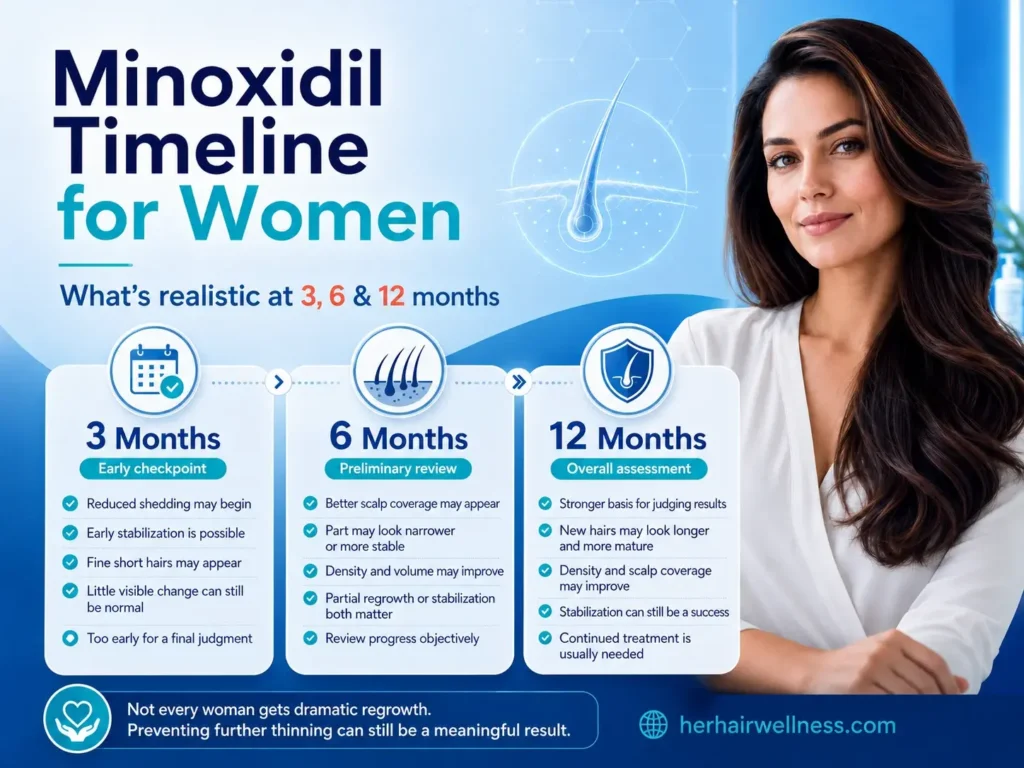
- After 3 months: Early signs such as reduced shedding, fine hairs, stabilization, or little visible change
- After 6 months: A useful preliminary assessment of density, scalp coverage, and part width
- After 12 months: A fairer judgment of regrowth, stabilization, weak response, or nonresponse
Continued treatment is generally required to maintain any improvement.
When Do Women Usually See Minoxidil Results?
Some women notice early changes after approximately three months, but visible cosmetic improvement often takes six months or longer.
Minoxidil does not instantly produce long, mature hair. A responding follicle must:
- Move into or remain in the active growth phase
- Begin producing a new hair shaft
- Grow that hair long enough to affect scalp coverage
- Potentially produce a thicker and more pigmented shaft over time
This is why biological activity can begin before a woman sees a meaningful difference in the mirror.
Early signs may include:
- Reduced daily shedding
- Stabilization of previously worsening thinning
- Short, fine hairs within the treatment area
- Less rapid widening of the center part
- Small changes visible only in standardized photographs
More obvious cosmetic improvement may include:
- Reduced scalp visibility
- A narrower-looking part
- Increased hair density
- Thicker-looking hair shafts
- Better coverage under ordinary lighting
- Improved volume during styling
Topical minoxidil remains the best-supported topical treatment for female-pattern hair loss. However, response varies significantly, and a substantial proportion of women do not achieve satisfactory improvement despite continued treatment (1).
What Results Can Women Expect After 3 Months of Minoxidil?
Three months should be treated as an early checkpoint, not a final result.
Some women begin seeing signs of progress at this stage. Others see almost no visible change. Both situations can occur during a reasonable early treatment course.
Possible minoxidil results after three months include:
- Less shedding than during the first several weeks
- Stabilization of progressive thinning
- Fine, soft, or lightly pigmented new hairs
- Short hairs emerging along the center part
- Slight improvement in scalp coverage
- No obvious photographic change yet
The most important mistake to avoid is expecting complete density restoration within 12 weeks.
New hairs appearing at month three may still be too short or fine to improve overall coverage. Even when follicles are responding, the new shafts need time to lengthen and potentially become thicker.
What is unlikely after only three months?
Most women should not expect:
- Full restoration of previous density
- Complete closure of a widening part
- Long and mature new hairs
- Dramatic before-and-after results
- Regrowth in every thinning region
- A reliable final judgment of success or failure
Three months is usually too early to call someone a minoxidil nonresponder.
Is No Visible Regrowth After 3 Months Normal?
Yes. No obvious regrowth after three months can still fall within a normal treatment timeline.
There may be early biological changes that are not yet cosmetically visible. New hairs may be:
- Too short to contribute to coverage
- Too fine to see under normal lighting
- Hidden beneath longer surrounding hair
- Present only in certain areas
- Difficult to distinguish from existing miniaturized hairs
Instead of asking only, “Do I have more hair?” consider these questions:
- Has shedding reduced?
- Has the center part stopped widening?
- Does the scalp appear stable in comparable photographs?
- Are short hairs appearing inside the thinning area?
- Has the rate of progression slowed?
- Is the hair becoming easier to style for coverage?
If hair was visibly deteriorating before treatment, stabilization at three months may be more encouraging than it initially appears.
Are Baby Hairs After 3 Months a Sign Minoxidil Is Working?
They can be, but not every short hair proves new minoxidil-induced growth.
Fine regrowth may initially appear:
- Short
- Soft
- Light in color
- Thin in diameter
- Unevenly distributed
However, short hairs may also be:
- Broken hair shafts
- Existing miniaturized hairs
- Ordinary regrowth after natural shedding
- Naturally shorter hairs near the hairline
- Hairs cut to different lengths during styling
Short hairs are more convincing as a treatment response when:
- They appear inside an established thinning area.
- Their number increases over several months.
- They continue getting longer.
- Some become darker or thicker.
- Scalp coverage gradually improves around them.
One close-up photograph of fine hairs is weak evidence. Consistent progress between months three, six, and twelve is far more meaningful.
What Should Minoxidil Results Look Like After 6 Months?
Six months is a useful preliminary assessment point.
A randomized trial in women found that once-daily 5% minoxidil foam and twice-daily 2% solution both stimulated hair growth over 24 weeks, which is approximately six months (2).
A woman responding to minoxidil may notice:
- Reduced scalp visibility
- A narrower or more stable center part
- Greater density in the treated area
- Longer and more pigmented new hairs
- Reduced or stabilized shedding
- Improved hair volume
- Slower progression of thinning
- Easier styling and coverage
However, six-month results vary widely.
Strong visible response
Signs may include:
- Clearly improved scalp coverage
- A visibly narrower part
- Multiple new hairs becoming longer and thicker
- Obvious improvement in standardized photographs
- Reduced progression of thinning
Partial response
A partial response may involve:
- Small improvements in density
- Fine new hairs
- Slightly better coverage
- Reduced shedding
- Changes visible mainly in photographs
Stabilization without obvious regrowth
This may look like:
- No major increase in density
- No continued widening of the part
- Reduced shedding
- Stable scalp coverage
- Slower progression than before treatment
Little or no response
Possible signs include:
- Continued worsening
- No photographic improvement
- No stabilization
- Persistent heavy shedding
- Increasing scalp visibility despite correct use
A modest response is still a response. Online before-and-after galleries overrepresent dramatic outcomes and create unrealistic expectations.
Is 6 Months Enough to Know Whether Minoxidil Works?
Six months is long enough for a meaningful review, but it may not be enough for a final decision in every woman.
Treatment may reasonably continue beyond six months when:
- The diagnosis has been confirmed.
- Minoxidil is well tolerated.
- Hair loss appears stabilized.
- Fine new growth is present.
- Photographs show slow improvement.
- Applications were inconsistent during part of the trial.
- A dermatologist believes a longer assessment is appropriate.
Six months should not be used as an excuse to continue ineffective treatment blindly. It should trigger an objective review.
At this stage, assess:
- Hair density
- Center-part width
- Scalp coverage
- Shedding pattern
- New-hair length and thickness
- Treatment adherence
- Side effects
- Quality of baseline photographs
The question is not merely whether dramatic regrowth occurred. It is whether the treatment has produced any meaningful improvement or stabilization.
What Should Women Do If There Are No Minoxidil Results After 6 Months?
First, confirm whether there is truly no response.
Ask the following:
- Were clear baseline photographs taken?
- Are the comparison photographs using the same lighting?
- Is the hair parted in exactly the same location?
- Was minoxidil applied directly to the scalp?
- Was the recommended amount used?
- Were applications missed frequently?
- Was treatment stopped during early shedding?
- Were multiple formulations changed during the trial?
- Has hair loss stabilized even without obvious regrowth?
A woman may think nothing has changed because the daily mirror view feels familiar. Photographs sometimes show that the part has remained stable or scalp coverage has improved slightly.
If there is no stabilization, no density improvement, and continued deterioration after six months of correct use, medical reassessment is appropriate.
Possible explanations include:
- The original diagnosis may be incorrect.
- Follicular miniaturization may be advanced.
- Minoxidil may not be reaching the scalp properly.
- Irritation may be reducing adherence.
- Another shedding process may be occurring.
- The woman may have a weak biological response.
- Another treatment strategy may be required.
Applying more minoxidil is not the solution. Excessive application does not guarantee greater follicular response and may increase irritation, facial hair growth, and other adverse effects.
What Can Women Expect After 12 Months of Minoxidil?
Twelve months provides a much stronger basis for judging the overall response.
A 48-week randomized trial involving 381 women found that topical minoxidil improved nonvellus hair count, patient assessments of hair growth, and scalp coverage compared with placebo (3).
By approximately one year, a responding woman may notice:
- More mature new hairs
- Increased terminal-hair density
- Better scalp coverage
- A narrower center part
- Thicker-looking hair
- Reduced progression of thinning
- A stable long-term response
That does not mean every woman will achieve complete regrowth.
Realistic twelve-month outcomes include:
- Strong visible regrowth
- Moderate density improvement
- Partial improvement
- Stabilization without major regrowth
- Little or no meaningful benefit
A one-year result should be evaluated against the woman’s own baseline—not against another person’s edited, selected, or differently lit photograph.
Does Minoxidil Reach Peak Results After One Year?
One year is a reasonable major assessment point, but it is not necessarily the absolute biological maximum for every woman.
Some women may continue seeing slower changes beyond month 12 because:
- New hairs continue lengthening.
- Fine hairs may gradually become more visible.
- Hair-shaft diameter may improve slowly.
- Better length can improve cosmetic coverage.
- Progress may have been delayed by inconsistent use.
Other women reach a plateau before one year.
By month 12, ask:
- Is there clear photographic improvement?
- Has scalp coverage increased?
- Is the center part narrower or stable?
- Has shedding improved?
- Is the benefit meaningful enough to justify continued use?
- Are side effects acceptable?
- Is another treatment needed?
Do not interpret a plateau as proof that minoxidil has suddenly stopped working. Maintaining the improvement already achieved may itself be the continuing benefit.
What If There Is No Hair Growth After 12 Months?
A full year of correct, consistent treatment without regrowth or stabilization suggests that the current regimen is providing limited value.
Before declaring nonresponse, confirm that:
- Treatment was used consistently.
- Minoxidil was applied to the scalp rather than the hair.
- The amount and frequency matched the product directions.
- Photographs were properly standardized.
- The diagnosis was appropriate for minoxidil.
- Treatment was not interrupted repeatedly.
- Another hair-loss process has not masked the response.
If these conditions were met and thinning continues to progress, the treatment plan needs professional review.
A dermatologist may consider:
- Reassessing the diagnosis
- Examining the scalp with trichoscopy
- Reviewing adherence
- Changing the topical formulation
- Discussing prescription treatments
- Considering combination therapy
- Evaluating medically supervised alternatives
Continuing indefinitely solely because stopping feels uncomfortable is not sound treatment management. Cost, inconvenience, side effects, and the absence of measurable benefit all matter.
Is Stabilization Without Regrowth Still a Good Result?
Yes. Stabilization can be a meaningful treatment outcome.
Female-pattern hair loss is usually progressive. If a woman’s center part was steadily widening before treatment and remains stable during the following year, minoxidil may be providing value even without dramatic regrowth.
Stabilization may involve:
- No further widening of the part
- No increase in scalp visibility
- Reduced shedding
- Maintained hair density
- Slower follicular miniaturization
- More consistent hair volume
However, stabilization should be documented rather than assumed.
Memory is unreliable. A woman checking her scalp every day may struggle to recognize slow progression or stability. Baseline and follow-up photographs are essential.
How Can Women Tell Whether Minoxidil Is Working?
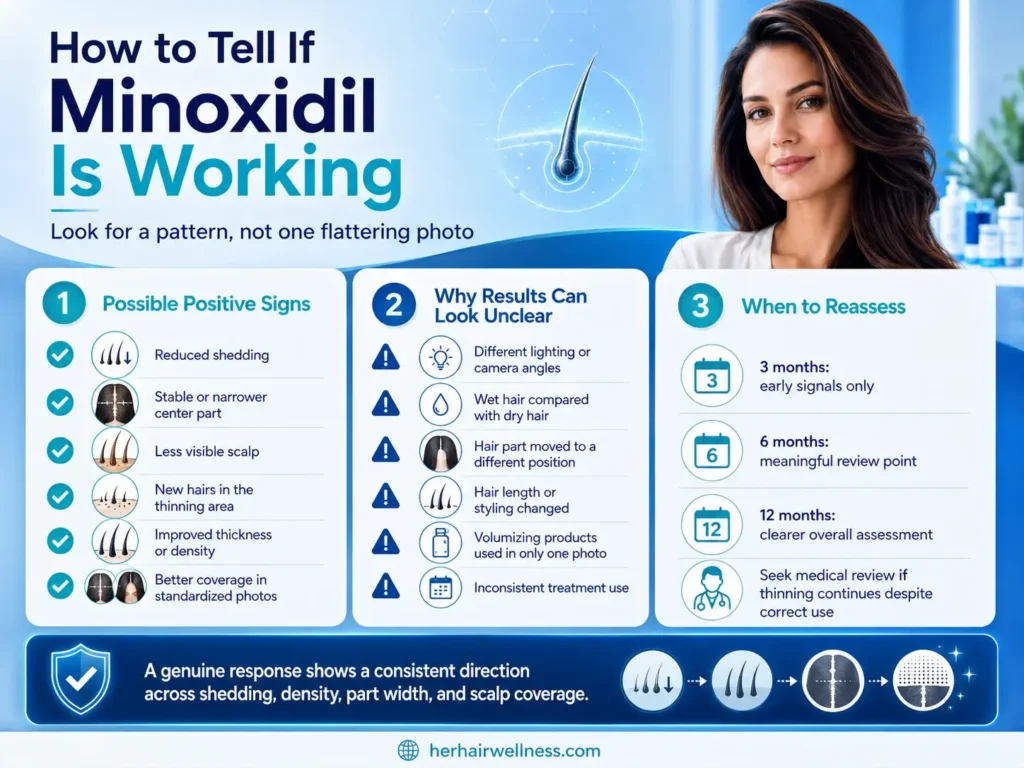
Do not rely on one sign alone.
Signs of a possible positive response
- Reduced progression of thinning
- A stable or narrower center part
- Less visible scalp
- Short new hairs within the treatment area
- Increasing hair-shaft thickness
- Reduced shedding
- Better coverage in standardized photographs
- Improved hair density during clinical assessment
Signs that the result remains uncertain
- New hairs remain extremely fine.
- Lighting differs between photographs.
- Hair length has changed significantly.
- The hair part has moved.
- Hair is wet in one image and dry in another.
- Volumizing products were used in only one photograph.
- Treatment was inconsistent.
- Several treatments were started simultaneously.
A genuine result should show a consistent direction across several measures, not one flattering photograph.
How Should Women Take Accurate Before-and-After Photos?

Before-and-after photographs are useful only when conditions remain consistent.
Take photographs at:
- Baseline
- Month 3
- Month 6
- Month 12
Keep these conditions the same
- Room
- Lighting
- Camera
- Camera distance
- Camera height
- Head position
- Hair part
- Wash-day timing
- Hair condition
- Styling products
Photograph these areas
- Front hairline
- Center part
- Top of the scalp
- Crown
- Left temple
- Right temple
Use dry hair without fibers, concealers, heavy oil, or volumizing products.
Avoid comparing:
- Wet hair with dry hair
- Freshly washed hair with oily hair
- Direct flash with soft daylight
- Different camera angles
- A tight part with a loose part
- Different hairstyles
Monthly photographs are enough. Daily photographs create anxiety and visual noise rather than reliable evidence.
Why Do Some Women See No Minoxidil Results?
Minoxidil does not work equally well for every woman.
A 2023 therapeutic review reported that approximately 40% of patients may not show satisfactory improvement with topical minoxidil (1).
A weak or absent response may be linked to:
- Inconsistent application
- Poor scalp delivery
- Advanced follicular miniaturization
- Insufficient treatment duration
- Incorrect diagnosis
- Scalp inflammation
- Individual differences in drug activation
- Repeated treatment interruptions
- Unrealistic expectations
- Another ongoing source of shedding
A woman who does not develop dramatic regrowth is not necessarily using the product incorrectly. Biological response genuinely differs between individuals.
Likewise, using unlimited quantities will not convert every weak responder into a strong responder.
Does Reduced Shedding Count as a Successful Result?
It can.
Reduced shedding may suggest that hair loss is becoming more stable, especially when accompanied by:
- Stable scalp coverage
- No further widening of the part
- Maintained density
- Fewer hairs lost during washing
- More consistent hair volume
However, shedding naturally fluctuates.
It can change with:
- Washing frequency
- Illness
- Stress
- Seasonal variation
- Nutrition
- Medication changes
- Hormonal changes
- Hair length
- Detangling habits
Reduced shedding is most meaningful when it forms part of a broader pattern of stabilization or improvement.
Do Topical and Oral Minoxidil Have the Same Results Timeline?
No. Their timelines should not be treated as interchangeable.
Topical minoxidil
- Is applied directly to the scalp
- Has women-specific over-the-counter formulations
- May produce early visible changes from month 3 onward
- Is commonly assessed over 6 to 12 months
- Can cause scalp irritation and unwanted facial hair
Low-dose oral minoxidil
- Is taken systemically
- Is used off-label for hair loss
- Requires individualized medical prescribing
- Has systemic risks and monitoring considerations
- Has a less standardized female results timeline
Do not compare topical-minoxidil progress with online oral-minoxidil transformations without checking the route, dose, diagnosis, and other treatments used.
Will Minoxidil Results Disappear After Stopping Treatment?
Usually, yes.
Minoxidil supports hair growth while treatment continues. It does not permanently cure female-pattern hair loss.
After stopping, treatment-supported hairs may gradually be lost, and the underlying thinning process may resume. This can become noticeable over the following several months.
This applies whether the woman achieved:
- Strong regrowth
- Moderate improvement
- Partial regrowth
- Stabilization
Before starting minoxidil, women should understand that it is generally a long-term treatment rather than a temporary course.
Final 3-, 6-, and 12-Month Expectations
Month 3: Look for early signals
Possible findings include:
- Reduced shedding
- Fine new hairs
- Early stabilization
- Little visible change
Do not make a final judgment this early.
Month 6: Review preliminary effectiveness
Possible findings include:
- Better scalp coverage
- Improved density
- A narrower or more stable part
- Partial regrowth
- Stabilized hair loss
- No meaningful response
This is an appropriate time for an objective review.
Month 12: Assess overall treatment value
Possible outcomes include:
- Strong regrowth
- Moderate improvement
- Partial response
- Stabilization
- Little or no benefit
Clinical evidence supports reviewing meaningful early progress around six months, while trials lasting close to one year provide a stronger basis for judging overall regrowth and scalp coverage (2,3).
Final Verdict
Minoxidil results for women should be judged in stages.
Three months is usually too early for a final conclusion. Six months is a useful preliminary review point. Twelve months provides a much clearer assessment of regrowth, density improvement, stabilization, and overall treatment value.
Do not compare your progress with carefully selected transformations online. Compare your scalp with your own standardized baseline photographs.
A successful result may mean growing more hair. It may also mean preserving the density you still have.
The treatment is providing value when the improvement or stabilization is real, measurable, medically appropriate, and sufficient to justify continued use.
Medical Disclaimer
This article is for educational purposes only and does not replace professional medical advice, diagnosis, or treatment. Consult a qualified healthcare professional before starting, stopping, or changing minoxidil, especially if hair loss is sudden, patchy, painful, unexplained, or occurs during pregnancy or breastfeeding.
Frequently Asked Questions
How soon can women notice minoxidil progress?
Some women notice reduced shedding or fine new hairs by month 3, but clearer improvement often requires 6 to 12 months.
What is realistic at the three-month mark?
Early stabilization, reduced shedding, fine hairs, or little visible change are all possible. Dramatic regrowth is not expected this early.
Is a six-month review enough?
Six months is a useful preliminary assessment, but some women require up to 12 months before their overall response becomes clear.
What can one-year results include?
Women may experience increased density, better scalp coverage, partial regrowth, stabilization, or little meaningful response.
Can maintaining current density count as success?
Yes. Preventing further thinning can be valuable when female-pattern hair loss was progressing before treatment.
Are results permanent after discontinuation?
Usually not. Continued treatment is generally needed to maintain regrown or preserved hair.
References
- Ramos PM, Melo DF, Radwanski H, de Almeida RFC, Miot HA. Female-pattern hair loss: therapeutic update. Anais Brasileiros de Dermatologia. 2023;98(4):506–519. doi: 10.1016/j.abd.2022.09.006.
- Blume-Peytavi U, Hillmann K, Dietz E, Canfield D, Garcia Bartels N. A randomized, single-blind trial of 5% minoxidil foam once daily versus 2% minoxidil solution twice daily in the treatment of androgenetic alopecia in women. Journal of the American Academy of Dermatology. 2011;65(6):1126–1134.e2. doi: 10.1016/j.jaad.2010.09.724.
- Lucky AW, Piacquadio DJ, Ditre CM, et al. A randomized, placebo-controlled trial of 5% and 2% topical minoxidil solutions in the treatment of female pattern hair loss. Journal of the American Academy of Dermatology. 2004;50(4):541–553. doi: 10.1016/j.jaad.2003.06.014.