

Minoxidil Foam vs Liquid for Women: Which Should You Choose?
Written by: Dr. Muhammad Ihsan Ullah, PhD Pharmacology
Medically reviewed by: Dr. Muhammad Mudassar Hassan Bhatti, MD (Dermatology)
Last updated: July 13, 2026.
- Topical minoxidil may be preferablefor women starting treatment, those who want to avoid systemic medication, and those with low blood pressure or cardiovascular concerns.
- Low-dose oral minoxidil may be worth discussingwhen topical treatment causes persistent scalp irritation, is difficult to apply consistently, or has not produced satisfactory results after an adequate trial.
- Neither form is universally superior.The decision depends on treatment adherence, medical history, tolerance, personal preference, and individual response.
Quick Answer
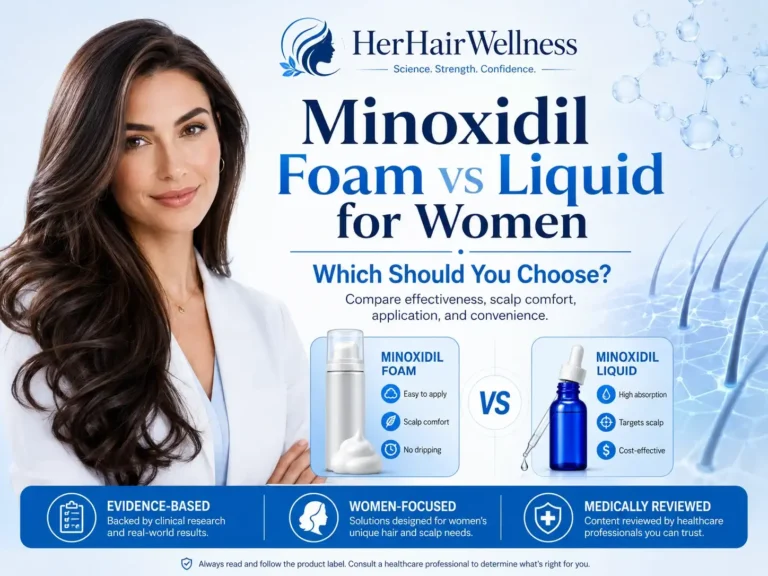
Minoxidil foam and liquid can both promote hair growth in women when used correctly. Foam is often the better choice for women who want faster drying, less greasiness, fewer styling problems, and a formulation that commonly avoids propylene glycol. Liquid may be better for women who need precise dropper application through long or dense hair. Current evidence does not prove that one vehicle works better for every woman.
Choose Based on Your Main Priority
- Choose foam when scalp comfort, faster drying, less dripping, and a simpler routine matter most.
- Choose liquid when precise application, access through dense hair, and lower cost are your priorities.
- Do not compare the vehicle alone.Concentration, application frequency, scalp coverage, dose, and consistency can all affect the result.
Minoxidil Foam vs Liquid for Women at a Glance
Comparison point | Minoxidil foam | Minoxidil liquid |
Texture | Light foam that melts on contact with warmth | Fluid solution applied with a dropper or spray |
Common studied female regimen | 5% foam once daily | 2% solution twice daily |
Scalp targeting | Can be harder through very dense or long hair | Dropper may provide more precise placement |
Drying time | Usually faster | Often slower |
Dripping | Less likely | More likely if overapplied |
Greasy or sticky feeling | Usually lower | More common |
Propylene glycol | Many commercial foams do not contain it | Present in many traditional liquid solutions |
Scalp irritation | Often better tolerated | May cause more itching or flaking |
Cost | Frequently more expensive | Generic liquid is often cheaper |
Styling convenience | Usually better | May leave visible residue at the roots |
Best suited to | Sensitive scalps and convenience-focused users | Precise application and budget-focused users |
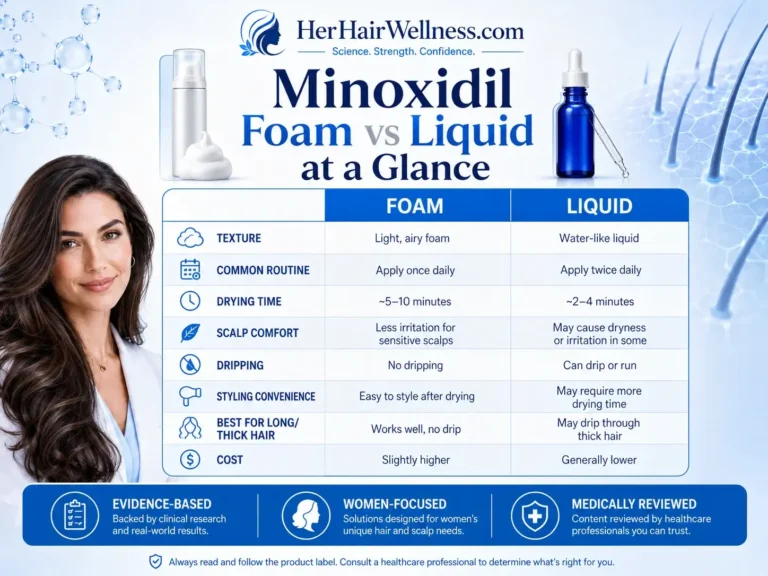
Product ingredients and directions vary by manufacturer and country. Always read the label on the exact product rather than assuming every foam or solution has the same composition or schedule.
Is Minoxidil Foam or Liquid Better for Women?
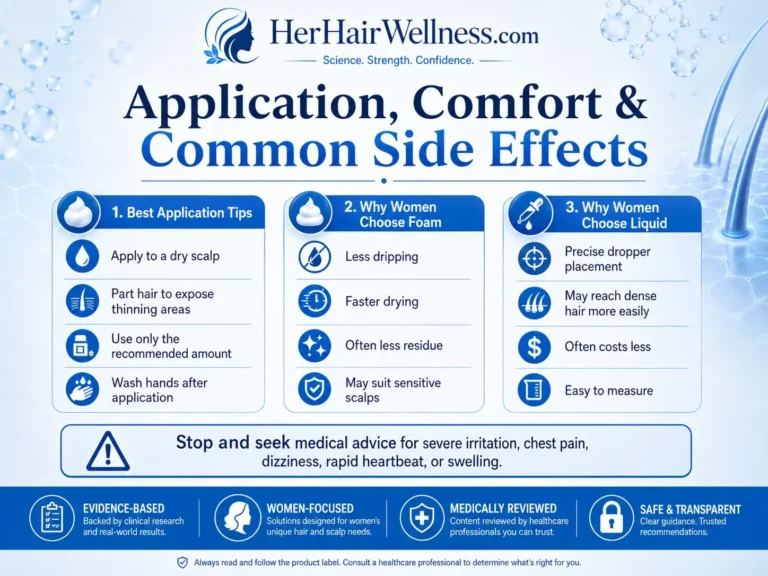
For many women, foam provides the better overall experience. That does not mean it is biologically stronger.
Foam may be more suitable when you:
- Experience itching or flaking with liquid minoxidil.
- Dislike wet, greasy, or stiff roots.
- Need a formulation that dries quickly.
- Apply minoxidil before work or hairstyling.
- Find twice-daily treatment difficult to maintain.
- Want to reduce the risk of liquid running onto your forehead.
- Have previously reacted to a propylene-glycol-containing solution.
Liquid may be more practical when you:
- Have long or thick hair that traps foam before it reaches the scalp.
- Need to apply minoxidil along several narrow part lines.
- Prefer measuring the product with a dropper.
- Treat a widening central part or crown.
- Have no irritation from liquid.
- Want a more affordable generic option.
- Find foam difficult to spread over diffuse thinning.
The formulation you use correctly every day is more useful than the supposedly “best” formulation sitting unused in a cupboard.
Is Minoxidil Foam as Effective as Liquid for Women?
The most directly relevant randomized trial compared 5% minoxidil foam once daily with 2% minoxidil solution twice daily in 113 women with androgenetic alopecia.
After 24 weeks, once-daily foam was found to be non-inferior to twice-daily solution for improving hair growth. Women using foam also reported practical advantages, including less interference with hairstyling and lower rates of local intolerance, particularly itching and dandruff. (1)
This finding supports foam as an effective alternative to liquid, but it does not prove that the foam vehicle is inherently superior.
The study changed three variables at the same time:
- The vehicle changed from liquid to foam.
- The concentration changed from 2% to 5%.
- The frequency changed from twice daily to once daily.
That distinction is critical. A comparison of 5% foam once daily against 2% liquid twice daily cannot isolate the effect of the vehicle alone.
Is 5% Foam Once Daily Better Than 2% Liquid Twice Daily?
Not conclusively.
Both regimens can improve female pattern hair loss. The main advantage of once-daily 5% foam may be that women find it easier and more cosmetically acceptable to use consistently.
A twice-daily liquid can work well when both applications are completed. In real life, however, the second application is often skipped because the solution:
- Leaves the roots looking oily.
- Takes too long to dry.
- Interferes with styling.
- Causes itching or flaking.
- Is inconvenient before bed.
- Runs onto the forehead.
A once-daily formulation may therefore perform better for a particular woman because she actually uses it—not because foam has been proven universally more potent.
Do not assume that a higher percentage always means proportionally greater regrowth. More concentrated treatment can also increase irritation or unwanted hair growth, and the correct regimen depends on the product label and medical advice.
What Is the Difference Between Minoxidil Foam and Liquid?
The active medicine is the same. The main difference is the vehicle, meaning the inactive ingredients that dissolve, stabilize, carry, and release minoxidil onto the scalp.
Minoxidil liquid
Many conventional liquid solutions contain:
- Minoxidil
- Alcohol
- Purified water.
- Propylene glycol.
Propylene glycol helps keep minoxidil dissolved and assists its distribution across the scalp. It can also leave the hair feeling sticky or greasy and may contribute to irritation in susceptible users.
Not every liquid has the same formula. Some newer or compounded solutions use alternative solvents, so the ingredient list matters more than the word “liquid.”
Minoxidil foam
Many commercial foam products contain:
- Minoxidil
- Alcohol
- Water
- Fatty alcohols that help create the foam structure.
- Glycerin or similar ingredients.
- Propellants that dispense the product as foam.
Common foam formulations do not use propylene glycol, which is one reason some women tolerate them better.
Foam can still cause irritation. It may contain alcohol and other ingredients capable of producing dryness, burning, redness, or an allergic reaction.
Does Minoxidil Foam Cause Less Scalp Irritation Than Liquid?
It often does, especially when the irritation is caused by propylene glycol rather than minoxidil itself.
A 2025 systematic review found that topical minoxidil-associated contact dermatitis can involve either the active medicine or ingredients in the vehicle. Typical symptoms include redness, itching, and increased scalp scaling. The review emphasized the value of patch testing when an allergic reaction is suspected because simply changing from liquid to foam will not solve the problem if minoxidil itself is the allergen. (2)
Possible signs of irritation include:
- Persistent itching.
- Burning or stinging.
- Redness
- Dryness
- Flaking
- Dandruff-like scaling.
- Tenderness
- Crusting
Foam may help when liquid causes irritation, but it is not guaranteed to solve every scalp reaction.
Stop self-treating and seek medical assessment when symptoms are severe, worsening, associated with swelling, or continuing after the product has been discontinued.
Is Foam Better for Women With a Sensitive Scalp?
Foam is generally the more logical formulation to try when a standard liquid solution repeatedly causes itching, flaking, or cosmetic discomfort.
It may be especially helpful when:
- Propylene glycol sensitivity is suspected.
- Liquid residue leads to frequent shampooing.
- The solution runs onto irritated facial skin.
- The scalp becomes flaky after each application.
- The woman stops treatment because of discomfort.
A sensitive scalp can still react to foam. Alcohol, preservatives, or minoxidil itself may cause irritation.
Do not apply either formulation to scalp skin that is:
- Severely inflamed.
- Sunburned
- Infected
- Open or bleeding.
- Painful
- Covered with active dermatitis.
Treating through significant inflammation can increase discomfort and may alter absorption. The scalp problem should be evaluated rather than hidden under another formulation.
Which Is Easier to Apply With Long Hair: Foam or Liquid?
For women with long, thick, curly, coily, or densely packed hair, liquid often provides more precise application.
A dropper can be placed directly against the exposed scalp. This is useful for:
- A widening central part.
- Crown thinning.
- Several parallel part lines.
- Diffuse thinning across the top.
- Areas hidden beneath dense hair.
Foam can become trapped on the hair shafts before reaching the skin. That wastes product and leaves residue without improving follicular delivery.
Foam can still work with long hair when applied carefully:
- Begin with a dry scalp.
- Divide the hair into several narrow sections.
- Expose the thinning scalp clearly.
- Dispense a small amount of foam onto cool fingertips or a cool surface.
- Place it directly onto the exposed skin.
- Spread it gently across the treatment area.
- Wash your hands immediately afterward.
Avoid rubbing foam through the full hair length. Minoxidil needs to reach the scalp, not coat the strands.
Does Liquid Minoxidil Reach the Scalp Better Than Foam?
Liquid may be easier to direct to the scalp, but that does not prove it penetrates the follicles better once applied correctly.
A dropper gives the user visible control. Small drops can be placed along each exposed part rather than spread across the hair.
Liquid also has disadvantages:
- It can run beyond the target area.
- It may drip onto the forehead or temples.
- Too much may collect in one spot.
- It can spread into the hair instead of remaining on the scalp.
- Wet residue may discourage consistent use.
Foam is less runny and usually stays where it is placed. Its weakness is that it may melt or disappear into long hair before reaching the skin.
The practical question is not which vehicle sounds more absorbable. It is whether the recommended amount repeatedly reaches the treatment area.
Which Dries Faster and Leaves Less Residue?
Foam usually dries faster and produces less greasy residue.
This can matter greatly for women who:
- Do not shampoo daily.
- Have fine or low-volume hair.
- Style their hair before work.
- Wear a visible central part.
- Use root powders or styling products.
- Avoid liquid because it makes thinning areas look more obvious.
Liquid may leave roots looking wet, oily, stiff, or separated. The effect depends on the formula, amount applied, scalp oil production, humidity, and whether the solution reaches the scalp or coats the hair.
Using more than directed does not accelerate regrowth. It mainly increases residue, transfer, irritation, and unnecessary exposure.
Which Causes More Side Effects: Minoxidil Foam or Liquid?

Both formulations can cause adverse effects, although the pattern may differ.
Side effects more commonly associated with liquid
- Greasy or sticky residue.
- Scalp itching.
- Flaking
- Dryness
- Propylene-glycol-related irritation.
- Product dripping onto the face.
- Irritant or allergic contact dermatitis.
Side effects that can occur with foam
- Scalp dryness.
- Itching
- Burning
- Redness
- Alcohol-related irritation.
- Residue when applied mainly to the hair.
Side effects possible with either formulation
- Temporary early shedding.
- Unwanted facial or body hair.
- Headache
- Lightheadedness
- Rapid heartbeat or palpitations.
- Swelling of the hands or feet.
- Sudden unexplained weight gain.
- Chest discomfort.
Topical minoxidil should be applied in the recommended amount and frequency. Expert guidance stresses safe, correct, and consistent use rather than increasing the dose in an attempt to force faster results. (3)
Seek urgent medical care for chest pain, fainting, difficulty breathing, a rapid heartbeat, or sudden significant swelling.
Does Foam Cause Less Unwanted Facial Hair Than Liquid?
Foam may reduce accidental facial transfer because it is less likely to drip, but it does not eliminate the risk of unwanted facial or body hair.
Liquid may reach the face when:
- Too much is applied.
- It runs down the forehead.
- The dropper releases product too quickly.
- Wet medication transfers onto a pillow.
- The hands are not washed after application.
Foam can also transfer when it is applied near the hairline, touched before drying, or rubbed onto the face.
Reduce the risk by:
- Applying only the recommended amount.
- Keeping the product on the scalp.
- Avoiding unnecessary application to the forehead or temples.
- Washing the hands immediately.
- Wiping accidental facial contact promptly.
- Allowing the scalp to dry before bed.
- Never doubling the next dose after a missed application.
Some unwanted hair growth may arise from individual sensitivity rather than visible dripping alone.
Can Women Switch From Liquid Minoxidil to Foam?
Yes. Switching is common when liquid causes irritation, residue, greasiness, or poor treatment adherence.
Topical minoxidil does not usually require gradual tapering when changing the vehicle. However, the strength and application schedule may also change, so the new product’s directions must be followed.
A sensible switch involves:
- Completing the last scheduled liquid application.
- Starting foam according to its own instructions.
- Avoiding overlapping or double doses.
- Applying the new product to the same treatment area.
- Monitoring for new irritation.
- Taking standardized monthly photographs.
- Seeking advice if shedding becomes severe or prolonged.
Do not assume that the same volume, frequency, or visual amount applies to both formulations.
Will Switching From Liquid to Foam Cause Shedding?
Changing the vehicle alone should not automatically cause major shedding. Problems may arise when the switch disrupts treatment consistency or scalp coverage.
Shedding can appear when:
- Treatment is stopped for several weeks.
- Several applications are missed.
- Foam becomes trapped in the hair.
- Too little reaches the scalp.
- The new schedule is misunderstood.
- The treated area becomes smaller.
- Natural hair cycling coincides with the change.
Temporary shedding may also occur during the early phase of minoxidil treatment.
Sudden heavy shedding, scalp pain, patchy loss, or continuing deterioration should not be blamed automatically on the formulation. Those changes require medical assessment.
Can Women Alternate Minoxidil Foam and Liquid?
Some women consider using foam in the morning and liquid at night, but this is not a standard routine that should be designed without professional guidance.
Alternating formulations can create confusion about:
- Total daily exposure.
- Product strength.
- Application frequency.
- Amount used.
- Side-effect attribution.
- Whether either formulation is being used correctly.
Using both does not guarantee better hair growth. It may instead increase scalp irritation, facial transfer, residue, and treatment burden.
A dermatologist may occasionally recommend a tailored schedule, but it should be specific about the formulation, amount, frequency, and treatment area.
Is Generic Minoxidil Liquid as Effective as Rogaine Foam?
A legitimate generic product containing the stated concentration of minoxidil can be effective. A higher price or famous brand name does not automatically produce better regrowth.
Differences between products may include:
- Vehicle ingredients.
- Propylene glycol content.
- Alcohol content.
- Dropper quality.
- Foam texture.
- Drying time.
- Residue
- Scalp tolerability.
- Packaging
- Application convenience.
The active medicine matters, but the vehicle determines how easily the product can be applied and tolerated.
A low-cost liquid may be the better option when it reaches the scalp accurately and causes no irritation. A premium foam is a poor choice when it remains trapped in the hair or is used irregularly.
Buy from a reliable source and check:
- Manufacturer details.
- Tamper-resistant packaging.
- Concentration
- Batch information.
- Expiry date.
- Complete ingredient list.
- Country-specific directions.
Who Is More Likely to Prefer Minoxidil Foam?
Foam may be the stronger practical choice for a woman who:
- Wants a faster-drying product.
- Has experienced itching with liquid.
- Has suspected propylene glycol sensitivity.
- Dislikes greasy roots.
- Styles her hair soon after application.
- Wants less dripping.
- Is more likely to follow a once-daily routine.
- Has enough scalp visibility to place foam accurately.
Foam’s main advantage is not magical potency. It is often easier to tolerate and continue.
Who Is More Likely to Prefer Minoxidil Liquid?
Liquid may be the better practical choice for a woman who:
- Has long, thick, curly, or dense hair.
- Needs precise dropper placement.
- Treats several narrow part lines.
- Has no irritation from the liquid vehicle.
- Wants an affordable generic option.
- Prefers a measured volume.
- Finds foam difficult to spread.
- Does not mind waiting for the solution to dry.
Liquid is not outdated or inferior. For some women, it is the most accurate and sustainable delivery method.
How Long Should You Test One Formulation Before Changing?
Do not judge foam or liquid after only a few days.
Unless side effects require earlier discontinuation, consistent use for several months is generally needed before the response can be assessed fairly.
A practical evaluation should include:
- Baseline scalp photographs.
- The same lighting and camera distance each time.
- The same hairstyle and part.
- Images every eight to twelve weeks.
- Notes about missed applications.
- Records of itching, flaking, or other side effects.
Changing products repeatedly makes it difficult to identify what is helping or causing irritation.
Consistency matters more than daily mirror checking.
Can Foam or Liquid Be Used During Pregnancy or Breastfeeding?
Pregnancy and breastfeeding are not situations for self-directed minoxidil use.
Women who are pregnant, trying to conceive, or breastfeeding should discuss topical minoxidil with a qualified healthcare professional. Even though topical treatment is applied locally, some systemic absorption can occur.
Do not assume foam is automatically safe because it feels lighter or contains different inactive ingredients. The concern is not limited to the vehicle; both formulations contain minoxidil.
The Bottom Line
Minoxidil foam and liquid can both work for women. Neither vehicle is universally superior.
Foam is usually the better fit when:
- The scalp is sensitive.
- Liquid causes itching or flaking.
- Faster drying matters.
- Greasy residue interferes with styling.
- Dripping is a concern.
- A simpler routine improves adherence.
Liquid is usually the better fit when:
- Long or dense hair makes foam difficult to place.
- Precise dropper application is important.
- Several narrow scalp sections require treatment.
- Cost matters.
- The liquid causes no irritation.
- The user prefers a measurable dose.
The evidence supports both formulations. The real difference is often practical rather than pharmacological.
Choose the formulation that reaches the scalp, fits your routine, remains tolerable, and can be used consistently. A product that is theoretically ideal but repeatedly skipped will not outperform a less glamorous formulation used correctly.
Medical Disclaimer
This article is for educational purposes only and does not replace professional medical advice, diagnosis, or treatment. Consult a qualified healthcare professional before starting, stopping, switching, combining, or increasing minoxidil products, especially if you are pregnant, breastfeeding, have heart or blood-pressure concerns, or develop persistent scalp irritation, dizziness, swelling, chest pain, fainting, or a rapid heartbeat.
Frequently Asked Questions
1. Can I apply minoxidil foam or liquid to wet hair?
It is generally better to apply topical minoxidil to a dry scalp so the product is not diluted or spread away from the treatment area.
2. Do I need to wash my hair every day while using minoxidil?
No. Daily shampooing is not automatically required. Apply minoxidil to a clean, dry scalp and manage residue according to your hair type and product instructions.
3. Can I use styling products after applying minoxidil?
Yes, but allow the minoxidil to dry first. Applying styling products too soon may spread the medication into the hair or away from the target area.
4. What should I do if I miss an application?
Skip the missed application and continue with the next scheduled dose. Do not double the amount to compensate.
5. Why does minoxidil foam melt before I apply it?
Foam melts when it contacts warm fingers or surfaces. Dispensing it onto cool fingertips or a cool surface may make scalp application easier.
6. Should I see a dermatologist before choosing foam or liquid?
Professional assessment is especially important when hair loss is sudden, patchy, painful, associated with scalp inflammation, or accompanied by other symptoms. It is also advisable when treatment causes persistent irritation or systemic effects.
References
- Blume-Peytavi U, Hillmann K, Dietz E, Canfield D, Garcia Bartels N. A randomized, single-blind trial of 5% minoxidil foam once daily versus 2% minoxidil solution twice daily in the treatment of androgenetic alopecia in women. Journal of the American Academy of Dermatology.2011;65(6):1126–1134.e2. doi:10.1016/j.jaad.2010.09.724.
- Junge A, Radonjic-Hoesli S, Bossart S, Simon D, de Viragh P, Hunger RE, Heidemeyer K, Seyed Jafari SM. Contact dermatitis caused by topical minoxidil: Allergy or just irritation. Acta Dermato-Venereologica.2025;105:adv42401. doi:10.2340/actadv.v105.42401.
- Olsen EA, Sinclair R, Hordinsky M, Mesinkovska NA, Sadick N, Shapiro J, Bergfeld W. Summation and recommendations for the safe and effective use of topical and oral minoxidil. Journal of the American Academy of Dermatology.2025;93(2):457–465. doi:10.1016/j.jaad.2025.04.016.