

Microneedling With Minoxidil: Does It Improve Hair Regrowth?
Written by:
Dr. Muhammad Ihsan Ullah, PhD
Medical Writer | Researcher
Medically reviewed by:
Dr. Muhammad Mudassar Hassan Bhatti, MD
Dermatology Reviewer
Last updated: 19 July, 2026

Microneedling with minoxidil is often presented as a simple way to “boost” hair growth, but the medical evidence is more nuanced. Recent pooled research suggests that adding scalp microneedling to topical minoxidil may improve hair count and hair diameter in some people with androgenetic alopecia. However, the combination does not outperform minoxidil under every treatment protocol, and the best needle depth, frequency and application schedule have not yet been established.
Evidence Summary in 30 Seconds
Microneedling may enhance the results of topical minoxidil in some people with pattern hair loss. Recent meta-analyses found better average improvements in hair count, density or diameter with combination treatment than with a single therapy. However, a large 2026 trial found no additional benefit from 0.50–0.55 mm microneedling performed every two or four weeks in women using 2% minoxidil (1–3).
The Practical Bottom Line
- Microneedling can be a useful adjunct, but it is not a replacement for minoxidil.
- More frequent or deeper needling is not automatically more effective.
- Results should be assessed over months, not days.
- Applying minoxidil to freshly injured skin may increase irritation and unpredictable absorption.
- A dermatologist should confirm the diagnosis before treatment begins.
- At-home needling carries additional risks related to depth, pressure, hygiene and device reuse.
What Is Microneedling With Minoxidil Intended to Achieve?
Scalp microneedling uses fine needles to create controlled microscopic injuries in the skin. Minoxidil is a medication applied to the scalp to support hair growth and slow the progression of pattern hair loss.
When used together, the treatments are intended to work in complementary ways:
- Topical minoxidil supports follicular activity and may prolong the anagen, or active growth, phase of the hair cycle.
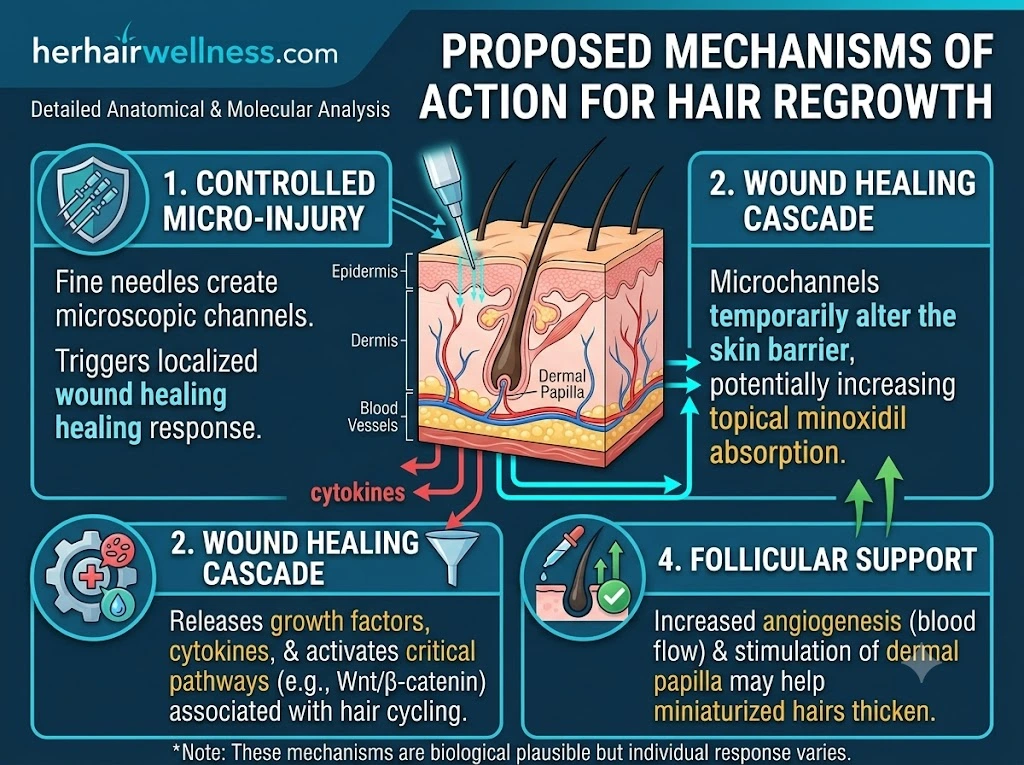
- Microneedling triggers a localized wound-healing response and temporarily alters the scalp barrier.
- The microchannels created during treatment may increase the penetration of a topical medication.
- Signals released during tissue repair may influence dermal papilla cells, blood-vessel formation and pathways involved in hair cycling.
These proposed mechanisms are biologically plausible, but they do not mean that every microneedling session will produce new hair. Hair growth still depends on the diagnosis, the condition of the follicles, treatment consistency and individual response.
The evidence discussed in this article mainly relates to androgenetic alopecia, also called male or female pattern hair loss. It should not automatically be applied to alopecia areata, telogen effluvium, traction alopecia, scarring alopecia or hair shedding caused by illness, nutritional deficiency or medication.
Does Microneedling Make Minoxidil Work Better?
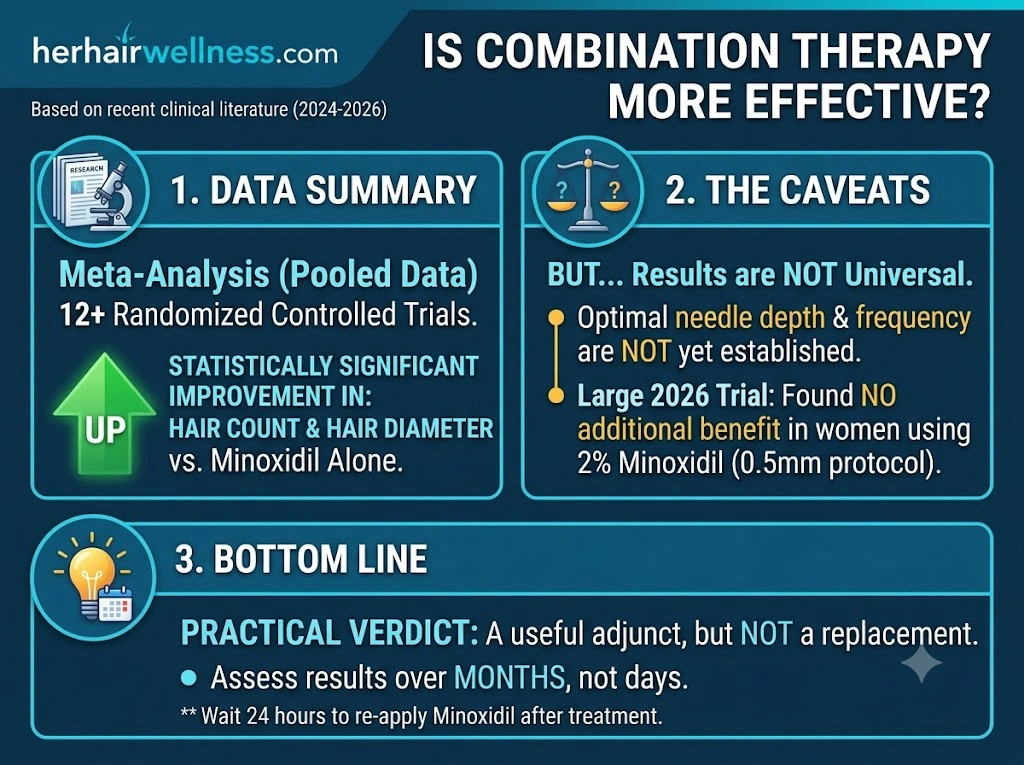
A 2025 systematic review and meta-analysis evaluated 12 randomized controlled trials involving 631 people with androgenetic alopecia. Eleven of the trials contributed data to the pooled analysis. Compared with minoxidil alone, microneedling plus minoxidil produced a statistically significant improvement in hair count. A smaller but significant improvement in hair diameter was also found. Investigator assessments and patient self-assessments generally favored combination treatment (2).
A separate 2024 meta-analysis included 13 randomized trials involving 696 participants. It also concluded that combined microneedling therapy improved hair density and hair diameter more than a single treatment, without showing a significant overall difference in adverse-reaction rates (3).
These findings are encouraging, but they need context. The studies used different:
- Needle depths
- Microneedling devices
- Treatment frequencies
- Treatment durations
- Minoxidil concentrations
- Outcome-measurement methods
- Participant populations
The 2025 analysis also reported substantial variation between the hair-count results. In other words, the studies did not all produce the same degree of improvement. The combination may work well under certain conditions without being universally superior.
Why Do Recent Studies Appear to Disagree?
The newest large randomized trial provides an important counterbalance to earlier positive findings.
Published online in May 2026, the trial enrolled 245 women with mild-to-moderate androgenetic alopecia. Participants were assigned to one of three groups:
- 2% topical minoxidil alone
- Minoxidil plus microneedling every four weeks
- Minoxidil plus microneedling every two weeks
The researchers used a 36-needle cartridge at a depth of 500–550 micrometres, equivalent to approximately 0.50–0.55 mm. After 24 weeks, all three groups showed significant increases in target-area non-vellus hair count. However, the microneedling groups did not achieve significantly better results than the minoxidil-only group. Hair density and hair-shaft measurements were also comparable (1).
This does not prove that microneedling never improves minoxidil results. It shows that this particular shallow-needling protocol, performed every two or four weeks, did not add a measurable clinical benefit in the women who participated.
The conflicting findings highlight an important point: microneedling is not one uniform treatment. A 0.5 mm procedure every four weeks cannot be assumed to produce the same biological effect as a deeper weekly procedure performed with another device.
How Could Scalp Microneedling Support Hair Regrowth?
Researchers have proposed several mechanisms.
Activation of a wound-healing response
Controlled micro-injury initiates a sequence of tissue-repair events. These may involve platelets, cytokines, growth factors and signalling pathways associated with follicular activity.
Pathways involving Wnt and β-catenin are often discussed because they participate in hair-follicle development and cycling. Microneedling may also influence vascular endothelial growth factor and local angiogenesis, potentially supporting blood supply around active follicles.
These mechanisms remain under investigation. It is more accurate to say that microneedling may create a biological environment that supports follicular activity than to claim that it “awakens dead follicles.”
Temporary alteration of the skin barrier
The microchannels produced by needling can temporarily increase transdermal drug delivery. This may help topical minoxidil reach the treated skin more readily.
Greater penetration is not always desirable, however. Applying an alcohol-based or propylene-glycol-containing minoxidil solution immediately after an invasive procedure may cause marked stinging, inflammation or unpredictable systemic absorption.
The therapeutic aim should be controlled treatment—not maximum possible penetration.
Possible effects on miniaturized follicles
Androgenetic alopecia gradually reduces the diameter and growth duration of susceptible follicles. Microneedling and minoxidil may help some miniaturized hairs become thicker and more visible.
Neither treatment creates entirely new follicles. Areas that have been smooth and bald for a long time are generally less likely to achieve cosmetically significant regrowth than areas where fine, miniaturized hairs remain.
How Long Does Microneedling With Minoxidil Take to Work?
Meaningful improvement usually takes several months.
Hair follicles cycle slowly, so a treatment cannot be judged accurately after one or two sessions. Most clinical studies assess results after approximately 12 to 24 weeks, while longer observation may be needed to determine the true cosmetic value.
A realistic timeline may look like this:
- First 4–8 weeks: There may be little visible change. Some people experience temporary shedding after beginning minoxidil.
- Around 12 weeks: Early changes in shedding, hair count or fine regrowth may become noticeable.
- Around 24 weeks: Hair density and scalp coverage can be assessed more reliably.
- Six to 12 months: The longer-term response becomes clearer, particularly when minoxidil has been used consistently.
Daily mirror checks are not a reliable way to measure progress. Lighting, styling and hair-washing patterns can dramatically change how the scalp looks.
For a more objective comparison:
- Take baseline photographs before treatment.
- Use the same room and lighting each time.
- Keep the camera angle and distance consistent.
- Part the hair in the same location.
- Compare photographs every four weeks rather than every day.
A dermatologist may also use standardized global photography, trichoscopy, target-area hair count or hair-shaft measurements.
What Needle Depth Is Best When Combining Microneedling and Minoxidil?
No single depth has been proven optimal.
Studies have evaluated depths ranging from approximately 0.5 mm to 1.5 mm, but they also differed in device type, frequency, treatment endpoint and operator technique. This makes direct comparison difficult.
The 2025 meta-analysis compared studies using depths of 1 mm or less with those using depths greater than 1 mm. Both subgroups generally favored combination treatment, but the analysis did not establish that one depth was superior (2).
The 2026 trial found no added benefit from 0.50–0.55 mm microneedling every two or four weeks. That result should not be interpreted as proof that 0.5 mm never works or that deeper needling must be better (1).
Increasing needle depth also increases tissue injury. Potential consequences include:
- More pain and tenderness
- Greater bleeding
- Longer recovery
- Increased inflammation
- Higher infection risk
- Post-inflammatory pigmentation
- Scarring after excessive or repeated trauma
The correct depth depends on the device, scalp area, skin thickness, intended clinical endpoint and practitioner’s experience. Copying a needle depth from an online video does not reproduce the conditions of a controlled clinical trial.
How Often Should the Scalp Be Microneedled?
There is no universally accepted schedule.
Published studies have used weekly, biweekly and monthly sessions. Some older trials reporting favorable results used weekly treatment, while the 2026 trial found that shallow microneedling every two or four weeks did not improve outcomes beyond minoxidil alone (1–3).
Frequency should not be considered separately from depth. A superficial procedure may have a different recovery period from a deeper treatment. The device, number of passes, applied pressure and degree of redness or bleeding also influence the amount of tissue injury.
Microneedling should not be repeated while the scalp remains:
- Painful or tender
- Swollen
- Intensely red
- Crusted
- Bleeding
- Irritated by minoxidil
- Affected by pustules or folliculitis
Performing additional sessions before the scalp has recovered may prolong inflammation rather than enhance growth.
How Long Should You Wait to Apply Minoxidil After Microneedling?
Applying topical minoxidil immediately after microneedling is generally not a cautious approach unless a treating clinician has specifically prescribed that protocol.
Freshly needled skin has a disrupted barrier. Minoxidil solutions often contain alcohol and may contain propylene glycol, which can cause intense burning when applied to injured skin. Immediate application may also increase drug absorption in a less predictable way.
Many clinical protocols have separated the microneedling session from the next minoxidil application, commonly by approximately 24 hours. However, strong head-to-head evidence comparing immediate, 12-hour and 24-hour application is limited.
A reasonable clinician-directed approach is to restart minoxidil only when:
- Pinpoint bleeding has completely stopped.
- The scalp is no longer markedly red or swollen.
- Applying a bland product does not cause significant burning.
- There are no open wounds, pustules or signs of infection.
- The recommended post-procedure interval has passed.
Waiting longer may be appropriate after a deeper procedure or when inflammation persists.
Should You Skip Minoxidil on Microneedling Day?
Many treatment protocols omit minoxidil on the day of the procedure.
Missing a single application is unlikely to reverse months of progress. Applying extra medication later to compensate for the missed dose is unnecessary and may increase irritation.
A typical medically supervised sequence may involve:
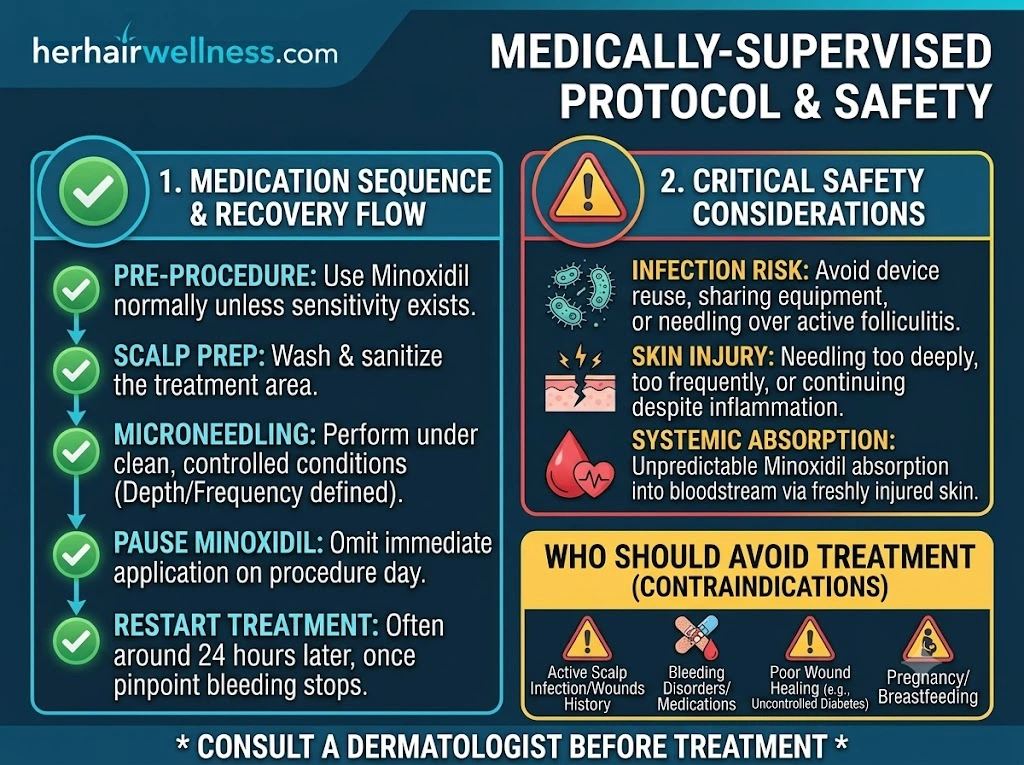
- Using minoxidil normally before the procedure date unless instructed otherwise.
- Washing and preparing the scalp as directed.
- Performing microneedling under clean, controlled conditions.
- Avoiding minoxidil immediately afterward.
- Restarting treatment after sufficient scalp recovery, often around 24 hours later.
The exact interval should be determined by the treating professional. Deeper needling, persistent redness or pre-existing scalp sensitivity may require a longer pause.
Does Microneedling With Minoxidil Work for Women?
Microneedling may help some women with female pattern hair loss, but the evidence is mixed.
Earlier small trials reported greater improvement when microneedling was added to topical minoxidil. The recent meta-analyses, which included studies of men and women, also favored combination treatment overall (2, 3).
However, the large 2026 trial specifically involving women found no additional benefit from shallow microneedling every two or four weeks with 2% minoxidil (1).
The most accurate conclusion is that results in women may depend on the protocol and the individual. It is not appropriate to promise that adding a dermaroller will automatically improve minoxidil results.
Women should also have diffuse or progressive hair loss properly evaluated. Female hair thinning may be influenced by several overlapping factors, and pattern hair loss can occur alongside:
- Iron deficiency
- Thyroid disease
- Recent illness
- Significant weight loss
- Postpartum shedding
- Menopause-related changes
- Medication-associated shedding
- Inflammatory scalp disease
Microneedling will not correct an untreated underlying cause.
People who are pregnant, planning pregnancy or breastfeeding should seek individualized medical advice before using minoxidil or undergoing elective scalp microneedling.
Can the Combination Regrow the Hairline, Temples or Crown?
Results depend largely on whether functioning miniaturized follicles remain in the area.
The crown or vertex may respond when thinning is relatively recent and numerous fine hairs are still present. The temples and frontal hairline can be more difficult to treat, particularly when recession is advanced or the skin has remained smooth for years.
Microneedling with minoxidil may:
- Reduce the visibility of the scalp
- Increase the diameter of miniaturized hairs
- Improve density in responsive areas
- Support maintenance of existing follicles
It cannot reliably rebuild a completely bald hairline or create new follicles where none remain.
Before-and-after photographs online should be interpreted cautiously. Differences in hair length, lighting, styling, wetness, camera angle and scalp pigmentation can make modest changes appear dramatic.
Can Microneedling Help a Minoxidil Nonresponder?
Possibly, but an apparent lack of response should first be investigated.
Before adding microneedling, consider whether:
- The diagnosis has been confirmed.
- Minoxidil has been used for long enough.
- Applications have been consistent.
- The correct amount reaches the scalp rather than coating the hair.
- Scalp irritation has reduced adherence.
- Treatment was stopped repeatedly because of early shedding.
- Another form of hair loss is present.
Microneedling may offer an additional stimulus for some people whose response has plateaued, but it cannot compensate for an incorrect diagnosis or inconsistent minoxidil use.
A dermatologist can also assess whether another evidence-based treatment is more appropriate than simply increasing the intensity of scalp needling.
What Side Effects Can Occur?
Microneedling studies generally describe adverse effects as mild and temporary, but complications can occur.
Expected short-term reactions may include:
- Redness
- Tenderness
- Mild swelling
- Pinpoint bleeding
- Tightness or dryness
- Temporary itching or flaking
More concerning complications include:
- Persistent or worsening pain
- Folliculitis
- Bacterial, viral or fungal infection
- Prolonged inflammation
- Post-inflammatory hyperpigmentation
- Scarring
- Worsening dermatitis
- Unwanted minoxidil exposure to the face
Minoxidil may also cause scalp irritation, itching or contact dermatitis. Symptoms such as dizziness, faintness, chest discomfort, rapid heartbeat, swelling or unexplained weight gain require prompt medical assessment.
In the 2025 meta-analysis, adverse events were reported somewhat more frequently with combined treatment than with minoxidil alone, although they were generally mild or self-limiting (2).
Who Should Avoid Scalp Microneedling?
Medical assessment is particularly important for anyone with:
- Active scalp folliculitis or infection
- Open wounds
- Significant eczema, psoriasis or dermatitis in the treatment area
- Unexplained patchy or rapidly progressive hair loss
- Suspected scarring alopecia
- A history of keloids or abnormal scarring
- A bleeding disorder
- Medication that significantly increases bleeding risk
- Reduced immunity
- Poor wound healing
- Poorly controlled diabetes
- A previous severe reaction to minoxidil
- Significant cardiovascular symptoms
- Pregnancy or breastfeeding
Microneedling should never be performed through an active infection or over intensely inflamed skin.
Is At-Home Microneedling Safe?
At-home treatment introduces uncertainty that is difficult to control.
A person using a dermaroller cannot easily confirm the true penetration depth, pressure or number of passes. Rolling devices may enter the skin at an angle, and hair can become caught around the barrel. Reusing a device also creates hygiene and needle-quality concerns.
Common mistakes include:
- Needling too deeply
- Treating too frequently
- Continuing until heavy bleeding occurs
- Using a device with bent or blunt needles
- Sharing equipment
- Needling over folliculitis or dermatitis
- Applying minoxidil immediately afterward
- Using harsh acids, fragrances or irritating scalp products
- Continuing despite persistent inflammation
“More aggressive” does not mean “more effective.” Repeated scalp injury may worsen discomfort, reduce treatment adherence and potentially cause lasting damage.
Professional treatment does not eliminate all risk, but it allows diagnosis, depth, sterility, treatment endpoint and follow-up to be managed more carefully.
Dermaroller, Dermastamp or Microneedling Pen: Which Is Better?
No device has been conclusively shown to produce the best hair-regrowth results.
Each has practical differences:
- Dermarollers can cover larger areas quickly, but needle entry may be angled and hair may tangle around the roller.
- Dermastamps allow localized treatment and may be easier to position over the temples or hairline.
- Motorized pens generally create more vertical punctures and allow adjustable depth, but they require sterile cartridges and appropriate technique.
The 2025 meta-analysis did not find a significant difference in hair-count outcomes between rolling and electrodynamic devices across the included studies. However, this indirect comparison does not prove that every device is equally precise or safe (2).
Device choice should follow a clinical plan. It should not determine the plan.
How Can Treatment Be Made Safer and Easier to Evaluate?
A structured approach is more useful than experimenting with multiple depths and schedules.
Before treatment
- Confirm that the diagnosis is androgenetic alopecia.
- Photograph the scalp under standardized conditions.
- Treat active dandruff, dermatitis or folliculitis.
- Review medications and medical conditions.
- Discuss whether minoxidil alone has been given an adequate trial.
During the treatment period
- Use minoxidil consistently as prescribed.
- Follow a defined microneedling depth and frequency.
- Allow complete recovery between sessions.
- Avoid applying irritating products to freshly treated skin.
- Do not increase depth because results are slow.
- Record side effects and missed treatments.
When assessing results
- Compare photographs every four weeks.
- Look for changes in density and shaft thickness, not just “new baby hairs.”
- Allow at least 12–24 weeks before judging early effectiveness.
- Consider whether improvement is cosmetically meaningful, not merely measurable.
- Reassess the diagnosis if shedding worsens or the scalp becomes inflamed.
The Evidence-Based Verdict
Microneedling with minoxidil is a promising combination treatment for androgenetic alopecia, but it is not a guaranteed upgrade over minoxidil alone.
Recent meta-analyses suggest that combination therapy can improve hair count, density and diameter on average. At the same time, the newest large randomized trial found that 0.50–0.55 mm microneedling every two or four weeks did not provide additional benefit in women using 2% topical minoxidil (1–3).
The evidence supports five practical conclusions:
- Some people may benefit, but not every protocol works.
- The optimal needle depth and frequency remain uncertain.
- Deeper or more frequent treatment is not automatically better.
- Minoxidil should not routinely be applied to freshly injured skin without medical guidance.
- Diagnosis and treatment consistency matter more than copying an online routine.
For a suitable person with confirmed pattern hair loss and an incomplete response to topical minoxidil, clinician-supervised microneedling may be reasonable. The potential improvement should be weighed against discomfort, cost, treatment burden, scalp irritation and the risk of improper technique.
Medical Disclaimer
This article is for educational purposes only and does not replace evaluation, diagnosis or treatment by a qualified healthcare professional. Consult a dermatologist before combining scalp microneedling with minoxidil, particularly if you are pregnant or breastfeeding or have cardiovascular disease, a bleeding disorder, active scalp disease, impaired wound healing or unexplained hair loss.
Frequently Asked Questions
Does the scalp need to bleed for microneedling to work?
No. Visible bleeding does not prove that treatment will be more effective. Aggressive needling may increase pain, inflammation, infection and scarring without improving hair regrowth.
Can minoxidil foam be used during a microneedling treatment plan?
Yes, when minoxidil foam is otherwise appropriate for the individual. It should not be applied to a scalp that is freshly bleeding, severely irritated, painful or infected.
Can I wash my hair after scalp microneedling?
Follow the aftercare instructions provided by your clinician. Avoid vigorous rubbing, harsh shampoos and potentially contaminated water or products while the scalp remains irritated.
Is temporary shedding normal after starting the combination?
Some people experience temporary shedding after beginning minoxidil. Severe, patchy, painful or persistent shedding should be medically assessed rather than automatically considered normal.
Will the results last if I stop microneedling?
The long-term contribution of microneedling after sessions are stopped is uncertain. Minoxidil-supported regrowth generally requires continued minoxidil treatment to be maintained.
References
- Liu Y, Luo H, Yang S, et al. Microneedle frequency adjunct to 2% minoxidil in female androgenetic alopecia: a randomized controlled trial. Journal of the American Academy of Dermatology. Published online May 25, 2026. doi:10.1016/j.jaad.2026.03.123.
- Ahmed KMA, Kozaa YA, Abuawwad MT, et al. Evaluating the efficacy and safety of combined microneedling therapy versus topical minoxidil in androgenetic alopecia: a systematic review and meta-analysis. Archives of Dermatological Research. 2025;317(1):528. doi:10.1007/s00403-025-04032-1.
- Pei D, Zeng L, Huang X, et al. Efficacy and safety of combined microneedling therapy for androgenic alopecia: a systematic review and meta-analysis of randomized clinical trials. Journal of Cosmetic Dermatology. 2024;23(5):1560–1572. doi:10.1111/jocd.16186.