

Hair Loss With Normal Blood Tests
Written by: Dr.Muhammad Ihsan Ullah, PhD
Medically reviewed by: Dr. Muhammad Mudassar Hassan Bhatti, MD (Dermatology)
Last updated on February 11,2026
You did everything you were supposed to do—you got your blood work done. Your CBC and thyroid (TSH) look normal, your iron seems “fine,” and maybe even your vitamin D is “in range’’ but your hair is still shedding anyway.
So the real question becomes:
- How can hair loss happen when blood tests are normal?
The medically honest answer is: yes, it can very often. Routine labs are helpful, but they cannot “see” many scalp and follicle-level hair disorders, and they don’t always capture timing (for example, hair shedding can start weeks after the trigger) (Natarelli, et al. 2023).
Can hair loss happen even when blood tests are normal?

Yes. In real clinics, it’s one of the most common scenarios:
“Blood tests normal but hair falling out.”
That happens because:
- Many hair loss types are not caused by a detectable blood abnormality.Genetic-pattern thinning can show normal labs (Natarelli, et al. 2023).
- “Normal range” isn’t “hair-optimal for everyone.”Especially for iron stores, interpretation depends on context (Zhang, et al. 2023).
- Hair shedding has a delay.The trigger may have passed, so labs can normalize while shedding continues (Natarelli, et al. 2023).
- Scalp inflammation or immune activity can exist with normal routine labs (Sibbald, et al. 2023).
If you’ve been searching:
- hair loss with normal blood tests
- hair shedding with normal blood work
- hair loss despite normal labs
- CBC normal but hair loss continues
- normal thyroid but hair loss
- normal ferritin but hair shedding
you are asking the right question. Now let’s answer it properly.
Why blood tests can be normal while hair keeps shedding
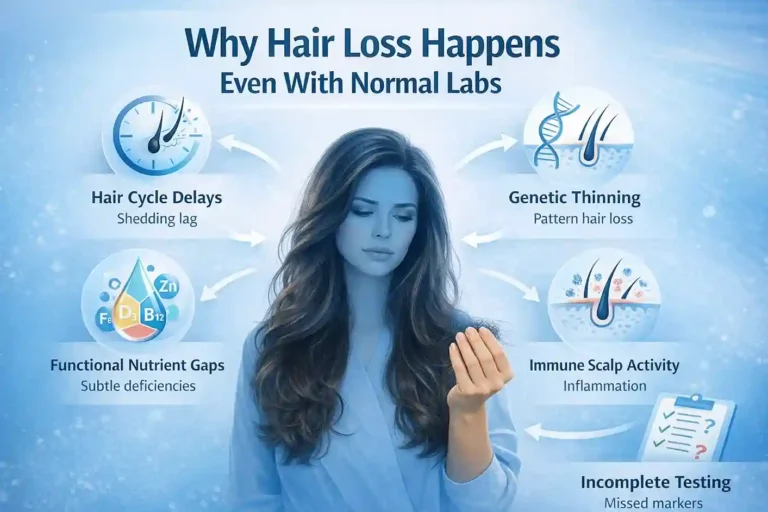
Think of routine blood work like a broad screening tool, not a hair-specific diagnostic camera. A CBC or TSH can confirm major systemic problems—but hair loss can be driven by follicle cycling, genetics, immune patterns, and scalp-level changes that don’t always show up on standard panels (Natarelli, et al. 2023).
The 5 most common “normal-lab” realities
- Hair cycle shift (telogen shedding pattern) without current lab abnormalities(Natarelli, et al. 2023)
- Pattern thinning (androgenetic / female pattern hair loss)where routine labs are often normal (Natarelli, et al. 2023)
- Immune-mediated hair loss patternsthat can occur with normal routine labs (Sibbald, et al. 2023)
- Borderline or “functional” nutrient status(especially ferritin interpretation) (Zhang, et al. 2023)
- “Everything tested was normal” is often untrue—sometimes only CBC/TSH were checked, not ferritin or other relevant markers (Zhang, et al. 2023)
The “must-check” labs people think are normal
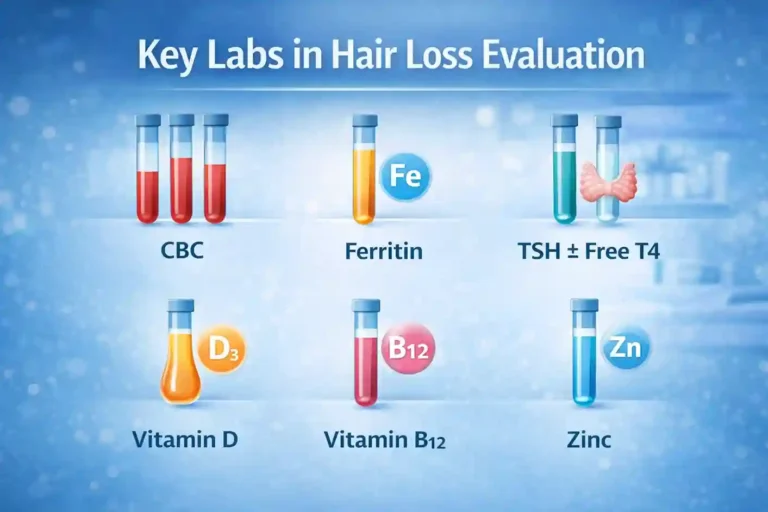
Key lab entities in hair-loss evaluation: CBC, ferritin/iron stores, TSH ± free T4, vitamin D (25 OH), vitamin B12, zinc (Durusu Turkoglu, et al. 2024).
1) CBC (Complete Blood Count)
What it screens for: anemia patterns, infection/inflammation hints.
Why hair loss can still happen with a normal CBC: CBC doesn’t measure iron stores directly and doesn’t diagnose most follicle-cycle problems.
2) Ferritin (iron stores) ± iron studies
Ferritin reflects body iron storage. Even “normal” ferritin may be low enough to contribute to shedding in certain individuals.
3) Thyroid tests (TSH ± free T4)
Normal TSH does not automatically explain hair loss—thyroid may not be the main driver.
4) Vitamin D (25 OH)
Vitamin D is often checked in diffuse or autoimmune hair loss cases, but normal levels don’t exclude shedding.
5) Vitamin B12
B12 is occasionally checked; normal B12 is common in most shedding patterns.
6) Zinc
Zinc deficiency can contribute in rare cases; many normal-range patients still shed due to other causes.
What normal labs do not rule out
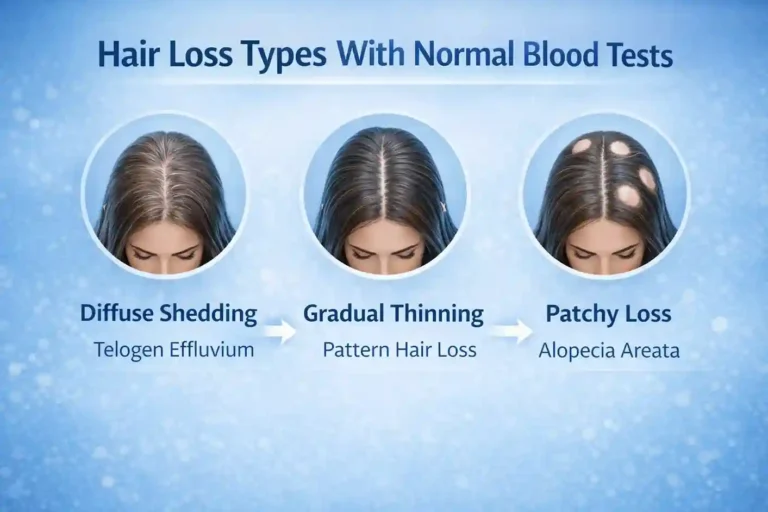
1) Telogen Effluvium (TE)
Diffuse shedding pattern, triggered by stressors, illness, or nutritional shifts. Labs may normalize by the time shedding starts.
2) Androgenetic / Female Pattern Hair Loss (AGA / FPHL)
Genetic pattern thinning; routine labs often normal.
3) Alopecia Areata (AA)
Autoimmune patchy hair loss; labs often normal.
4) Functional or borderline nutrient differences
Even normal-range labs may hide subtle deficiencies relevant to hair shedding.
What to do next when blood tests are normal
Step 1: Verify what was tested
Ensure ferritin, CBC, TSH, vitamin D, B12, and zinc were actually measured and interpreted in context.
Step 2: Identify your hair loss pattern
- Diffuse shedding → TE
- Gradual thinning → AGA/FPHL
- Patchy loss → AA
- Scarring or crusting → consider scarring alopecia
Step 3: Prioritize scalp-focused assessment
Dermatologist evaluation with dermoscopy/trichoscopy and pull test is critical.
Step 4: Targeted lab add-ons (only if clinically indicated)
Hormone panel or autoimmune labs based on pattern and symptoms.
The “normal-lab trap”
Common pitfalls:
- Only CBC/TSH were checked.
- Expecting labs to identify pattern thinning.
- Not accounting for hair-cycle timing lag.
- Guessing supplements instead of targeting confirmed deficiencies.
Red flags even when labs are normal
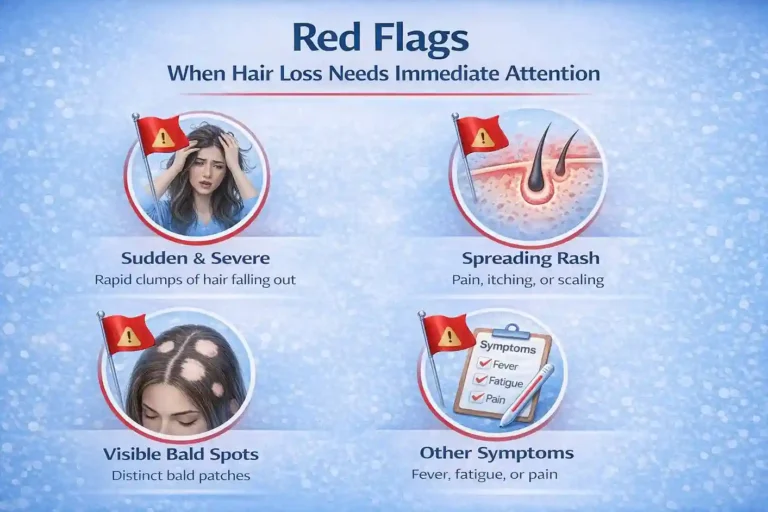
Seek urgent evaluation if you notice:
- Sudden patchy hair loss
- Eyebrow/eyelash loss
- Scalp pain, crusting, pustules
- Rapid progression
These may indicate conditions needing early intervention.
Medical Disclaimer
This article is for educational purposes only and does not replace professional medical advice. Hair loss can have multiple causes, and proper diagnosis usually requires a scalp exam and individualized evaluation. If your hair loss is sudden, patchy, or associated with pain or scalp changes, seek prompt medical care.
Frequently Asked Questions(FAQs)
1. Can I lose hair even if all my blood tests are normal?
Yes. Hair loss can occur due to scalp-level issues, genetic pattern thinning, or delayed shedding—even when routine labs show normal results.
2. Which types of hair loss can happen with normal labs?
Common types include telogen effluvium (diffuse shedding), androgenetic/female pattern hair loss, alopecia areata (patchy loss), and scarring alopecia.
3. What labs should I check if my blood tests are normal but I’m losing hair?
Key labs include ferritin/iron, TSH, vitamin D, vitamin B12, and sometimes zinc. Even normal values may need contextual interpretation.
4. What should I do next if my labs are normal but hair keeps falling out?
A scalp-focused evaluation with a dermatologist, dermoscopy, or pull test is recommended. Targeted lab testing may follow based on pattern and history.
5. Are there warning signs that need urgent attention despite normal blood tests?
Yes. Patchy bald spots, rapid shedding, scalp pain, crusting, or shiny scar-like areas should prompt immediate medical evaluation.
References
- Zhang, D., LaSenna, C., & Shields, B. E. (2023). Serum ferritin levels: A clinical guide in patients with hair loss. Cutis, 112(2), 62–67.
- Natarelli, N., Gahoonia, N., & Sivamani, R. K. (2023). Integrative and mechanistic approach to the hair growth cycle and hair loss. Journal of Clinical Medicine, 12(3), 893.
- Sibbald, C., Sinclair, R., Zheng, R., & Tosti, A. (2023). Alopecia areata: An updated review for 2023. Journal of Cutaneous Medicine and Surgery.
- Durusu Turkoglu, I. N., et al. (2024). A comprehensive investigation of biochemical status in patients with telogen effluvium: Analysis of Hb, ferritin, vitamin B12, vitamin D, thyroid function tests, zinc, copper, biotin, and selenium levels. Journal of Cosmetic Dermatology.
- Liran, O., Vered, S., Cohen, B., Shapiro Ben David, S., Nakhleh, A., Rahamim Cohen, D., Azuri, J., & Adler, L. (2025). Hair loss and zinc deficiency: A cross-sectional study. Healthcare, 13(22), 2965.