

Does Minoxidil Foam Cause Facial Hair Growth in Women?
Written by: Dr.Muhammad Ihsan Ullah, PhD
Medically reviewed by: Dr. Muhammad Mudassar Hassan Bhatti, MD (Dermatology)
Last updated on October 10, 2026

Minoxidil foam is widely used by women to support hair regrowth in conditions such as female pattern hair loss. However, one concern often makes women hesitant to begin treatment: can applying minoxidil foam to the scalp cause unwanted facial hair growth?
The answer is yes, minoxidil foam can cause facial hair growth in some women, but this effect is considered uncommon. When it occurs, it is usually related to accidental exposure of facial skin, excessive application, or individual sensitivity to the medication. This unwanted hair growth is medically described as hypertrichosis, meaning excessive hair growth in areas where increased hair is not desired (1).
Understanding the likelihood of this side effect and how to minimize the risk can help women use minoxidil foam more confidently.
Can women’s minoxidil foam cause unwanted facial hair?
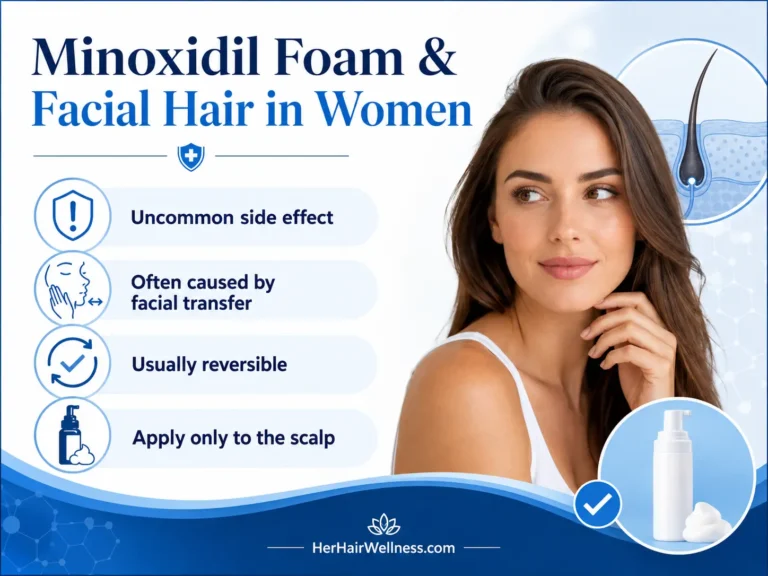
Women’s minoxidil foam is designed to stimulate scalp hair follicles, but the active ingredient can also influence other hair follicles if it reaches unintended areas.
Some women may notice increased fine hair growth on areas such as:
- Upper lip
- Chin
- Forehead
- Sideburn region
This does not mean every woman using minoxidil foam will develop facial hair. Many women use topical minoxidil regularly without experiencing this effect.
The likelihood depends on several factors, including how carefully the product is applied, how much medication reaches facial skin, and individual follicle sensitivity.
Does 5% minoxidil foam cause facial hair growth in females?
5% minoxidil foam may cause facial hair growth in females, but the occurrence is relatively uncommon when the product is used correctly.
Clinical studies evaluating 5% minoxidil foam in women with female pattern hair loss have shown that it can improve scalp hair growth with an acceptable safety profile (2).
The risk of unwanted facial hair is more likely when minoxidil comes into direct contact with facial skin. For example, applying foam too close to the forehead, allowing it to spread during sleep, or touching the face after application may increase exposure.
Using a higher amount than recommended does not improve results faster and may increase unnecessary exposure to the medication.
Why am I growing facial hair after using minoxidil foam?
Facial hair growth after starting minoxidil foam can happen because minoxidil promotes activity in hair follicles. Although the treatment is applied to the scalp, accidental transfer can allow small amounts of the medication to reach nearby facial areas.
Common situations that may contribute include:
- Foam spreading beyond the scalp application area
- Not washing hands after applying the medication
- Applying excessive amounts
- Contact between treated hair/scalp and facial skin
Some women may also naturally have facial hair follicles that are more responsive to minoxidil. This individual variation explains why one person may notice facial hair changes while another does not.
Can minoxidil foam cause chin hair or upper lip hair in women?
Yes, some women may notice increased chin hair or upper lip hair after using minoxidil foam.
These changes are usually related to stimulation of previously fine, barely visible facial hairs. The hair may become darker, thicker, or more noticeable after exposure to minoxidil.
However, new facial hair growth should not automatically be assumed to be caused by minoxidil. Hormonal changes, polycystic ovary syndrome (PCOS), thyroid disorders, and other medical conditions can also influence facial hair growth.
Women experiencing sudden or significant facial hair changes should consider medical evaluation.
Is facial hair from minoxidil permanent in women?
Facial hair caused by minoxidil is generally considered reversible.
When the medication is discontinued, affected hair follicles usually gradually return toward their previous growth pattern. However, the timeframe can vary depending on how long minoxidil was used and how strongly the individual responded.
Women should not stop treatment without discussing it with a healthcare professional, especially if minoxidil is being used to manage ongoing female pattern hair loss.
Minoxidil foam vs. liquid: is one more likely to cause facial hair growth?
There is currently no strong evidence showing that minoxidil foam causes more facial hair growth than liquid minoxidil.
Both products contain the same active ingredient, and unwanted facial hair is mainly related to medication exposure outside the intended scalp area rather than the formulation itself.
Feature | Minoxidil Foam | Minoxidil Liquid |
Active ingredient | Minoxidil | Minoxidil |
Can cause facial hair growth? | Possible in some women | Possible in some women |
Main risk factor | Transfer to facial skin | Dripping or spreading beyond scalp |
Application | Usually easier to control | May spread more easily |
Proven higher risk of facial hair | No evidence | No evidence |
Foam formulations may be preferred by some women because they dry faster and are often easier to apply precisely.
How can women reduce the risk of facial hair from minoxidil foam?
Women using minoxidil foam can reduce unwanted facial exposure by following proper application habits:
- Apply only the recommended amount
- Keep application limited to thinning scalp areas
- Wash hands immediately after use
- Avoid touching the face after application
- Allow the product to dry before sleeping
- Avoid applying the foam near areas where it can easily spread
Correct application technique plays an important role in reducing unwanted side effects.
Can women use minoxidil foam without getting facial hair?
Yes. Many women use minoxidil foam successfully without developing unwanted facial hair.
The potential benefit of improved scalp hair density often outweighs the risk of uncommon side effects for suitable candidates. The decision to use minoxidil should consider the type of hair loss, medical history, treatment goals, and personal tolerance.
A dermatologist or qualified healthcare professional can help determine whether topical minoxidil is appropriate.
Medical Disclaimer
This article is intended for educational purposes only and does not replace personalized medical advice, diagnosis, or treatment. Consult a qualified healthcare professional or dermatologist for guidance based on your individual health needs.
Frequently Asked Questions(FAQs)
1. Does minoxidil foam cause facial hair growth in women?
Yes, minoxidil foam can cause unwanted facial hair growth in some women, although it is not a common reaction.
2. Is facial hair from minoxidil foam permanent?
In most cases, unwanted facial hair related to minoxidil improves after stopping exposure to the medication.
3. Can minoxidil foam cause chin hair in women?
Yes, some women may notice increased chin hair if facial skin is exposed to minoxidil.
4. Does 5% minoxidil foam increase facial hair risk?
5% minoxidil foam may cause facial hair growth in sensitive individuals, but many women use it without this side effect.
5. Should women stop minoxidil if facial hair appears?
Women who develop noticeable facial hair changes should discuss their options with a healthcare professional before stopping treatment.
References
- Dawber RPR, Rundegren J. Hypertrichosis in females applying minoxidil topical solution and in normal controls. Journal of the American Academy of Dermatology. 2003;49(2):354-356. doi:10.1067/mjd.2003.583
- Blume-Peytavi U, Hillmann K, Dietz E, Canfield D, Bartels NG. A randomized, single-blind trial of 5% minoxidil foam once daily versus 2% minoxidil solution twice daily in women with androgenetic alopecia. Journal of the American Academy of Dermatology. 2011;65(6):1126-1134. doi:10.1016/j.jaad.2010.09.724
- Desai DD, et al. Minoxidil-induced hypertrichosis: Pathophysiology, clinical implications, and management. JAAD Reviews. 2024. doi:10.1016/j.jadr.2024.01.020