

Can You Use Minoxidil While Pregnant or Breastfeeding?
Written by: Dr.Muhammad Ihsan Ullah, PhD
Medically reviewed by: Dr. Muhammad Mudassar Hassan Bhatti, MD (Dermatology)
Last updated on September 13, 2026

Minoxidil is generally avoided for hair-loss treatment during pregnancy because fetal safety has not been adequately established. Breastfeeding is more nuanced: recent guidance distinguishes topical minoxidil from oral minoxidil and considers factors such as whether lactation is established, the infant’s age and maturity, and the possibility of direct skin exposure. Oral minoxidil requires greater caution because maternal systemic exposure is substantially higher (1, 2).
Can You Use Minoxidil While Pregnant?
For elective hair-loss treatment, both topical and oral minoxidil are generally avoided during pregnancy.
Human pregnancy data remain limited. Published case reports have raised concerns about fetal or neonatal effects, while available observational evidence is too small and inconsistent to establish a reliable level of safety. A recent review of alopecia therapies during pregnancy therefore continues to recommend against topical and oral minoxidil during pregnancy (1).
This does not mean that fetal harm is inevitable after exposure. It means that there is not enough high-quality evidence to justify routine use of minoxidil for hair loss when a person is pregnant.
The distinction between topical and oral treatment is still relevant. Topical minoxidil produces considerably less systemic exposure than oral minoxidil, but topical absorption is not zero. Therefore, “applied only to the scalp” should not be interpreted as “no potential fetal exposure.”
What If I Used Minoxidil Before Knowing I Was Pregnant?
Accidentally using minoxidil before realizing you were pregnant does not mean that your baby has been harmed.
If this happens:
- stop further use unless your healthcare professional specifically recommends otherwise;
- tell your obstetric clinician whether you used topical or oral minoxidil;
- provide the concentration or dose, frequency, and approximate dates of exposure; and
- avoid drawing conclusions from isolated case reports found online.
The available evidence cannot provide a precise individual risk estimate after accidental early-pregnancy exposure. Your clinician can interpret the exposure according to gestational timing and your medical history.
When Should I Stop Minoxidil Before Trying to Conceive?
If you are planning pregnancy, discuss stopping minoxidil before conception.
There is no well-established evidence-based washout period showing that every woman needs to stop topical minoxidil exactly a particular number of weeks or months before trying to conceive. Claims of a universal fixed washout interval therefore go beyond the available evidence.
A practical approach is to discuss pregnancy plans with the clinician supervising your hair-loss treatment and agree on when to discontinue treatment before conception.
This is especially important if you take oral minoxidil, which creates substantially greater systemic drug exposure than correctly applied topical therapy.
Can Minoxidil Cause Birth Defects or Harm the Fetus?
Minoxidil cannot currently be considered proven safe for fetal exposure.
Case reports have described congenital abnormalities or neonatal hypertrichosis following maternal minoxidil exposure, but case reports cannot establish how frequently these outcomes occur or prove causation in every case. Controlled human pregnancy data remain inadequate (1).
The appropriate conclusion is therefore not that minoxidil definitely causes birth defects. It is that the available evidence is insufficient to establish fetal safety, making avoidance appropriate for elective hair-loss treatment during pregnancy.
Can You Use Topical Minoxidil While Breastfeeding?
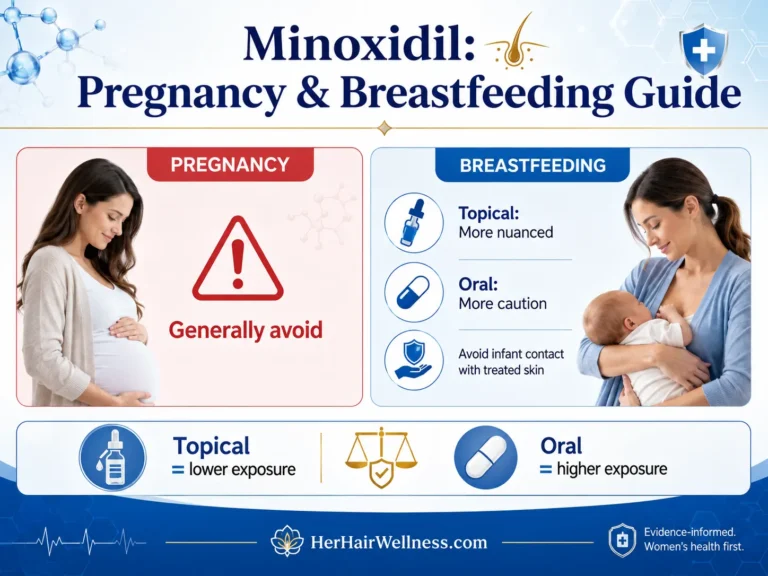
Breastfeeding guidance is less straightforward than pregnancy guidance.
Recent lactation-focused literature and the current LactMed position are more permissive about topical minoxidil once breastfeeding is established than many older product labels and dermatology resources. Current guidance considers maternal topical minoxidil potentially acceptable in established lactation when infant exposure is minimized, while systemic oral treatment requires more caution (2, 3).
That does not make topical minoxidil automatically appropriate for every breastfeeding mother. The decision should consider:
- whether the infant was born full-term or prematurely;
- whether the baby is a newborn or an older infant;
- whether breastfeeding is fully established;
- the minoxidil formulation and treated scalp area; and
- whether direct infant contact with treated skin can reliably be prevented.
For elective hair-loss treatment, discussing these factors with a dermatologist, obstetric clinician, or pediatric healthcare professional is preferable to applying a blanket rule.
Minoxidil during Pregnancy vs. Breastfeeding
Situation | Topical Minoxidil | Oral Minoxidil |
Pregnancy | Generally avoided because fetal safety is not established | Avoided for hair-loss treatment; systemic exposure is considerably higher |
Trying to conceive | Discuss discontinuation before conception; no universal washout interval is established | Discuss stopping before conception with the prescribing clinician |
Breastfeeding a newborn or premature infant | Greater caution and individualized assessment are appropriate | Greater caution is required, particularly with newborns |
Established breastfeeding with an older, full-term infant | Recent guidance is more permissive when direct infant exposure is prevented | Requires individualized risk-benefit assessment |
Direct infant contact | Infant contact with treated scalp or wet medication should be prevented | Scalp transfer is not relevant, but breast-milk exposure remains a consideration |
Maternal systemic exposure | Relatively low when appropriately applied topically | Substantially greater than topical exposure |
Does Minoxidil Pass Into Breast Milk?
Minoxidil has been detected in human milk after oral administration.
Published milk-level data are extremely limited, so they cannot define a universally safe oral dose during breastfeeding. This limited evidence is one reason oral minoxidil is treated more cautiously during lactation (3).
Topical minoxidil generally produces much lower maternal systemic exposure than oral dosing. However, low exposure is not the same as zero exposure, and breastfeeding safety also involves another pathway: direct transfer of topical medication to the infant.
Is Minoxidil Safe While Breastfeeding a Newborn or Premature Baby?
Greater caution is appropriate with newborns and premature infants.
Very young and preterm infants differ from older children in body size, skin-barrier function, drug metabolism, and renal elimination. These differences can make small exposures more clinically important.
A reported preterm breastfed infant developed facial hypertrichosis while the mother was using 5% topical minoxidil. Causality could not be confirmed, but the case contributes to the recommendation for additional caution with premature infants and direct topical exposure (3).
This is one reason advice suitable for a healthy older infant should not automatically be applied to a premature newborn.
Can My Baby Touch My Hair or Scalp After I Apply Minoxidil?
Direct contact between an infant and minoxidil-treated skin should be avoided.
Topical minoxidil can be transferred from the treated area and absorbed through another person’s skin. Reports of excessive hair growth in infants after secondary topical exposure reinforce the importance of preventing accidental transfer (2, 3).
If topical minoxidil is continued during breastfeeding after medical discussion:
- wash your hands thoroughly after application;
- let the treated scalp dry completely;
- prevent the baby’s face, hands, or skin from touching the treated area;
- avoid transferring wet medication to pillows, towels, bedding, or clothing; and
- never apply minoxidil to the breast or nipple.
These precautions matter independently of how much minoxidil may enter breast milk.
Is Topical Minoxidil Safer Than Oral Minoxidil While Breastfeeding?
From an exposure perspective, topical minoxidil is generally preferable to oral minoxidil because appropriately applied topical therapy produces much lower systemic exposure.
Recent breastfeeding guidance therefore treats the two formulations differently. Oral minoxidil requires a more careful maternal-infant risk-benefit assessment, particularly when breastfeeding a newborn or premature infant (2, 3).
Oral minoxidil used for hair loss is also an off-label systemic treatment, making casual self-treatment during lactation inappropriate.
Should I Pump and Dump After Using Minoxidil?
There is no established evidence-based pump-and-dump schedule for minoxidil used for hair loss.
With topical minoxidil, breast milk is only one possible exposure route. Direct contact with wet medication or a treated scalp may also expose the infant, and pumping would not prevent that.
Rather than relying on an arbitrary interval, breastfeeding decisions should be based on the formulation, dose, infant age and maturity, and advice from an appropriate healthcare professional.
When Can I Restart Minoxidil after Pregnancy?
If you are no longer pregnant and are not breastfeeding, minoxidil may generally be reconsidered postpartum once your clinician confirms there is no other reason to avoid it.
If you are breastfeeding, the decision is more individualized. Recent evidence is more permissive about topical minoxidil once lactation is established, particularly when nursing an older full-term infant and when direct contact with treated skin can be prevented (2, 3).
Oral minoxidil deserves greater caution because maternal systemic and breast-milk exposure are higher.
There is therefore no single postpartum date that is appropriate for every woman.
Bottom Line
Pregnancy and breastfeeding require different minoxidil safety decisions.
During pregnancy, minoxidil is generally avoided for hair-loss treatment because fetal safety has not been established. Accidental exposure before recognizing pregnancy does not mean fetal harm has occurred, but it should be discussed with an obstetric clinician.
During breastfeeding, current evidence is more nuanced. Topical minoxidil may be considered once breastfeeding is established in selected circumstances, whereas oral minoxidil requires greater caution. Infant age, prematurity, maternal dose, and prevention of direct contact with treated skin all matter (2, 3).
Medical Disclaimer
This article is for educational purposes only and does not replace individualized medical advice. If you are pregnant, trying to conceive, or breastfeeding, discuss minoxidil use with your obstetric clinician, dermatologist, or pediatric healthcare professional before starting, stopping, or restarting treatment.
Frequently Asked Questions(FAQs)
1. Can I use minoxidil while pregnant?
Minoxidil is generally avoided during pregnancy because adequate fetal safety has not been established.
2. Can I use topical minoxidil while breastfeeding?
Recent guidance is more permissive once breastfeeding is established, but the decision should consider the infant’s age, prematurity, and risk of direct contact with treated skin.
3. What if I used minoxidil before knowing I was pregnant?
Accidental early exposure does not mean fetal harm has occurred. Stop further use and discuss the formulation, dose, and timing with your obstetric clinician.
4. Does minoxidil pass into breast milk?
Minoxidil has been measured in breast milk after oral use. Exposure from appropriate topical use is expected to be considerably lower.
5. Is topical minoxidil safer than oral minoxidil while breastfeeding?
Topical treatment generally produces much lower maternal systemic exposure than oral minoxidil, so oral therapy requires greater caution during lactation.
References
- Brinks AL, Needle Lawrence C, Kearney CA, et al. Safety and clinical considerations of alopecia therapies during pregnancy, fertility treatment, and polycystic ovary syndrome workup. International Journal of Women’s Dermatology. 2026;12(2):e275. doi:10.1097/JW9.0000000000000275
- Lyons CE, Smith AD, Schwartzman G, et al. Managing skin diseases that flare during pregnancy and in the postpartum period: Part 2—Management & safety considerations. Journal of the American Academy of Dermatology. 2026. doi:10.1016/j.jaad.2026.01.090
- Needle CD, Brinks AL, Kearney CA, et al. Alopecia treatments in breastfeeding: Safety and clinical considerations. International Journal of Dermatology. 2025;64(12):2215–2234. doi:10.1111/ijd.17940