

Can You Take Biotin and Spironolactone Together?
Written by: Dr.Muhammad Ihsan Ullah, PhD
Medically reviewed by: Dr. Muhammad Mudassar Hassan Bhatti, MD (Dermatology)
Last updated on September 21, 2026

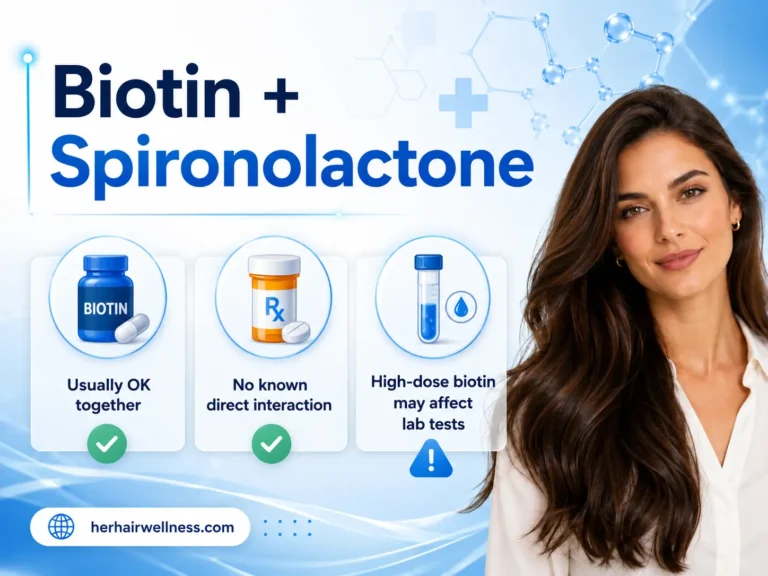
Yes, biotin and spironolactone can generally be taken together because no clinically established direct interaction between pure biotin and spironolactone is known.
However, that does not mean everyone taking spironolactone for hair loss needs a biotin supplement. The two work very differently, and adding biotin does not necessarily make spironolactone more effective for hair growth.
There are also two practical issues worth knowing: high-dose biotin can interfere with certain blood tests, and some multi-ingredient hair supplements contain ingredients that may be unsuitable with spironolactone.
Does Biotin Interact With Spironolactone?
Biotin, also known as vitamin B7, is a water-soluble vitamin involved in normal metabolism. Spironolactone is a prescription potassium-sparing diuretic with antiandrogen activity. It is also used off-label in appropriately selected women with female-pattern hair loss.
The two substances act through different biological pathways, and there is no established evidence that biotin:
- blocks the absorption of spironolactone;
- reduces its antiandrogen activity;
- significantly changes spironolactone concentrations; or
- directly increases potassium levels when taken with spironolactone.
For this reason, pure biotin does not normally need to be avoided simply because someone has been prescribed spironolactone.
The situation can be different with a multi-ingredient hair supplement. A product labeled for “hair, skin and nails” may contain much more than biotin, so its full ingredient list should be reviewed rather than treating it as pure vitamin B7.
Can I Take Biotin While on Spironolactone for Hair Loss?
In most cases, the combination itself is not the main concern. A more useful question is whether biotin is likely to add meaningful benefit.
Spironolactone has a pharmacologic role in androgen-related female-pattern hair loss. A 2025 randomized, double-blind, placebo-controlled pilot study in premenopausal women found that spironolactone 100 mg daily added to topical minoxidil produced greater improvement on global photographic assessment than placebo plus minoxidil, although the study was small and some objective differences did not reach statistical significance (1).
Biotin has a very different evidence base.
A 2026 systematic review found that biotin supplementation did not consistently improve objective hair-growth outcomes and concluded that routine supplementation for alopecia is not supported in the absence of documented deficiency or a relevant risk of deficiency (2).
Therefore, taking biotin with spironolactone may be reasonable when biotin supplementation is clinically appropriate, but adding biotin should not be assumed to enhance spironolactone’s effect.
Biotin vs. Spironolactone for Hair Loss
Feature | Biotin | Spironolactone |
What it is | Vitamin B7 | Prescription potassium-sparing diuretic with antiandrogen activity |
Role in hair health | Most relevant when deficiency or increased risk of deficiency is present | Used off-label for androgen-related female-pattern hair loss |
Evidence for hair growth | Limited without biotin deficiency | Clinical evidence supports benefit in appropriately selected women |
Antiandrogen effect | No | Yes |
Direct interaction with the other | No clinically established interaction | No clinically established interaction with pure biotin |
Key consideration | High doses can interfere with some laboratory tests | Can increase serum potassium and affect kidney function |
The important point is that these are not interchangeable hair-loss treatments. Spironolactone targets androgen-related pathways, whereas biotin primarily serves a nutritional role.
Can Biotin and Spironolactone Be Taken at the Same Time?
There is no evidence-based requirement to separate biotin and spironolactone by several hours.
If both have been approved as part of your regimen, they can generally be taken within the same daily schedule. Taking biotin in the morning and spironolactone later in the day is also acceptable if that routine is more convenient, but spacing the doses has not been shown to prevent a specific interaction.
Your prescribed spironolactone schedule should take priority over the timing of a dietary supplement.
Can I Take 5,000 or 10,000 mcg of Biotin With Spironolactone?
High-dose biotin deserves more consideration than ordinary dietary intake.
Hair supplements commonly provide biotin doses far beyond normal nutritional requirements. Although these doses are not known to create a specific spironolactone interaction, taking more biotin has not been shown to produce greater hair growth in people without deficiency (2).
Therefore, a 5,000- or 10,000-mcg supplement should not be considered automatically beneficial simply because you are being treated for hair loss.
Before using high-dose biotin, consider whether there is a clear reason for supplementation and tell your healthcare professional about the dose you are taking.
Does Biotin Affect Blood Tests While Taking Spironolactone?
Yes. This is one of the most clinically important issues associated with high-dose biotin.
Biotin can interfere with laboratory tests that rely on biotin-streptavidin immunoassay technology. Depending on the test design and laboratory platform, interference may produce falsely high or falsely low results.
A 2025 study confirmed clinically relevant biotin interference across susceptible immunoassays and also showed that vulnerability varies between laboratory systems and individual assays (3).
This may affect tests involving thyroid hormones and other biomarkers. Therefore:
- tell your clinician that you take biotin;
- tell laboratory staff before blood is collected;
- provide the dose if you know it;
- ask whether your supplement should be temporarily withheld before a specific test.
Avoid applying a universal rule about how many hours or days biotin should be stopped. The appropriate approach depends on the biotin dose, assay being performed, laboratory method, and clinical circumstances.
Can I Take Biotin Gummies or Hair, Skin and Nails Vitamins With Spironolactone?
A pure biotin gummy and a multi-ingredient hair supplement are not necessarily equivalent.
Spironolactone can increase serum potassium because it is a potassium-sparing medication. For that reason, check the entire supplement label, particularly if a hair, skin and nails formula contains potassium or additional minerals, botanicals, or active ingredients.
Before adding a combination hair supplement:
- review all ingredients and serving sizes;
- avoid potassium supplements unless specifically recommended;
- tell your pharmacist or prescriber about other medicines and supplements you use;
- do not assume a product is interaction-free simply because it is marketed as natural.
This is especially important for people with kidney problems, abnormal potassium levels, or medications that can also increase potassium.
When Should You Check With a Healthcare Professional?
Although biotin and spironolactone can often be used together, individualized advice is particularly important if you:
- have kidney disease or reduced kidney function;
- have previously had high potassium levels;
- use other medicines or supplements that can increase potassium;
- take very high doses of biotin;
- are scheduled for laboratory testing;
- experience new symptoms after starting a supplement; or
- are pregnant, planning pregnancy, or could become pregnant while taking spironolactone.
For hair loss, treatment should ideally be based on the underlying diagnosis rather than adding supplements without evidence of need.
The Bottom Line
Biotin and spironolactone can generally be taken together, and there is no clinically established direct interaction between pure biotin and spironolactone. They also do not need to be separated by a specific number of hours.
However, compatibility does not mean that biotin is necessary.
Spironolactone has evidence supporting its use in selected women with female-pattern hair loss, whereas current research does not support routine high-dose biotin for improving hair growth in people without biotin deficiency (1,2).
If you choose a biotin-containing hair supplement, check its complete ingredient list and remember that high-dose biotin can interfere with certain laboratory tests (3). A treatment plan based on diagnosis, evidence, and individual medical factors is more useful than simply combining multiple products marketed for hair growth.
Medical Disclaimer
This article is for educational purposes only and does not replace professional medical advice, diagnosis, or treatment. Consult a qualified healthcare professional before starting, stopping, or combining spironolactone with biotin or other supplements.
Frequently Asked Questions(FAQs)
1. Can you take biotin and spironolactone together?
Yes. No clinically established direct interaction between pure biotin and spironolactone is known. Your healthcare professional should still know about all supplements you use.
2. Does biotin make spironolactone work better for hair loss?
Not necessarily. There is no good evidence that adding biotin improves spironolactone’s hair-growth effect in people without biotin deficiency.
3. How far apart should I take biotin and spironolactone?
There is no established minimum interval between them. They can generally be included in the same daily schedule unless your healthcare professional advises otherwise.
4. Can I take biotin gummies with spironolactone?
Usually, but check the entire ingredient list. Multi-ingredient hair supplements may contain potassium or other substances that require additional consideration with spironolactone.
5. Does biotin affect blood tests while taking spironolactone?
High-dose biotin can interfere with some laboratory tests and produce misleading results. Tell your clinician and laboratory staff that you take biotin before blood testing.
6. Is high-dose biotin necessary while taking spironolactone for hair loss?
Usually not. Routine high-dose biotin has not been shown to improve hair growth in people who have adequate biotin status.
References
- Werachattawatchai P, Khunkhet S, Harnchoowong S, Lertphanichkul C. Efficacy and safety of oral spironolactone for female pattern hair loss in premenopausal women: a randomized, double-blind, placebo-controlled, parallel-group pilot study. International Journal of Women’s Dermatology. 2025;11(3):e227. doi:10.1097/JW9.0000000000000227.
- Moltó-Balado P, Simeó-Monzo A, del Barrio-Gonzalez A. Effectiveness of biotin supplementation for hair growth in patients with alopecia: a systematic review. Dermato. 2026;6(2):17. doi:10.3390/dermato6020017.
- Chiu KC, Jhan JR, Yan HN, et al. Biotin interference in routine clinical immunoassays. Practical Laboratory Medicine. 2025;45:e00472. doi:10.1016/j.plabm.2025.e00472.